Andrew Carnie - Syntax
Здесь есть возможность читать онлайн «Andrew Carnie - Syntax» — ознакомительный отрывок электронной книги совершенно бесплатно, а после прочтения отрывка купить полную версию. В некоторых случаях можно слушать аудио, скачать через торрент в формате fb2 и присутствует краткое содержание. Жанр: unrecognised, на английском языке. Описание произведения, (предисловие) а так же отзывы посетителей доступны на портале библиотеки ЛибКат.
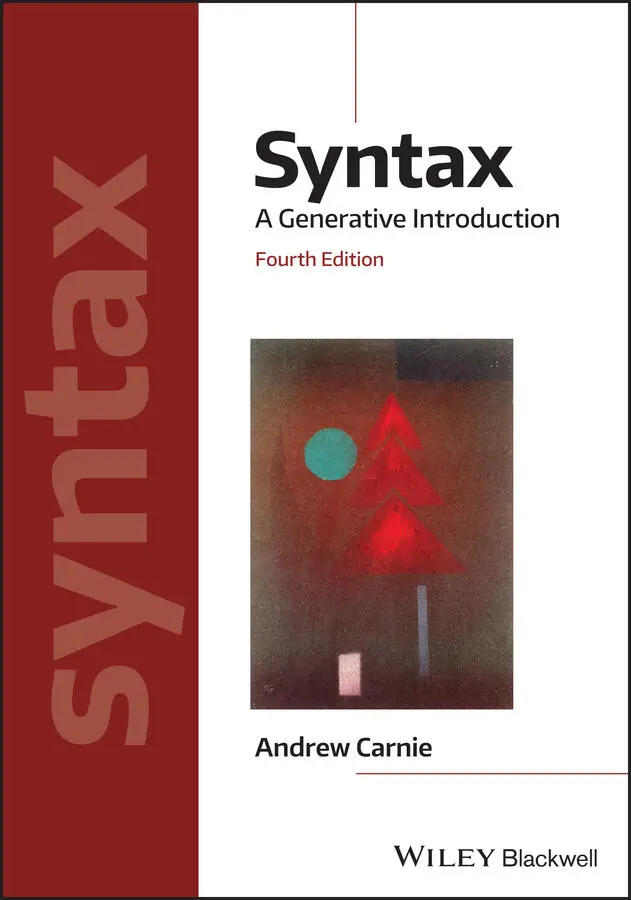
- Название:Syntax
- Автор:
- Жанр:
- Год:неизвестен
- ISBN:нет данных
- Рейтинг книги:4 / 5. Голосов: 1
-
Избранное:Добавить в избранное
- Отзывы:
-
Ваша оценка:
Syntax: краткое содержание, описание и аннотация
Предлагаем к чтению аннотацию, описание, краткое содержание или предисловие (зависит от того, что написал сам автор книги «Syntax»). Если вы не нашли необходимую информацию о книге — напишите в комментариях, мы постараемся отыскать её.
remains the leading introduction to the rules, principles, and processes that determine the structure of sentences in language. Comprehensive yet accessible, the text provides a well-balanced, student-friendly introduction to syntactic theory. Topics include phrase structure, the lexicon, binding theory, case theory, movement, covert movement, locality conditions, ditransitives, verbal inflection and auxiliaries, ellipsis, control theory, non-configurational languages, and more. Students are provided with numerous exercises and pedagogical features designed to strengthen comprehension, review learning objectives, test knowledge, and highlight major issues in the field.
The
features revised material throughout, including a new section on Chomsky's Merge and additional problem sets in every chapter, while new examples throughout the text broaden the appeal and relatability of the text to a more diverse set of students. The optional
has also been thoroughly revised and expanded to offer students the opportunity to practice the skills and concepts introduced in the primary text. This classic textbook:
Presents authoritative and comprehensive coverage of basic, intermediate, and advanced topics Includes ample exercises and clear explanations using straightforward language Offers extensive online student and instructor resources, including problem sets, PowerPoint slides, an updated instructor's manual, author-created videos, online-only chapters, and other supplementary material Features a wealth of learning tools, including learning objectives, discussion questions, and problems of varying levels of difficulty In the new fourth edition,
remains an essential textbook for beginning syntacticians, perfect for undergraduate and graduate course in linguistics, grammar, language, and second language teaching.
Available as a set with
, 2nd Edition
Syntax — читать онлайн ознакомительный отрывок
Ниже представлен текст книги, разбитый по страницам. Система сохранения места последней прочитанной страницы, позволяет с удобством читать онлайн бесплатно книгу «Syntax», без необходимости каждый раз заново искать на чём Вы остановились. Поставьте закладку, и сможете в любой момент перейти на страницу, на которой закончили чтение.
Интервал:
Закладка:
GPS4. PREPOSITIONS
[Application of Skills; Basic]
Using the passage above in question 1, identify all the prepositions.
GPS5. PART OF SPEECH 1 13
[Application of Skills; Basic]
Identify the main parts of speech (i.e., Nouns, Verbs, Adjectives/Adverbs, and Prepositions) in the following sentences. Treat hyphenated words as single words:
1 The old rusty pot-belly stove has been replaced.
2 The red-haired assistant put the vital documents through the new efficient shredder.
3 The large evil leathery alligator complained to her aging keeper about her extremely unattractive description.
4 I just ate the last piece of chocolate cake.
GPS6. NOOTKA
[Application of Skills; Intermediate]
Consider the following data from Nootka (data from Sapir and Swadesh 1939), a language spoken in British Columbia, Canada, and answer the questions that follow.
a) Mamu:k-ma qu:ʔas-ʔi.
working-PRES man-DEF
“The man is working.”
b) Qu:ʔas-ma mamu:k-ʔi.
man-PRES working-DEF
“The working one is a man.”
(The: mark indicates a long vowel. ʔ is a glottal stop. PRES in the second line means “present tense”, DEF means “definite determiner” (the).)
Questions about Nootka :
1 In sentence a, is Qu :ʔ as functioning as a verb or a noun?
2 In sentence a, is Mamu:k functioning as a verb or a noun?
3 In sentence b, is Qu :ʔ as a verb or a noun?
4 In sentence b, is Mamu:k a verb or a noun?
5 What criteria did you use to tell what is a noun in Nootka and what is a verb?
6 How does this data support the idea that there are no semantic criteria involved in determining the part of speech?
GPS7. GENDER NEUTRAL PRONOUNS
[Creative and Critical Thinking; Basic]
Most standard varieties of English don’t have a gender-neutral singular pronoun that can refer to humans (other than the very awkward “one”). There have been numerous attempts to introduce gender-neutral singular human pronouns into English. The following list is a subset of the ones found on John Chao’s gender-neutral pronoun FAQ: 14
ae, ar, co, e, em, ems, en, es, et, ey, fm, ha, hann, he’er, heesh, heir, hem, her’n, herim, herm, hes, hesh, heshe, hey, hez, hi, himer, hir, hirem, hires, hirm, his’er, his’n, hisher, hizer, ho, hom, hse, hymer, im, ip, ir, iro, jhe, le, lem, na, ne, ner, nim, on, per, po, rim, s/he, sap, se, sem, ser, sheehy, shem, shey, shim, sie, sim, ta, tem, term, tey, thim, thon, uh, ve, vim, vir, vis, xe, z, ze, zie, zim, zir .
None of these have caught on. Instead, the otherwise plural they/them/their/themselves is usually felt to be more natural by native speakers. Why have the above forms not caught on, but instead we have co-opted a plural pronoun for this usage?
GPS8. FUNCTIONAL CATEGORIES
[Application of Skills; Basic]
The following is an extract from the preface to Captain Grose’s Dictionary of the Vulgar Tongue (1811) (from the open source Gutenberg project):
The propriety of introducing the university slang will be readily admitted; it is not less curious than that of the College in the Old Bailey, and is less generally understood. When the number and accuracy of our additions are compared with the price of the volume, we have no doubt that its editors will meet with the encouragement that is due to learning, modesty, and virtue.
For every word in this paragraph identify its part of speech, and mark whether each part of speech is a lexical or functional part of speech and whether the part of speech is open or closed.
GPS9. FUNCTIONAL CATEGORIES
[Creative and Critical Thinking; Intermediate]
Interjections are functional items, in that they express a grammatical notion (such as the speaker’s agreement or attitude with respect to the thing being said), but are they closed class? Is it possible to make up new interjections?
GPS10. PART OF SPEECH 2
[Application of Skills; Intermediate]
Consider the following selection from Jabberwocky , a poem by Lewis Carroll (From
Through the Looking-Glass and What Alice Found There , 1872):
’Twas brillig, and the slithy toves
Did gyre and gimble in the wabe;
All mimsy were the borogoves,
And the mome raths outgrabe.
“Beware the Jabberwock, my son!
The jaws that bite, the claws that catch! Beware the Jubjub bird, and shun
The frumious Bandersnatch!”
He took his vorpal sword in hand:
Long time the manxome foe he sought – So rested he by the Tumtum tree
And stood awhile in thought.
And, as in uffish thought he stood, The Jabberwock, with eyes of flame,
Came whiffling through the tulgey wood, And burbled as it came.
For each underlined word, indicate its part of speech (word class), and for Ns, Vs, Adjs, and Advs, explain the distributional criteria by which you came up with that classification. If the item is a closed class part of speech, indicate that. Do not try to use a dictionary. Most of these words are nonsense words. You will need to figure out what part of speech they are according to what suffixes and prefixes they take, along with where they appear relative to other words.
GPS11. SUBCATEGORIES OF NOUNS
[Application of Knowledge; Basic]
For each of the nouns below put a + sign in the box under the features that they have. Note that some nouns might have a plus value for more than one feature. The first one is done for you. Do not mark the minus (–) values, or the values for which the word is not specified; mark onlythe plus values!
| Noun | PLURAL | COUNT | PROPER | PRONOUN | ANAPHOR |
| Cats | + | + | |||
| Milk | |||||
| New York | |||||
| They | |||||
| people | |||||
| language | |||||
| printer | |||||
| himself | |||||
| wind | |||||
| lightbulb |
GPS12. SUBCATEGORIES OF VERBS
[Application of Knowledge; Intermediate]
For each of the verbs below, list whether it is intransitive, transitive or ditransitive and list which features it takes (see the list in (32) as an example). In some cases they may allow more than one feature (e.g., the verb eat is both [NP NP] and [NP]). Give an example for each feature:
spray, sleep, escape, throw, wipe, say, think, begrudge (or grudge), thank, pour, send, promise, kiss, arrive
CHALLENGE PROBLEM SETS
CPS1. -IAN AND -ISH
[Critical and Creative Thinking; Challenge]
In the text we claimed that the suffixes -ian and -ish mark adjectives. Consider the following sentences:
1 The Canadian government uses a parliamentary system of democracy.
2 The Canadian bought herself a barbeque.
3 The prudish linguist didn’t enjoy looking at the internet.
4 We keep those censored copies of the book hidden to protect the sensibilities of the prudish.
Читать дальшеИнтервал:
Закладка:
Похожие книги на «Syntax»
Представляем Вашему вниманию похожие книги на «Syntax» списком для выбора. Мы отобрали схожую по названию и смыслу литературу в надежде предоставить читателям больше вариантов отыскать новые, интересные, ещё непрочитанные произведения.







Обсуждение, отзывы о книге «Syntax» и просто собственные мнения читателей. Оставьте ваши комментарии, напишите, что Вы думаете о произведении, его смысле или главных героях. Укажите что конкретно понравилось, а что нет, и почему Вы так считаете.