Andrew Carnie - Syntax
Здесь есть возможность читать онлайн «Andrew Carnie - Syntax» — ознакомительный отрывок электронной книги совершенно бесплатно, а после прочтения отрывка купить полную версию. В некоторых случаях можно слушать аудио, скачать через торрент в формате fb2 и присутствует краткое содержание. Жанр: unrecognised, на английском языке. Описание произведения, (предисловие) а так же отзывы посетителей доступны на портале библиотеки ЛибКат.
- Название:Syntax
- Автор:
- Жанр:
- Год:неизвестен
- ISBN:нет данных
- Рейтинг книги:4 / 5. Голосов: 1
-
Избранное:Добавить в избранное
- Отзывы:
-
Ваша оценка:
Syntax: краткое содержание, описание и аннотация
Предлагаем к чтению аннотацию, описание, краткое содержание или предисловие (зависит от того, что написал сам автор книги «Syntax»). Если вы не нашли необходимую информацию о книге — напишите в комментариях, мы постараемся отыскать её.
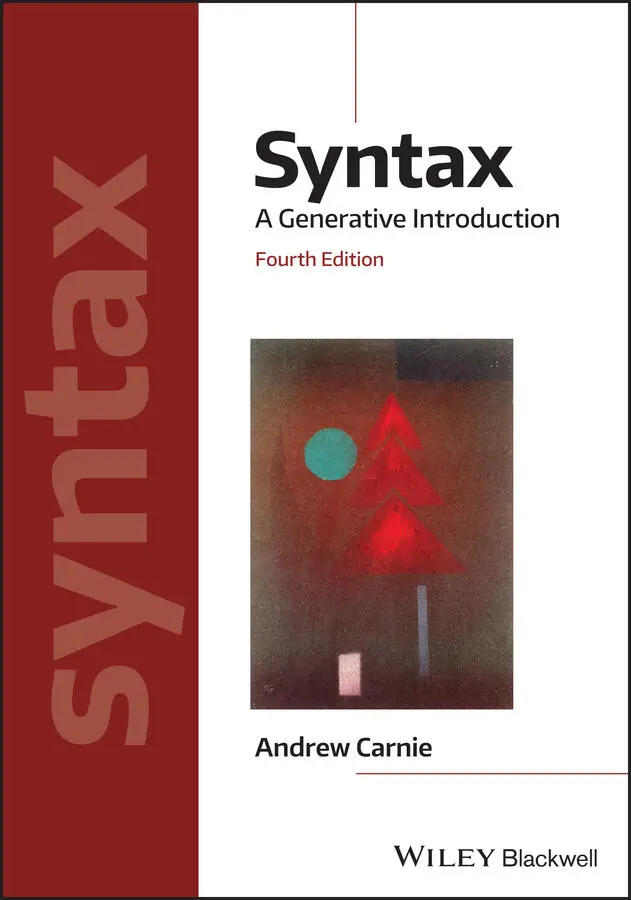
remains the leading introduction to the rules, principles, and processes that determine the structure of sentences in language. Comprehensive yet accessible, the text provides a well-balanced, student-friendly introduction to syntactic theory. Topics include phrase structure, the lexicon, binding theory, case theory, movement, covert movement, locality conditions, ditransitives, verbal inflection and auxiliaries, ellipsis, control theory, non-configurational languages, and more. Students are provided with numerous exercises and pedagogical features designed to strengthen comprehension, review learning objectives, test knowledge, and highlight major issues in the field.
The
features revised material throughout, including a new section on Chomsky's Merge and additional problem sets in every chapter, while new examples throughout the text broaden the appeal and relatability of the text to a more diverse set of students. The optional
has also been thoroughly revised and expanded to offer students the opportunity to practice the skills and concepts introduced in the primary text. This classic textbook:
Presents authoritative and comprehensive coverage of basic, intermediate, and advanced topics Includes ample exercises and clear explanations using straightforward language Offers extensive online student and instructor resources, including problem sets, PowerPoint slides, an updated instructor's manual, author-created videos, online-only chapters, and other supplementary material Features a wealth of learning tools, including learning objectives, discussion questions, and problems of varying levels of difficulty In the new fourth edition,
remains an essential textbook for beginning syntacticians, perfect for undergraduate and graduate course in linguistics, grammar, language, and second language teaching.
Available as a set with
, 2nd Edition
Syntax — читать онлайн ознакомительный отрывок
Ниже представлен текст книги, разбитый по страницам. Система сохранения места последней прочитанной страницы, позволяет с удобством читать онлайн бесплатно книгу «Syntax», без необходимости каждый раз заново искать на чём Вы остановились. Поставьте закладку, и сможете в любой момент перейти на страницу, на которой закончили чтение.
Интервал:
Закладка:
Most transitive verbs require an NP object, so we can mark these with the feature [NP NP]. An example of this is the verb hit , seen above in (27). Verbs like ask (see 26 above), think, say , etc. allow either an NP object or a CP (embedded clause) object. We can mark this using curly brackets {} and a slash. {NP/CP} means “a choice of NP or CP”. So the feature structure for predicates like this is [NP {NP/CP}].
Ditransitive verbs come in several major types. Some ditransitives require two NP objects (the first is an indirect object, the other a direct object). The verb spare is of this category. It does not allow an NP and a PP:
28)
1 I spared [NP him] [NP the trouble].
2 *I spared [NP the trouble] [PP to him].
This category of ditransitive is marked with the feature [NP NP NP]. The opposite kind of ditransitive is found with the verb put . Put requires an NP and a PP:
29)
1 *I put [NP the box] [NP the book].
2 I put [NP the book] [PP in the box].
This kind of ditransitive takes the feature [NP NP PP]. We also have ditransitives that appear to be a combination of these two types and allow either an NP or a PP in the second position:
30)
1 I gave [NP the box] [PP to Leah].
2 I gave [NP Leah] [NP the box].
These have the feature [NP NP {NP/PP}]. Finally we have ditransitives that take either two NPs, or one NP and one CP, or an NP and a PP:
31)
1 I told [NP Daniel] [NP the story].
2 I told [NP Daniel] [CP that the exam was cancelled].
3 I told [NP the story] [PP to Daniel].
Verbs like tell have the feature [NP NP {NP/PP/CP}].
The following chart summarizes all the different subcategories of verb we’ve discussed here:
32)
| Subcategory | Example |
| V[NP__] (intransitive) | leave |
| V[NP ___ NP] (transitive type 1) | hit |
| V[NP ___ {NP/CP}] (transitive type 2) | ask |
| V[NP ___ NP NP] (ditransitive type 1) | spare |
| V[NP ___ NP PP] (ditransitive type 2) | put |
| V[NP ___ NP {NP/PP}] (ditransitive type 3) | give |
| V[NP ___ NP {NP/PP/CP}] (ditransitive type 4) | tell |
There are other types of verbs that we haven’t listed here. We’ll introduce similar features as we need them.
You can now try WBE14, GPS12, and CPS6–9 .
Did You Run the Race?
The claim that only obligatory arguments are found in argument structure is not as straightforward as it sounds. Consider the verb run . It has both an intransitive use (I ran) and a transitive use (I ran the race) . A similar problem is raised by languages that can drop the subject argument (e.g. Spanish and Italian) and by imperative sentences in English ( Go home now! ). The subject is still an argument in these constructions, even though you can’t hear it. In cases like the verb run , we’ll simply claim that there are two verbs to run : one that takes an object and one that doesn’t.
5. CONCLUSION
In this chapter, we’ve surveyed the parts of speech categories that we will use in this book. We have the lexical parts of speech N, V, Adj, and Adv, and the functional categories D, P, C, Conj, Neg, and T. Determining part of speech is done not by traditional semantic criteria, but by using morphological and syntactic distribution tests. We also looked at distributional evidence for various subcategories of nouns and verbs, and represented these distinctions as feature notations on the major categories.
IDEAS, RULES, AND CONSTRAINTS INTRODUCED IN THIS CHAPTER
1 Parts of Speech (a.k.a . Word Class , Syntactic Categories ): The labels we give to constituents (N, V, Adj, Adv, D, P, C, T, Neg, Conj). These determine the position of the word in the sentence.
2 Distribution : Parts of speech are determined based on their distribution. We have both morphological distribution (what affixes are found on the word) and syntactic distribution (what other words are nearby).
3 Complementary Distribution : When you have two categories and they never appear in the same environment (context), you have complementary distribution. Typically complementary distribution means that the two categories are subtypes of a larger class.
4 Parts of speech that are Open Class can take new members or coinages: N, V, Adj, Adv.
5 Parts of speech that are Closed Class don’t allow new coinages: D, P, Conj, C, T, Neg, and the pronoun and anaphor subcategories of N.
6 Lexical Categories express the content of the sentence. N (including pronouns), V, Adj, Adv.
7 Functional Categories contain the grammatical information in a sentence: D, P, Conj, T, Neg, C.
8 Subcategories : The major parts of speech can often be divided up into subtypes. These are called subcategories.
9 Feature Notations on major categories are a mechanism for indicating subcategories.
10 Plurality refers to the number of nouns. It is usually indicated in English with an -s suffix. Plural nouns in English do not require a determiner.
11 Count vs. Mass : Count nouns can appear with determiners and the quantifier many . Mass nouns appear with much and usually don’t have articles.
12 The Predicate defines the relation between the individuals being talked about and some fact about them, as well as relations among the arguments.
13 Argument Structure : The number of arguments that a predicate takes.
14 The Arguments are the entities that are participating in the predicate relation.
15 Intransitive : A predicate that takes only one argument.
16 Transitive : A predicate that takes two arguments.
17 Ditransitive : A predicate that takes three arguments.
FURTHER READING:Baker (2003), Grimshaw (1990), Harley (2006), Katamba (2004), Levin (1993), Williams (1983)
GENERAL PROBLEM SETS
GPS1. NOUNS
[Application of Skills; Basic]
Identify all the nouns in the following passage from The Adventures of Sherlock Holmes by Sir Arthur Conan Doyle. 12You can ignore pronouns like I, he, my, whom, her , and me – although these are, of course, nouns as well.
The lamps had been lit, but the blinds had not been drawn, so that I could see Holmes as he lay upon the couch. I do not know whether he was seized with compunction at that moment for the part he was playing, but I know that I never felt more heartily ashamed of myself in my life than when I saw the beautiful creature against whom I was conspiring, or the grace and kindliness with which she waited upon the injured man. And yet it would be the blackest treachery to Holmes to draw back now from the part which he had entrusted to me. I hardened my heart, and took the smoke-rocket from under my ulster. After all, I thought, we are not injuring her. We are but preventing her from injuring another.
GPS2. VERBS
[Application of Skills; Basic]
Using the passage above in question 1, identify all the verbs. Do not worry about modals and auxiliary verbs. So ignore had, been, could, do, was, would, be, and are (all of which are of category T).
GPS3. ADJECTIVES AND ADVERBS
[Application of Skills; Basic]
Using the passage above in question 1, identify all the adjectives and adverbs.
Читать дальшеИнтервал:
Закладка:
Похожие книги на «Syntax»
Представляем Вашему вниманию похожие книги на «Syntax» списком для выбора. Мы отобрали схожую по названию и смыслу литературу в надежде предоставить читателям больше вариантов отыскать новые, интересные, ещё непрочитанные произведения.








Обсуждение, отзывы о книге «Syntax» и просто собственные мнения читателей. Оставьте ваши комментарии, напишите, что Вы думаете о произведении, его смысле или главных героях. Укажите что конкретно понравилось, а что нет, и почему Вы так считаете.