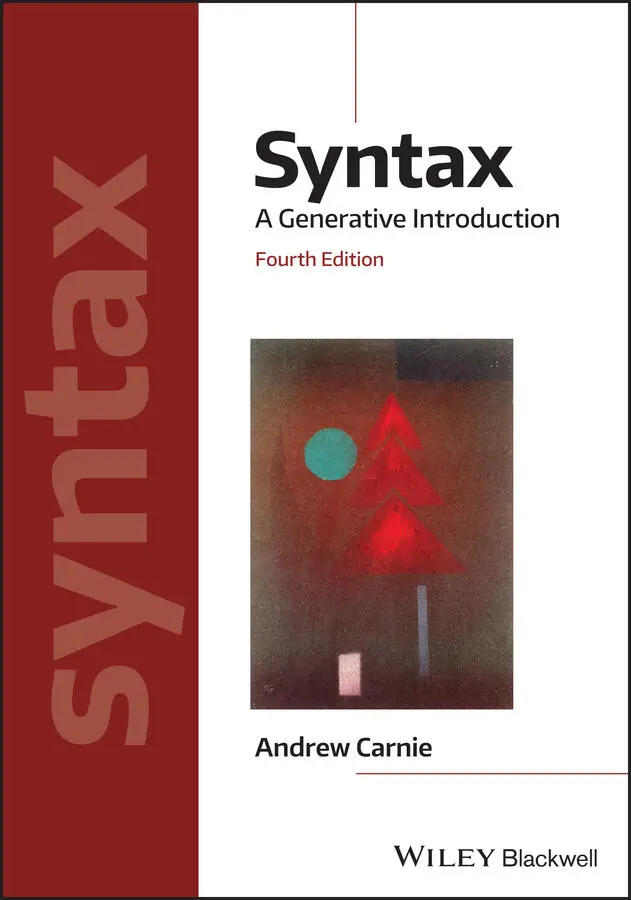
Andrew Carnie - Syntax
Здесь есть возможность читать онлайн «Andrew Carnie - Syntax» — ознакомительный отрывок электронной книги совершенно бесплатно, а после прочтения отрывка купить полную версию. В некоторых случаях можно слушать аудио, скачать через торрент в формате fb2 и присутствует краткое содержание. Жанр: unrecognised, на английском языке. Описание произведения, (предисловие) а так же отзывы посетителей доступны на портале библиотеки ЛибКат.
- Название:Syntax
- Автор:
- Жанр:
- Год:неизвестен
- ISBN:нет данных
- Рейтинг книги:4 / 5. Голосов: 1
-
Избранное:Добавить в избранное
- Отзывы:
-
Ваша оценка:
Syntax: краткое содержание, описание и аннотация
Предлагаем к чтению аннотацию, описание, краткое содержание или предисловие (зависит от того, что написал сам автор книги «Syntax»). Если вы не нашли необходимую информацию о книге — напишите в комментариях, мы постараемся отыскать её.
remains the leading introduction to the rules, principles, and processes that determine the structure of sentences in language. Comprehensive yet accessible, the text provides a well-balanced, student-friendly introduction to syntactic theory. Topics include phrase structure, the lexicon, binding theory, case theory, movement, covert movement, locality conditions, ditransitives, verbal inflection and auxiliaries, ellipsis, control theory, non-configurational languages, and more. Students are provided with numerous exercises and pedagogical features designed to strengthen comprehension, review learning objectives, test knowledge, and highlight major issues in the field.
The
features revised material throughout, including a new section on Chomsky's Merge and additional problem sets in every chapter, while new examples throughout the text broaden the appeal and relatability of the text to a more diverse set of students. The optional
has also been thoroughly revised and expanded to offer students the opportunity to practice the skills and concepts introduced in the primary text. This classic textbook:
Presents authoritative and comprehensive coverage of basic, intermediate, and advanced topics Includes ample exercises and clear explanations using straightforward language Offers extensive online student and instructor resources, including problem sets, PowerPoint slides, an updated instructor's manual, author-created videos, online-only chapters, and other supplementary material Features a wealth of learning tools, including learning objectives, discussion questions, and problems of varying levels of difficulty In the new fourth edition,
remains an essential textbook for beginning syntacticians, perfect for undergraduate and graduate course in linguistics, grammar, language, and second language teaching.
Available as a set with
, 2nd Edition
Syntax — читать онлайн ознакомительный отрывок
Ниже представлен текст книги, разбитый по страницам. Система сохранения места последней прочитанной страницы, позволяет с удобством читать онлайн бесплатно книгу «Syntax», без необходимости каждый раз заново искать на чём Вы остановились. Поставьте закладку, и сможете в любой момент перейти на страницу, на которой закончили чтение.
Интервал:
Закладка:
One easy way to see if something is a noun is to see if you can replace it with another word that is clearly a noun. So if we want to see if the word people is a noun or not, we can substitute another word we know for sure to be a noun, e.g., John in I saw people running all over the place vs. I saw John running all over the place) .
2.2 Verbs
Derivational Suffixes:Verbs often end in derivational endings such as -ate (dissipate) , and -ize/-ise (regularize) .
Inflectional Suffixes:In the past tense, verbs usually take an -ed or -t ending. In the present tense, third person singular ( he, she, it ), they usually take the -s ending. Verbs can also take an -ing ending in some aspectual constructions, ( she was walking ) and most take either an -en or an -ed suffix when they are passivized (more on passivization in later chapters): the ice cream was eaten .
Note that the following endings have homophonous usage with other parts of speech: -ing, -s, -en, -ed .
Syntactic Distribution:Verbs can follow auxiliaries and modals such as will, have, having, had, has, am, be, been, being, is, are, were, was, would, can, could, shall, should, may, must , and the special non-finite marker to . Verbs follow subjects, and can follow adverbs such as often and frequently . Verbs can be negated with not (as opposed to no and un- 4).
2.3 Adjectives
Derivational Suffixes:Adjectives often end in derivational endings such as -ing (the dancing cat), -ive (indicative) , -able (readable), -al (traditional), -ate (intimate), -ish (childish), - some (tiresome), -(i)an (reptilian), -ful (wishful), -less (selfless), -ly (friendly) .
Inflectional Suffixes:Adjectives can be inflected into a comparative form using -er (alternately they follow the word more ). They can also be inflected into their superlative form using -est (alternately they follow the word most ). Adjectives are typically negated using the prefix un- (in its sense meaning “not”, not in its sense meaning “undo”).
Note that the following affixes have homophonous usage with other parts of speech:
-ing, -er, -en, -ed, un-, -ly .
Syntactic Distribution:Adjectives can appear between determiners such as the, a, these , etc. and nouns ( the big peanut ). They also can follow the auxiliary am/is/are/was/were/be/been/being (warning: this distribution overlaps with verbs). Frequently, adjectives can be modified by the adverb very (warning: this distribution overlaps with adverbs).
You now have enough information to try CPS1 & 2 .
2.4 Adverbs
Derivational Suffixes:Many adverbs end in -ly : quickly , frequently , etc.
Inflectional Suffixes:Adverbs generally don’t take any inflectional suffixes. However, on rare occasions they can be used comparatively and follow the word more : She went more quickly than he did . Adverbs typically don’t take the prefix un- unless the adjective they are derived from does first (e.g., unhelpfully from unhelpful , but *unquickly, *unquick ).
Syntactic Distribution:The syntactic distribution of adverbs is most easily described by stating where they can’t appear. Adverbs can’t appear between a determiner and a noun (* the quickly fox ) or after the verb is and its variants. 5They can really appear pretty much anywhere else in the sentence, although typically they appear at either the beginning or the end of the clause/sentence. Frequently, like adjectives, they can be modified by the adverb very .
You now have enough information to answer WBE1-5, GPS1–6 and CPS3
Adjectives and Adverbs: Part of the Same Category?
Look carefully at the distributions of adjectives and adverbs. There is a great deal of overlap between them. Adverbs typically take -ly ; however, there are a number of clear adjectives that take this suffix too (e.g., the friendly cub ). Both Adj and Adv can be modified by the word very , and they both have the same basic function in the grammar – to attribute properties to the items they modify. In fact, the only major distinction between them is syntactic: Adjectives appear inside NPs, while adverbs appear elsewhere. This kind of phenomenon is called complementary distribution. (Where you get an adjective vs. an adverb is entirely predictable.) When two elements are in complementary distribution in linguistics, we normally think of them as variants of the same basic category. For example, when two sounds in phonology are in complementary distribution, we say they are allophones of the same phoneme. We might extend this analysis to parts of speech: There is one “supercategory” labeled “A” that has two subcategories in it (allo-parts-of-speech, if you will): Adj and Adv. In this book we’ll stick with the traditional Adj and Adv categories, simply because they are familiar to most people. But you should keep in mind that the category A (including both adjectives and adverbs) might provide a better analysis and might be better motivated scientifically.
3. OPEN VS. CLOSED; LEXICAL VS. FUNCTIONAL
3.1 Open vs. Closed Parts of Speech
Some parts of speech allow you to add neologisms (new words). For example, imagine I invented a new tool especially for the purpose of removing spines from cacti, and I called this tool a pulfice . This kind of word is easily learned and adopted by speakers of English. In fact, we might even predict that speakers would take pulfice and develop a verb pulficize , which means to remove cactus spines using a pulfice . New words may be coined at any time, if they are open class (e.g., fax, internet, grody ). By contrast there are some parts of speech that don’t allow new forms. Suppose I wanted to describe a situation where one arm is under the table and another is over the table, and I called this new preposition uvder : My arms are uvder the table . It’s fairly unlikely that my new preposition, no matter how useful it is, will be adopted into the language. Parts of speech that allow new members are said to be open class. Those that don’t (or where coinages are very rare) are closed class. All of the cases that we’ve looked at so far have been open class parts of speech.
3.2 Lexical vs. Functional
The open/closed distinction is similar to (but not identical to) another useful distinction in parts of speech. This is the distinction between lexical and functional parts of speech. Lexicalparts of speech provide the “content” of the sentence. Nouns, verbs, adjectives, and adverbs are all lexical parts of speech. Functionalparts of speech, by contrast, provide the grammatical information. Functional items are the “glue” that holds a sentence together. One way to tell if a lexical item is functional or lexical is to see if it is left behind in “telegraphic speech” (that is, the way a telegram would be written; e.g., Brian bring computer! Disaster looms! ). Functional categories include determiners, prepositions, complementizers, conjunctions, negation, auxiliaries, and modals. We will detail some of these below in section 3.3.
Читать дальшеИнтервал:
Закладка:
Похожие книги на «Syntax»
Представляем Вашему вниманию похожие книги на «Syntax» списком для выбора. Мы отобрали схожую по названию и смыслу литературу в надежде предоставить читателям больше вариантов отыскать новые, интересные, ещё непрочитанные произведения.








Обсуждение, отзывы о книге «Syntax» и просто собственные мнения читателей. Оставьте ваши комментарии, напишите, что Вы думаете о произведении, его смысле или главных героях. Укажите что конкретно понравилось, а что нет, и почему Вы так считаете.