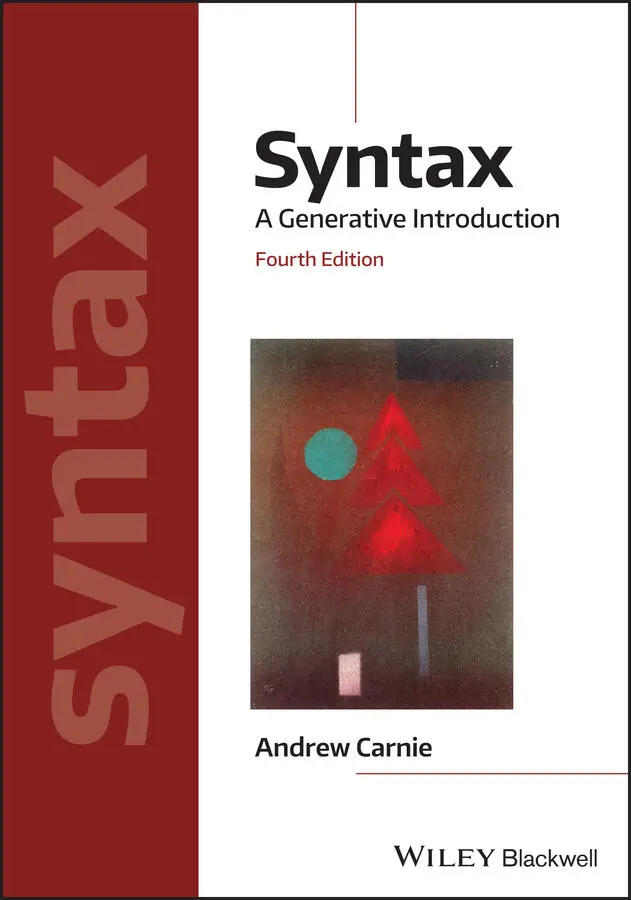
Andrew Carnie - Syntax
Здесь есть возможность читать онлайн «Andrew Carnie - Syntax» — ознакомительный отрывок электронной книги совершенно бесплатно, а после прочтения отрывка купить полную версию. В некоторых случаях можно слушать аудио, скачать через торрент в формате fb2 и присутствует краткое содержание. Жанр: unrecognised, на английском языке. Описание произведения, (предисловие) а так же отзывы посетителей доступны на портале библиотеки ЛибКат.
- Название:Syntax
- Автор:
- Жанр:
- Год:неизвестен
- ISBN:нет данных
- Рейтинг книги:4 / 5. Голосов: 1
-
Избранное:Добавить в избранное
- Отзывы:
-
Ваша оценка:
Syntax: краткое содержание, описание и аннотация
Предлагаем к чтению аннотацию, описание, краткое содержание или предисловие (зависит от того, что написал сам автор книги «Syntax»). Если вы не нашли необходимую информацию о книге — напишите в комментариях, мы постараемся отыскать её.
remains the leading introduction to the rules, principles, and processes that determine the structure of sentences in language. Comprehensive yet accessible, the text provides a well-balanced, student-friendly introduction to syntactic theory. Topics include phrase structure, the lexicon, binding theory, case theory, movement, covert movement, locality conditions, ditransitives, verbal inflection and auxiliaries, ellipsis, control theory, non-configurational languages, and more. Students are provided with numerous exercises and pedagogical features designed to strengthen comprehension, review learning objectives, test knowledge, and highlight major issues in the field.
The
features revised material throughout, including a new section on Chomsky's Merge and additional problem sets in every chapter, while new examples throughout the text broaden the appeal and relatability of the text to a more diverse set of students. The optional
has also been thoroughly revised and expanded to offer students the opportunity to practice the skills and concepts introduced in the primary text. This classic textbook:
Presents authoritative and comprehensive coverage of basic, intermediate, and advanced topics Includes ample exercises and clear explanations using straightforward language Offers extensive online student and instructor resources, including problem sets, PowerPoint slides, an updated instructor's manual, author-created videos, online-only chapters, and other supplementary material Features a wealth of learning tools, including learning objectives, discussion questions, and problems of varying levels of difficulty In the new fourth edition,
remains an essential textbook for beginning syntacticians, perfect for undergraduate and graduate course in linguistics, grammar, language, and second language teaching.
Available as a set with
, 2nd Edition
Syntax — читать онлайн ознакомительный отрывок
Ниже представлен текст книги, разбитый по страницам. Система сохранения места последней прочитанной страницы, позволяет с удобством читать онлайн бесплатно книгу «Syntax», без необходимости каждый раз заново искать на чём Вы остановились. Поставьте закладку, и сможете в любой момент перейти на страницу, на которой закончили чтение.
Интервал:
Закладка:
You now have enough information to answer WBE6, GPS7, and CPS4 .
3.3 Some Functional (Closed) Categories of English
We’ll survey here some of the main functional categories of English. This list is by no means complete. While it is possible to provide distributional definitions for various functional parts of speech, because they are closed class there are relatively few members of each class. So it is possible to simply list most of them.
We’ll start our categorization with prepositions(abbreviated P). Prepositions appear before nouns (or more precisely, noun phrases). English prepositions include the following:
12) Prepositions of English (P): to, from, under, over, with, by, at, above, before, after, through, near, on, off, for, in, into, of, during, across, without, since, until.
The class of determiners(D) is a little broader. It contains a number of subcategories including articles, quantifiers, numerals, deictics, and possessive pronouns. Determiners appear at the very beginning of English noun phrases.
13) Determiners of English (D)
1 Articles : the, a, an
2 Deictic articles : this, that, these, those, yon
3 Quantifiers :6every, some, many, most, few, all, each, any, less, fewer, no
4 (Cardinal) numerals : one, two, three, four, etc.
5 Possessive pronouns :7my, your, his, her, its, our, their
6 Some wh-question words : which, whose
You now have enough information to answer WBE7 & 8 .
Conjunctions(Conj) are words that connect two or more phrases together on an equal level:
14) Conjunctions of English (Conj): and, or, nor, neither … nor, either … or
The class of complementizers(C) also connects structures together, but they embed one clause inside of another instead of keeping them on an equal level:
15) Complementizers of English (C): that, for, if, whether
One of the most important categories that we’ll use is the category of tense(T). For the moment we will not include tense suffixes such as -ed and -s in this class, and treat those as parts of verbs (we will revisit this issue in chapter 9). Instead, the category T consists of auxiliaries, modals, and the non-finite tense marker. In the older syntactic literature, the category T is sometimes called Infl (inflection) or Aux (Auxiliary). We’ll use the more modern T.
16) Tense categories of English (T)
Auxiliaries : have/has/had, am/is/are/was/were, do/does/did Modals : will, would, shall, should, can, could, may, might, must Non-finite tense marker : to
There is one special category containing only one word: not , which we’ll call negation(Neg). There are other categories that express negation (e.g., the determiners no, any , and the noun none ). We’ll reserve the category Neg for the word not , however.
You now have enough information to answer WBE9 & 10, GPS8–10, and CPS5 .
Are Numerals of Category D or Adj?
Cardinal numerals, in phrases like two books , seem to function like quantifiers like all or few at least in terms of their function as counting elements. In the case of one big book , the one can stand in place of an obligatory determiner (normally we’d require a determiner like a or the -- leaving off the determiner makes the phrase ungrammatical ( *big book ). This suggests, then, that numerals are of category D. However, consider the case of these two books . In this phrase, the numeral functions more like an adjective, in that it appears between the deictic article these and the noun. What category are numerals? That’s a difficult question to answer, and one that requires more theoretical tools than I can give you in this book, at this stage in your learning at least. I tell my own students that for the purposes of doing assignments in this book either analysis is plausible, and possibly both situations exist.
4. SUBCATEGORIES AND FEATURES
You may have noticed that in sections 2 and 3, I hinted that each major part of speech category may have subtypes. For example, we listed six different kinds of D (articles, deictics, quantifiers, numerals, possessive pronouns, wh -pronouns) and three kinds of T (auxiliaries, modals, and the non-finite marker). The technical term for these subtypes is subcategories. For the most part, we are going to be interested in the main part of speech categories (N, V, Adj, Adv, P, D, Conj, C, T, and Neg), but sometimes we will want to refer to the subcategories.
One way to mark subcategories is through the use of features. Consider the case of
T. To distinguish among the subcategories we can appeal to the features [±MODAL] and [±FINITE]:
17) Auxiliary 8 T[–MODAL, +FINITE]
Modal T [+MODAL, +FINITE]
to T [+MODAL, -FINITE]
One set of possible values of these features is missing ([-MODAL, -FINITE]). We might similarly distinguish among tense forms using features like [±PAST] etc. So was is [+PAST]; is is [-PAST] etc.
Similarly we can distinguish among the various kinds of determiner using features like [±WH], [±QUANTIFIER], [±DEICTIC], etc. The details of this kind of analysis aren’t crucial to the grammar fragments you are given in this book, as long as you understand the basic concept behind using features to mark subcategories. 9In the rest of this section,
we look at some of the subcategories of N, V, and P that will be of use to us in the rest of the book.
I’m not going to discuss subcategories of Adj and Adv, although they exist. In a grey textbox above, I’ve suggested that Adj and Adv are themselves subcategories of a larger category A. We also find many subcategories within the Adj and Adv categories. Some of these distinctions are explored in problem sets at the end of the chapter.
4.1 Subcategories of Nouns
We can slice the pie of English nouns apart along several dimensions including plural vs. singular, proper vs. common, pronoun vs. lexical noun, and count vs. mass noun.
First, let’s distinguish along the line of plurality. English nouns can be either singular or plural. The distinction between singular and plural is usually morphologically marked with one of the plural endings like -s or -es (although it need not be, as in mice or deer ). Most singular nouns in English require a D; 10plural ones do not require a D, although they allow one:
18)
1 *Cat ate the spider.
2 The cat ate the spider.
3 Cats ate the spider.
4 The cats ate the spider.
We mark this distinction with the feature [±PLURAL].
Closely related to the plural/singular distinction is the countvs. massnoun distinction. Count nouns represent individual, “countable” elements. For example, apple is a count noun. “Mass nouns” usually can’t be counted in the same way. For example sincerity and air are mass nouns. There are two easy distributional tests to distinguish between mass and count nouns. Mass nouns take the quantifier much , while count nouns take many .
19)
1 many apples
2 *much apples/apple11
3 *many sincerity
4 *many air
5 much sincerity
6 much air
Like plurals, mass nouns generally don’t require a determiner, but count nouns do:
20)
1 *I ate apple.
Читать дальшеИнтервал:
Закладка:
Похожие книги на «Syntax»
Представляем Вашему вниманию похожие книги на «Syntax» списком для выбора. Мы отобрали схожую по названию и смыслу литературу в надежде предоставить читателям больше вариантов отыскать новые, интересные, ещё непрочитанные произведения.








Обсуждение, отзывы о книге «Syntax» и просто собственные мнения читателей. Оставьте ваши комментарии, напишите, что Вы думаете о произведении, его смысле или главных героях. Укажите что конкретно понравилось, а что нет, и почему Вы так считаете.