Andrew Carnie - Syntax
Здесь есть возможность читать онлайн «Andrew Carnie - Syntax» — ознакомительный отрывок электронной книги совершенно бесплатно, а после прочтения отрывка купить полную версию. В некоторых случаях можно слушать аудио, скачать через торрент в формате fb2 и присутствует краткое содержание. Жанр: unrecognised, на английском языке. Описание произведения, (предисловие) а так же отзывы посетителей доступны на портале библиотеки ЛибКат.
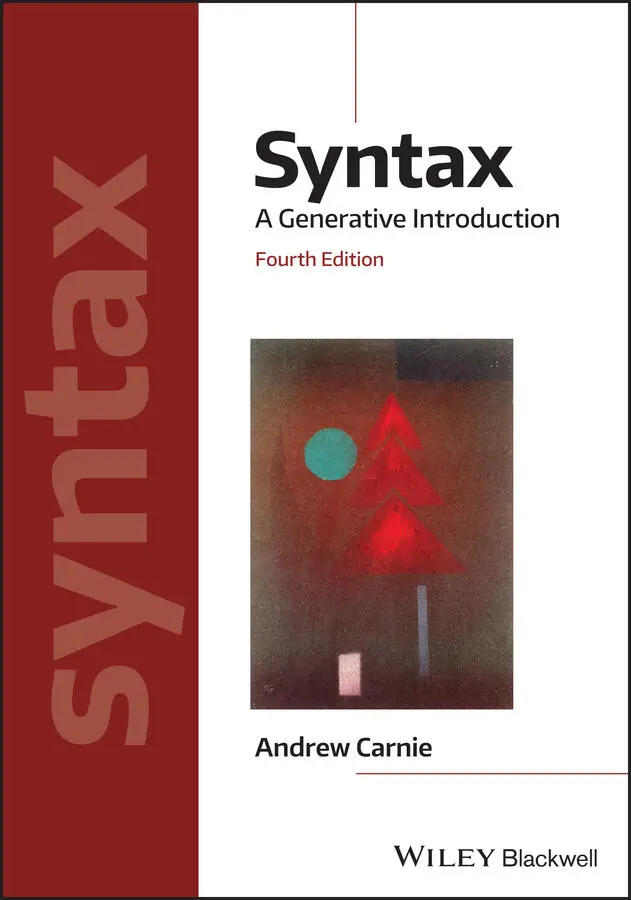
- Название:Syntax
- Автор:
- Жанр:
- Год:неизвестен
- ISBN:нет данных
- Рейтинг книги:4 / 5. Голосов: 1
-
Избранное:Добавить в избранное
- Отзывы:
-
Ваша оценка:
Syntax: краткое содержание, описание и аннотация
Предлагаем к чтению аннотацию, описание, краткое содержание или предисловие (зависит от того, что написал сам автор книги «Syntax»). Если вы не нашли необходимую информацию о книге — напишите в комментариях, мы постараемся отыскать её.
remains the leading introduction to the rules, principles, and processes that determine the structure of sentences in language. Comprehensive yet accessible, the text provides a well-balanced, student-friendly introduction to syntactic theory. Topics include phrase structure, the lexicon, binding theory, case theory, movement, covert movement, locality conditions, ditransitives, verbal inflection and auxiliaries, ellipsis, control theory, non-configurational languages, and more. Students are provided with numerous exercises and pedagogical features designed to strengthen comprehension, review learning objectives, test knowledge, and highlight major issues in the field.
The
features revised material throughout, including a new section on Chomsky's Merge and additional problem sets in every chapter, while new examples throughout the text broaden the appeal and relatability of the text to a more diverse set of students. The optional
has also been thoroughly revised and expanded to offer students the opportunity to practice the skills and concepts introduced in the primary text. This classic textbook:
Presents authoritative and comprehensive coverage of basic, intermediate, and advanced topics Includes ample exercises and clear explanations using straightforward language Offers extensive online student and instructor resources, including problem sets, PowerPoint slides, an updated instructor's manual, author-created videos, online-only chapters, and other supplementary material Features a wealth of learning tools, including learning objectives, discussion questions, and problems of varying levels of difficulty In the new fourth edition,
remains an essential textbook for beginning syntacticians, perfect for undergraduate and graduate course in linguistics, grammar, language, and second language teaching.
Available as a set with
, 2nd Edition
Syntax — читать онлайн ознакомительный отрывок
Ниже представлен текст книги, разбитый по страницам. Система сохранения места последней прочитанной страницы, позволяет с удобством читать онлайн бесплатно книгу «Syntax», без необходимости каждый раз заново искать на чём Вы остановились. Поставьте закладку, и сможете в любой момент перейти на страницу, на которой закончили чтение.
Интервал:
Закладка:
2 I ate the apple.
3 I ate sugar.
4 I ate the sugar.
5 She is filled with sincerity.
6 I doubt her sincerity.
We distinguish between count and mass nouns using the feature [±COUNT].
Next, let us distinguish between proper namesand common nouns. Proper names are nouns like Andrew Carnie . Common nouns are all other nouns. For the most part, proper names resist taking determiners:
21) a) Andrew Carnie
b) *the Andrew Carnie
There are some exceptions to this generalization. For example, when referring to a family it’s common to say the Smiths . In other languages, proper names can take determiners. For example, in some dialects of Spanish, it is okay to say La Rosamaria “the Rosemary”. If necessary, we can distinguish proper names from common nouns using the feature [±PROPER], although this feature is less useful than the others.
Finally let’s look at the subcategories of pronounsand anaphors. These classes differ from the others in that they are closed. They never allow determiners or adjectival modification.
| 22) a) | he | b) | himself |
| c) | *the he | d) | *the himself |
| e) | *big he | f) | *big himself |
Pronouns belong to the class [+PRONOUN, –ANAPHOR]. Anaphors are [+PRONOUN,
+ANAPHOR]. All other nouns are [–PRONOUN, –ANAPHOR].
You now have enough information to do WBE 11-13 and GPS 11 .
The Special Case of Possessive Pronouns
Possessive pronouns are an especially tricky case. They clearly function semantically like nouns. So for example, Susan’s father might be the same person as her father , where her refers to Susan. In chapter 5, you’ll see cases where possessive pronouns behave like pronouns with respect to a phenomenon called binding. But in other regards, possessive pronouns actually behave more like determiners: they are in complementary distribution with determiners ( *the her book ). They appear at the beginning of the noun phrase. This gives possessive pronouns the flavor of a determiner. So are possessive pronouns a subcategory of noun or a subcategory of determiners? That’s a really tricky question. Once you learn about head movement in chapter 10, you might consider an analysis where they start out as nouns and become determiners via the mechanism of head movement. But for the first part of this book, it’s probably easier just to treat them as determiners, because they normally appear in the same syntactic positions as determiners.
4.2 Subcategories of Verbs
There are really two major ways in which we can divide up verbs into subcategories. One is along the lines of tense/finiteness (i.e., whether the verb is left , leaves , ( will ) leave or ( to ) leave ). We’re going to leave these distinctions aside until chapter 9, although I hope it is obvious by now how we’d use features to distinguish among them, even if the precise features we’d use aren’t defined yet. The other way to divvy up verbs is in terms of the number of noun phrases (NPs) and prepositional phrases (PPs) or clauses (CPs) they require. This second kind of division is known as argument structure.
In order to discuss argument structure, we first need to define some basic terms. If you took grammar in school, you probably learned that “every sentence has a subject and a predicate.” Under your schoolroom definitions, the subject is usually the first noun phrase (that is, the first noun and all things that go along with it), and the predicate is everything else in the sentence. So for example, in (23) the subject is the dastardly phonologist , and the predicate would be stole the syntactician’s lunch .
23) [The dastardly phonologist][stole the syntactician’s lunch].
subject predicate ( traditional definitions )
The definition of subject isn’t too bad (we’ll refine it later though), but syntacticians use the term “predicate” entirely differently . The syntactician’s definition of predicate is based on the mathematical notion of a “relation”. The predicatedefines the relation between the individuals being talked about and the real world – as well as among themselves. The entities (which can be abstract) participating in the relation are called arguments. To see how this works, look at the following example:
24) Gwen hit the baseball.
There are two arguments in this example, Gwen and the baseball . These are elements in the world that are participants in the action described by the sentence. The predicate here is hit . Hit expresses a relation between the two arguments: more precisely, it indicates that the first argument ( Gwen ) is applying some force on the second argument ( the baseball ). This may seem patently self-evident, but it’s important to understand what is going on here on an abstract level. This usage of the terms predicate and argument is identical to how they are used in formal logic.
We can speak about any particular predicate’s argument structure. This refers to the number of arguments that a particular predicate requires. Another name for argument structure is valency. Take, for example, predicates that take only one argument (i.e., they have a valency of 1). These are predicates like smile , arrive , sit , run , etc. The property of transitivity refers to how many arguments follow the verb. In predicates with a valency of 1, no arguments follow the verb (the single argument precedes the verb), so these predicates are said to be intransitive. Predicates that take two obligatory arguments have a valency of 2; some examples are hit , love , see , kiss , admire , etc. These predicates are said to be transitive, because they have a single argument after the verb (the other argument precedes the verb). Finally predicates that take three arguments have a valency of 3. Put and give are the best examples of this class. These predicates have two arguments after the verb so are said to be ditransitive.
| 25) Transitivity | Valency | Example |
| Intransitive | 1 argument | smile, arrive |
| Transitive | 2 arguments | hit, love, kiss |
| Ditransitive | 3 arguments | give, put |
In determining how many arguments a predicate has, we only consider the obligatory NPs and PPs. Optional ones are never counted in the list of arguments. Only obligatory elements are considered arguments.
Predicates not only restrict the number of arguments that appear with them, they also restrict the categories of those arguments. A verb like ask can take either an NP or a clause (embedded sentence = CP) as a complement:
26)
1 I asked [NP the question].
2 I asked [CP if you knew the answer].
But a verb like hit can only take an NP complement:
27)
1 I hit [NP the ball].
2 *I hit [CP that you knew the answer].
With these basics in mind, we can set up a series of features based on how many and what kind of arguments a verb takes.
Let’s start with intransitives. These require a single NP subject. We’ll mark this with the feature [NP] where the underscore represents where the verb would go in the sentence. An example of such a verb would be leave .
Читать дальшеИнтервал:
Закладка:
Похожие книги на «Syntax»
Представляем Вашему вниманию похожие книги на «Syntax» списком для выбора. Мы отобрали схожую по названию и смыслу литературу в надежде предоставить читателям больше вариантов отыскать новые, интересные, ещё непрочитанные произведения.








Обсуждение, отзывы о книге «Syntax» и просто собственные мнения читателей. Оставьте ваши комментарии, напишите, что Вы думаете о произведении, его смысле или главных героях. Укажите что конкретно понравилось, а что нет, и почему Вы так считаете.