Jeffrey McCullough - Transfusion Medicine
Здесь есть возможность читать онлайн «Jeffrey McCullough - Transfusion Medicine» — ознакомительный отрывок электронной книги совершенно бесплатно, а после прочтения отрывка купить полную версию. В некоторых случаях можно слушать аудио, скачать через торрент в формате fb2 и присутствует краткое содержание. Жанр: unrecognised, на английском языке. Описание произведения, (предисловие) а так же отзывы посетителей доступны на портале библиотеки ЛибКат.
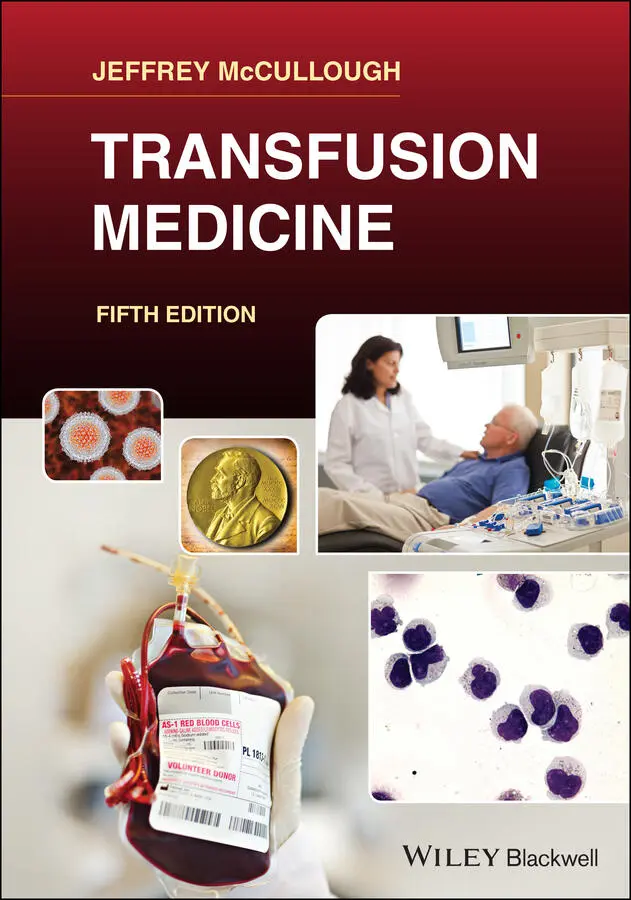
- Название:Transfusion Medicine
- Автор:
- Жанр:
- Год:неизвестен
- ISBN:нет данных
- Рейтинг книги:3 / 5. Голосов: 1
-
Избранное:Добавить в избранное
- Отзывы:
-
Ваша оценка:
Transfusion Medicine: краткое содержание, описание и аннотация
Предлагаем к чтению аннотацию, описание, краткое содержание или предисловие (зависит от того, что написал сам автор книги «Transfusion Medicine»). Если вы не нашли необходимую информацию о книге — напишите в комментариях, мы постараемся отыскать её.
The Fifth Edition of
delivers a succinct, thorough, clinically focused, practical and authoritative treatment of a full range of topics in transfusion therapy. This ranges from issues with the blood supply, recruitment of both whole blood and apheresis donors, blood collection and storage, blood testing, blood safety, and transmissible diseases. This edition has been fully updated and revised to include exciting cellular therapies for cancer, transplantation of both hematopoietic cells and solid organs, infectious diseases and regenerative medicine.
The Fifth Edition includes new authors with highly relevant content that provides a solid grounding for readers in the field. The book:
Is an approachable comprehensive guide to the field of blood banking and transfusion medicine Provides complete and timely perspective on crucial topics, including the HLA system in transfusion medicine and transplantation and quality programs in blood banking and transfusion medicine Is extensively referenced, making it simple for readers to conduct further research on the topics of interest to them Includes new chapters on pediatric transfusion medicine and pathogen reduction Has an expended chapter on patient blood management Provides extensive discussions of the clinical use of blood transfusion in a wide variety of clinical situations including recent development In the management of acute traumatic blood loss Provides updated information about blood groups and molecular testing making inroads into clinical practice along with discussions of laboratory detection of blood groups and provision of red cells Perfect for all those working in the field of blood banking, transfusion medicine and hematology or oncology and fellows in pathology, hematology, surgery and anesthesiology.
is a good introduction for technologists specializing in blood banking and non-medical personnel working in areas related to hematology and transfusion medicine. Transfusion Medicine will also earn a place in the libraries of practicing pathologists with responsibility for blood banks.
Transfusion Medicine — читать онлайн ознакомительный отрывок
Ниже представлен текст книги, разбитый по страницам. Система сохранения места последней прочитанной страницы, позволяет с удобством читать онлайн бесплатно книгу «Transfusion Medicine», без необходимости каждый раз заново искать на чём Вы остановились. Поставьте закладку, и сможете в любой момент перейти на страницу, на которой закончили чтение.
Интервал:
Закладка:
The actual time for phlebotomy and bleeding is usually about 7 minutes and almost always less than 10 minutes. If the blood flow is slow, clots may form in the tubing before the blood mixes with the anticoagulant in the container. Although there is no FDA‐defined maximum allowable time for the collection of a unit of blood, most blood banks establish a maximum, usually no more than about 15 minutes. There is no difference in factor VIII or platelet recovery between units collected in less than 8 minutes versus those collected in 8–12 minutes [51]. Extremely rapid, pulsatile blood flow or the appearance of bright red blood may indicate an arterial puncture. This can be confirmed by feeling the pressure building in the blood container. An arterial puncture is nearly unmistakable because of the very rapid filling and pressure that develops in the blood container.
During blood donation, there is a slight decrease in systolic and a rise in diastolic blood pressure and peripheral resistance, along with a slight decline in cardiac output but little change in heart rate [52]. The regional cerebral oxygen saturation decreases significantly but still remains within the range of individual physiologic variation, while the cerebral tissue hemoglobin concentration increases significantly, probably because of an increase in cerebral blood volume, which appears to be the major compensation mechanism during acute blood loss to maintain cerebral oxygenation [53].
At the conclusion of blood collection, the needle is removed and the donor is asked to apply pressure to the vein in the antecubital fossa for at least 1 or 2 minutes. Many blood centers have a policy of asking the donor to raise his or her arm to minimize the venous pressure while pressure is applied to the vein. When there is no bleeding, discoloration, or evidence of a hematoma at the venipuncture site, the donor should be evaluated for other symptoms of a reaction to donation. If none is present, the donor can move off the donor table to the refreshment area. The donor should be observed during this time, because the movement into an upright posture may bring on lightheadedness or even fainting.
4.4 Postdonation care and adverse reactions to blood donation
Postdonation care
Many donor reactions, especially lightheadedness or syncope, may occur when the donor is having refreshments. Donors are advised to drink extra fluids to replace and maintain lost blood volume. The nature of the fluid is generally left to donor discretion, except that alcoholic beverages are not recommended. Alcohol is a vasodilator and may cause a shift of blood flow to the periphery, resulting in reduced cerebral blood flow and hypotension or fainting. Even after the loss of a few hundred milliliters of blood, some donors are subject to lightheadedness or even fainting if they change position quickly. Therefore, donors are also advised not to return to work for the remainder of the day in an occupation where fainting would be hazardous to themselves or others. Likewise, donors are also advised to avoid strenuous exercise for the remainder of the day [54]. This may also minimize the chance of hematoma development at the venipuncture site.
Adverse reactions
Reactions have been associated with approximately 4% of blood donations, although many either occur or are first noticed when the donor is off‐site, which complicates accurate reporting. Fortunately, most reactions are not serious [55–57]. Minimizing donor reactions begins with the selection of the site for blood collection, the staff training, the general treatment the donor receives from the staff, and the ambience of the blood collection situation. These factors are important because reactions increase when the blood collection situation is crowded, noisy, or hot, or when the donor endures a long wait. Donors who have reactions are more likely to be younger [58, 59], to be unmarried, to have a higher predonation heart rate and lower diastolic blood pressure, and to be first‐time donors or to have donated fewer times than donors who do not experience reactions [59].
Adverse reactions to whole blood donation can be categorized generally as those due to: (a) hypovolemia, (b) vasovagal effects, and (c) complications of the venipuncture ( Table 4.4). The most common symptoms of reaction to blood donation are weakness, cool skin, diaphoresis, and pallor. A more extensive but still moderate reaction may involve dizziness, pallor, hypertension, hypotension, and/or bradycardia. Bradycardia is usually taken as a sign of a vasovagal reaction rather than hypotensive or cardiovascular shock, in which tachycardia would be expected. The vasovagal syndrome can have detrimental effects on blood donors and the blood supply [60, 61]. The most common cause of these symptoms is probably due to the psychological stress of the situation or to neurologic factors rather than hypovolemia caused by loss of blood volume. In the past, a common response to a donor reaction was to have the donor rebreathe into a paper bag. This is effective only if the lightheadedness is due to hyperventilation and reduced bicarbonate levels. Most reactions do not have this basis, and the paper bag may only add to the tension of the situation. This is not recommended as routine practice, but should be reserved for situations in which it seems clear that hyperventilation is a major part of the reaction. Other systemic reactions may include nausea, vomiting, and hyperventilation, sometimes leading to twitching or muscle spasms, convulsions, or serious cardiac difficulties. These kinds of serious reactions are rare. Several strategies have been used to reduce donor reactions, especially in populations of young, first‐time donors, such as 16‐to 17‐year‐old students, who are seen as important to building a future donor base [62]. Intervention strategies studied include predonation education, distraction, and additional water intake, which can reduce the rate of vasovagal reactions [63–65]. Minimizing donor reactions is very important because donors who experience adverse reactions are less likely to return [60, 66, 67].
Table 4.4 Adverse reactions to whole blood donation.
| Hypovolemia | Syncope |
| Lightheadedness | |
| Diaphoresis | |
| Nausea | |
| Vomiting | |
| Vasovagal effects | Syncope |
| Bradycardia | |
| Diaphoresis | |
| Pallor | |
| Venipuncture | Hematoma |
| Nerve injury | |
| Local infection | |
| Thrombophlebitis |
No clinically significant positive or negative effects have been proved for long‐term, even multigallon, donors of whole blood, although there has been interest in determining impact on areas such as cardiovascular health, occurrence of malignancy, and immunologic response. In recent years, taking precautionary measures to protect young donors from iron depletion has become an area of interest, because there are concerns regarding neurologic development of adolescent donors and possible sequelae if young females become pregnant [68, 69].
Severe reactions to blood donation
Although most reactions are mild, severe reactions defined as those requiring hospitalization can occur. These include seizures, myocardial infarction, tetany, and death. Popovsky [57] reviewed 4,100,000 blood donations and found very severe reactions in 0.0005%, or 1 per 198,110 allogeneic blood donations. The kinds of reaction included severe vasovagal reaction, angina, tetany, and problems related to the venipuncture site. Most reactions occurred during donation while the donor was at the donor site, although 6% occurred more than 3 days later. Reactions were more likely in first‐time donors. If this incidence is generalized to the total yearly donations of 15 million, approximately 75 such reactions may occur annually.
Читать дальшеИнтервал:
Закладка:
Похожие книги на «Transfusion Medicine»
Представляем Вашему вниманию похожие книги на «Transfusion Medicine» списком для выбора. Мы отобрали схожую по названию и смыслу литературу в надежде предоставить читателям больше вариантов отыскать новые, интересные, ещё непрочитанные произведения.









Обсуждение, отзывы о книге «Transfusion Medicine» и просто собственные мнения читателей. Оставьте ваши комментарии, напишите, что Вы думаете о произведении, его смысле или главных героях. Укажите что конкретно понравилось, а что нет, и почему Вы так считаете.