Jeffrey McCullough - Transfusion Medicine
Здесь есть возможность читать онлайн «Jeffrey McCullough - Transfusion Medicine» — ознакомительный отрывок электронной книги совершенно бесплатно, а после прочтения отрывка купить полную версию. В некоторых случаях можно слушать аудио, скачать через торрент в формате fb2 и присутствует краткое содержание. Жанр: unrecognised, на английском языке. Описание произведения, (предисловие) а так же отзывы посетителей доступны на портале библиотеки ЛибКат.
- Название:Transfusion Medicine
- Автор:
- Жанр:
- Год:неизвестен
- ISBN:нет данных
- Рейтинг книги:3 / 5. Голосов: 1
-
Избранное:Добавить в избранное
- Отзывы:
-
Ваша оценка:
Transfusion Medicine: краткое содержание, описание и аннотация
Предлагаем к чтению аннотацию, описание, краткое содержание или предисловие (зависит от того, что написал сам автор книги «Transfusion Medicine»). Если вы не нашли необходимую информацию о книге — напишите в комментариях, мы постараемся отыскать её.
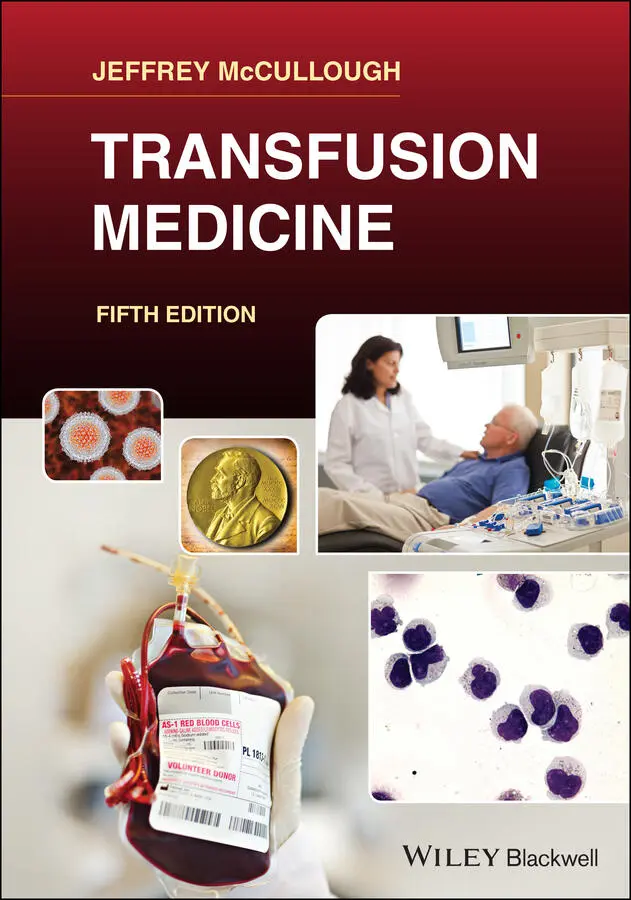
The Fifth Edition of
delivers a succinct, thorough, clinically focused, practical and authoritative treatment of a full range of topics in transfusion therapy. This ranges from issues with the blood supply, recruitment of both whole blood and apheresis donors, blood collection and storage, blood testing, blood safety, and transmissible diseases. This edition has been fully updated and revised to include exciting cellular therapies for cancer, transplantation of both hematopoietic cells and solid organs, infectious diseases and regenerative medicine.
The Fifth Edition includes new authors with highly relevant content that provides a solid grounding for readers in the field. The book:
Is an approachable comprehensive guide to the field of blood banking and transfusion medicine Provides complete and timely perspective on crucial topics, including the HLA system in transfusion medicine and transplantation and quality programs in blood banking and transfusion medicine Is extensively referenced, making it simple for readers to conduct further research on the topics of interest to them Includes new chapters on pediatric transfusion medicine and pathogen reduction Has an expended chapter on patient blood management Provides extensive discussions of the clinical use of blood transfusion in a wide variety of clinical situations including recent development In the management of acute traumatic blood loss Provides updated information about blood groups and molecular testing making inroads into clinical practice along with discussions of laboratory detection of blood groups and provision of red cells Perfect for all those working in the field of blood banking, transfusion medicine and hematology or oncology and fellows in pathology, hematology, surgery and anesthesiology.
is a good introduction for technologists specializing in blood banking and non-medical personnel working in areas related to hematology and transfusion medicine. Transfusion Medicine will also earn a place in the libraries of practicing pathologists with responsibility for blood banks.
Transfusion Medicine — читать онлайн ознакомительный отрывок
Ниже представлен текст книги, разбитый по страницам. Система сохранения места последней прочитанной страницы, позволяет с удобством читать онлайн бесплатно книгу «Transfusion Medicine», без необходимости каждый раз заново искать на чём Вы остановились. Поставьте закладку, и сможете в любой момент перейти на страницу, на которой закончили чтение.
Интервал:
Закладка:
Circulatory effects
Because the extracorporeal volume of the cytapheresis instruments is small (usually less than 200 mL), hypovolemia is rare and these donors do not experience circulatory problems. This becomes a more significant consideration in small donors (e.g., children) or donors with very low hemoglobin levels, populations who could be undergoing therapeutic procedures.
Air embolus
Because the blood is actively pumped into the donor’s veins, there is the theoretical possibility that air could be pumped into the donor if air enters the system. Some of the early models of apheresis instruments contained bubble chambers connected to a device that stopped the pumps if the chamber became filled with air. Air emboli have occurred but without reports of serious consequences. Contemporary instruments do not contain safety devices to prevent air embolus, and so this complication remains a concern. Staff members must be aware of this possibility and ensure that containers and tubing sets do not develop leaks that would allow air to enter the system.
Hematoma
Hematomas may develop after removal of the needles used for apheresis just as after whole blood donation. There is no reason that this should be a more or less frequent complication than following whole blood donation. However, because blood is returned to the donor by active pumping, if the needle becomes dislodged, the blood will continue to be injected into the antecubital fossa under pressure, and a substantial hematoma may develop quickly. The signs of this are pain, discoloration, or oozing at the venipuncture site. If this occurs, the blood flow is discontinued immediately, pressure is applied, and the hematoma is managed as described for whole blood donation.
Mechanical hemolysis
Because blood is pumped through tubing and centrifuges of various configurations, hemolysis is a theoretical complication due to constricted tubing or the geometry of the flow pathways. When this rare event occurs in practice, generally a defective collection kit is suspected [91, 92].
Platelet depletion or damage
Plateletpheresis does not damage the donor’s remaining platelets, and the donor’s platelet function is normal after donation [93]. Removal of platelets equivalent to several units of the donor’s blood does not result in thrombocytopenia. In a rather dramatic example, a female donor underwent 101 donations during a 33‐month period, with donation frequencies ranging from once to three times weekly [94]. Her platelet count remained in the range of 135,000–430,000 during this time. In donors who undergo repeated plateletpheresis, the platelet count decreases somewhat more, but then stabilizes [78, 95]. Thus, it appears that platelets can be donated safely approximately every 2–4 days if needed.
Lymphocyte depletion
Instruments and procedures have been improved to minimize the leukocyte content in the product, and thus also avoid potential complications of lymphocyte depletion in the donor. As a result, most plateletpheresis procedures today remove about 1 × 10 6to 5 × 10 7leukocytes. Loss of this number of leukocytes is very unlikely to lead to leukocyte depletion or any clinical effects on the donor’s immune function and has the advantage of producing a leukodepleted product. This is true even after serial collections completed in a relatively short period [96, 97]. However, in studies using the previously employed methods, significant lymphocyte depletion was observed together with decrease in total lymphocyte count and B and T cells, lower T4/T8 ratio, and reduced mitogen response [98–100]. Separate studies indicated that at least 10 9lymphocytes must be removed daily to observe a significant decline in lymphocyte count and at least 10 11lymphocytes total must be removed over a short time and/or the individual’s lymphocyte count must be less than 500/μL for clinical immunosuppression to occur [97, 101]. The most recent studies show that although there is variability in lymphocyte loss in serial donors with the two most common collection instruments, the loss does not appear to lead to any clinical predisposition to infection [102–104]. Although one study suggests a possible increased risk of immunosuppression related infections [105].
Complications unique to granulocyte donation
The complications related to leukapheresis itself are not different from those in plateletpheresis, but donors receive HES, corticosteroids, and possibly G‐CSF that can cause additional problems. Although there are only a few studies of side effects in frequent granulocyte donors [106], experience with stem cell donors has also provided information about side effects [107]. Short‐term effects of HES include rashes and fluid shifts, while the effects of corticosteroids and G‐CSF are also well known and are discussed in Chapter 6. Although there have been concerns about long‐term effects, such as cataracts [108, 109] or malignancy [110], in repeat donors, these have not been confirmed in studies.
Complications unique to plasmapheresis
One unexpected risk from plasmapheresis, especially when done frequently for therapeutic purposes, is the development of anemia, which is probably due to the blood samples used for laboratory testing [111].
Complications unique to mononuclear cell apheresis for collection of peripheral blood stem cells
Because of the low level of circulating PBSCs in normal donors, donors receive the hematopoietic growth factor G‐CSF to mobilize PBSCs and increase the yield. G‐CSF is also often used, sometimes in combination with glucocorticoids, to increase yields for granulocyte collections. G‐CSF, itself, is associated with a high frequency of side effects and is responsible for most of the complications of the donation of mononuclear cells as a source of PBSCs [107].
References
1 1. Fung MK, Eder AF, Spitalnik S, Westhoff CM, eds. Technical Manual, 19th edn. Arlington, VA: American Association of Blood Banks, 2017.
2 2. Custer B, Johnson ES, Sullivan SD, et al. Quantifying losses to the donated blood supply due to donor deferral and miscollection. Transfusion 2004; 44:1417–1426.
3 3. Whitaker BI, Rajbhandary S, Harris A. The 2013 National Blood Collection and Utilization Survey Report, Department of Health and Human Services. Conducted under contract (HHSP23320110008TC) with the American Association of Blood Banks, and using OMB Number 0990–0313. Bethesda, MD: AABB. Available from: https://www.aabb.org/research/hemovigilance/bloodsurvey/Documents/2013‐AABB‐Blood‐Survey‐Report.pdf. Published December 18, 2015.
4 4. Custer B, Schlumpf K, Simon TL, et al. Demographics of successful, unsuccessful and deferral visits at six blood centers over a four‐year period. Transfusion 2012; 52(4):712–721.
5 5. Riley W, Schwei M, McCullough J. The United States’ potential blood donor pool: estimating the prevalence of donor exclusion factors on the pool of potential donors. Transfusion 2007; 47:1180–1188.
6 6. Grossman BJ, Springer KM, Zuck TF. Blood donor deferral registries: highlights of a conference. Transfusion 1992; 32:868–872.
7 7. Simon TL, Rhyne RL, Wayne SJ, Garry PJ. Characteristics of elderly blood donors. Transfusion 1991; 31:693–697.
8 8. Pindyck J, Avorn J, Kuriyan M, et al. Blood donation by the elderly—clinical and policy considerations. JAMA 1987; 257:1186–1188.
9 9. Garry PJ, VanderJagt DJ, Wayne SJ, et al. A prospective study of blood donations in healthy elderly persons. Transfusion 1991; 31:686–692.
10 10. Goldman M, Uzicanin S, Osmond L, et al. A large national study of ferritin testing in Canadian blood donor. Transfusion 2017; 57:564–570.
Читать дальшеИнтервал:
Закладка:
Похожие книги на «Transfusion Medicine»
Представляем Вашему вниманию похожие книги на «Transfusion Medicine» списком для выбора. Мы отобрали схожую по названию и смыслу литературу в надежде предоставить читателям больше вариантов отыскать новые, интересные, ещё непрочитанные произведения.











Обсуждение, отзывы о книге «Transfusion Medicine» и просто собственные мнения читателей. Оставьте ваши комментарии, напишите, что Вы думаете о произведении, его смысле или главных героях. Укажите что конкретно понравилось, а что нет, и почему Вы так считаете.