Jeffrey McCullough - Transfusion Medicine
Здесь есть возможность читать онлайн «Jeffrey McCullough - Transfusion Medicine» — ознакомительный отрывок электронной книги совершенно бесплатно, а после прочтения отрывка купить полную версию. В некоторых случаях можно слушать аудио, скачать через торрент в формате fb2 и присутствует краткое содержание. Жанр: unrecognised, на английском языке. Описание произведения, (предисловие) а так же отзывы посетителей доступны на портале библиотеки ЛибКат.
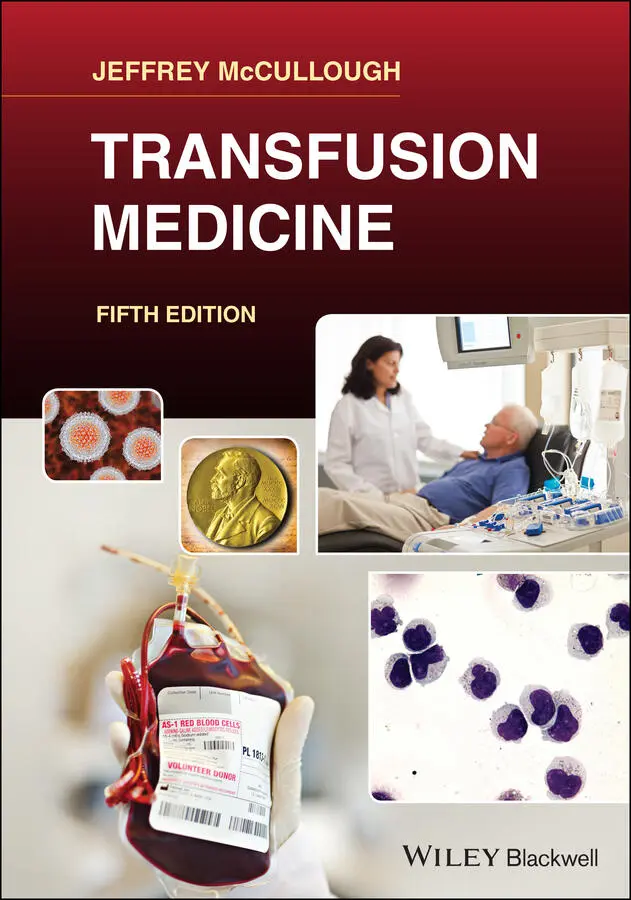
- Название:Transfusion Medicine
- Автор:
- Жанр:
- Год:неизвестен
- ISBN:нет данных
- Рейтинг книги:3 / 5. Голосов: 1
-
Избранное:Добавить в избранное
- Отзывы:
-
Ваша оценка:
Transfusion Medicine: краткое содержание, описание и аннотация
Предлагаем к чтению аннотацию, описание, краткое содержание или предисловие (зависит от того, что написал сам автор книги «Transfusion Medicine»). Если вы не нашли необходимую информацию о книге — напишите в комментариях, мы постараемся отыскать её.
The Fifth Edition of
delivers a succinct, thorough, clinically focused, practical and authoritative treatment of a full range of topics in transfusion therapy. This ranges from issues with the blood supply, recruitment of both whole blood and apheresis donors, blood collection and storage, blood testing, blood safety, and transmissible diseases. This edition has been fully updated and revised to include exciting cellular therapies for cancer, transplantation of both hematopoietic cells and solid organs, infectious diseases and regenerative medicine.
The Fifth Edition includes new authors with highly relevant content that provides a solid grounding for readers in the field. The book:
Is an approachable comprehensive guide to the field of blood banking and transfusion medicine Provides complete and timely perspective on crucial topics, including the HLA system in transfusion medicine and transplantation and quality programs in blood banking and transfusion medicine Is extensively referenced, making it simple for readers to conduct further research on the topics of interest to them Includes new chapters on pediatric transfusion medicine and pathogen reduction Has an expended chapter on patient blood management Provides extensive discussions of the clinical use of blood transfusion in a wide variety of clinical situations including recent development In the management of acute traumatic blood loss Provides updated information about blood groups and molecular testing making inroads into clinical practice along with discussions of laboratory detection of blood groups and provision of red cells Perfect for all those working in the field of blood banking, transfusion medicine and hematology or oncology and fellows in pathology, hematology, surgery and anesthesiology.
is a good introduction for technologists specializing in blood banking and non-medical personnel working in areas related to hematology and transfusion medicine. Transfusion Medicine will also earn a place in the libraries of practicing pathologists with responsibility for blood banks.
Transfusion Medicine — читать онлайн ознакомительный отрывок
Ниже представлен текст книги, разбитый по страницам. Система сохранения места последней прочитанной страницы, позволяет с удобством читать онлайн бесплатно книгу «Transfusion Medicine», без необходимости каждый раз заново искать на чём Вы остановились. Поставьте закладку, и сможете в любой момент перейти на страницу, на которой закончили чтение.
Интервал:
Закладка:
106 106. Strauss RG, Goeken JA, Eckermann I, et al. Effects of intensive granulocyte donation on donors and yields. Transfusion 1986; 26:441–445.
107 107. Pulsipher MA, Chitphakdithai P, Miller JP, et al. Adverse events among 2408 unrelated donors of peripheral blood stem cells: results of a prospective trial from the National Marrow Donor Program. Blood 2009; 113(15):3604–3611.
108 108. Ghodsi Z, Strauss RG. Cataracts in neutrophil donors stimulated with adrenal corticosteroids. Transfusion 2001; 41:1464–1468.
109 109. Burch JW, Mair DC, Meny GM, et al. The risk of posterior subcapsular cataracts in granulocyte donors. Transfusion 2005; 45:1701–1708.
110 110. Shaw B, Confer D, Hwang W, et al. A review of the genetic and long‐term effects of G‐CSF injections in healthy donors: a reassuring lack of evidence for the development of haematological malignancies. Bone Marrow Transplant 2015; 50:334–340.
111 111. Bier‐Ulrich AM, Haubelt H, Anders C, et al. The impact of intensive serial plasmapheresis and iron supplementation on iron metabolism and Hb concentration in menstruating women: a prospective randomized placebo‐controlled double‐blind study. Transfusion 2003; 43:405–410.
5 Preparation, Storage, and Characteristics of Whole Blood, Blood Components, and Plasma Derivatives
Alesia Kaplan MD
Whole blood (WB) transfusion was a standard of care for military and civilian settings during the period between World War I and World War II. When the technology to manufacture the components became available and the need for transfusion component therapy grew with advancement of medicine, WB fell out of favor. WB had a limited use and mainly was used only for pediatric cardiothoracic surgery patients in the United States until recently [1–3]. In the past decade, a renewed interest in WB has emerged. This is due to a published military experience that showed successful use of blood products, including low titer O whole blood (LTOWB), for prehospital resuscitation [4, 5]. Military success was adapted for civilian trauma patients with severe, life‐threatening hemorrhage in prehospital and hospital settings. Retrospective data from military and civilian trauma patients indicates that LTOWB transfusion is associated with improved or noninferior survival compared with resuscitation with blood components [4–8]. Although secondary analysis of the prehospital air medical plasma trial showed that patients receiving red blood cells (RBCs) + plasma had the greatest mortality benefit [6], a prospective, randomized, controlled trial comparing mortality between LTOWB and standard therapy (1:1:1 component therapy) during air medical transport and through the early in‐hospital phase of care is being conducted [9]. Several authors pointed out that use of LTOWB in severely bleeding patients is associated with biological and logistical advantages ( Table 5.1) [10–12]. WB has less anticoagulant preservative solution and higher hematocrit, number of platelets, and coagulation factors compared with a reconstituted unit of WB with three components (RBC, platelets, and plasma). Also, it provides more effective oxygen‐carrying capacity [10–12]. In addition, studies showed that WB stored at cold temperatures (1–6°C) has functional platelets that provide improved hemostasis [2, 13]. Logistically, WB simplifies resuscitation and accelerates the provision of all blood components needed for patients with severe hemorrhage. The future application of LTOWB in different phases of care and clinical indications are still being explored.
Interestingly, in less developed parts of the world, WB is usually used and not blood components because equipment to produce components may not be available. However, in these situations, given the kind of patients being transfused, WB may be the best use of limited blood transfusion resources. In addition, the use of rapid tests for human immunodeficiency virus (HIV), hepatitis C virus, hepatitis B virus, and syphilis make fresh WB available in those situations. Additional information on the current use of WB for transfusion is available in Chapter 11.
Table 5.1 Some advantages and disadvantages of whole blood versus blood component therapy used primarily for hemorrhagic shock resuscitation.
| Whole blood | Component therapy |
|---|---|
| Advantages:Easy preparation, no additional separation is required byblood centerEasy to transport and store (room temperature or 1–6°C)Improved efficiency in preparation for issuing (no thawing plasma)Easy to administer during resuscitation (single product)Ensures 1:1:1 ratioHigher hematocrit, number of platelets, and coagulationfactors in WB unit compared with a reconstitutedunit of WBLess donor exposureLess anticoagulant‐preservative solution Disadvantages:Cannot be administered to patients with specifictransfusion requirements (e.g., low hemoglobin or lowplatelet count only)Requires maintaining dual inventoryNeed to titer anti‐A and anti‐B | Advantages:Blood components are provided for isolated deficit (e.g., RBC for anemia, platelets for thrombocytopenia)Provides blood components that can be used to supplement WB massive transfusion (e.g., cryoprecipitate, platelets)Provides some flexibility (can use O group RBC and A plasma)Guided by TEG and laboratory data, 1:1:1 ratio can be altered to meet needs of patientsProvides plasma for fractionation for manufacturing plasma concentrates Disadvantages:WB requires a separation step into componentsEach component requires different temperatures and conditions for transport and storage, and because of that a potential for a higher wastage1:1:1 ratio needs to be met during resuscitationDifficult to transport and provide needed ratio in the prehospital settingReconstituted WB yields lower hematocrit and less platelets and coagulation factorsMore donor exposureMore anticoagulant‐preservative solution and citrate toxicity |
RBC, red blood cell; TEG, thromboelastography; WB, whole blood.
Despite growing use of WB in patients with severe hemorrhage, the majority of WB collected in the United States is separated into its components, and each component is stored under conditions optimal for that component. This makes it possible to retain all of the activities of the original unit of WB and results in a large number of different components being available for transfusion therapy ( Tables 5.2and 5.3).
This chapter describes the characteristics of blood products, their preparation, and storage. Clinical uses are described in Chapters 10and 11.
5.1 Whole blood preparation and storage
WB can be collected in 450‐ and 500‐mL bags that contain citrate–phosphate–dextrose (CPD), citrate–phosphate–double dextrose (CP2D), or citrate–phosphate–dextrose adenin‐1 (CPDA‐1). WB collected in CPD and CP2D is stored for 21 days, and blood collected in CPDA‐1 is stored for 35 days at 1–6°C. No additional manufacturing step is required prior to issuing of WB. WB can be leukoreduced. There is one platelet‐sparing leukoreduction filter available in the United States (Imuflex WB‐SP, Terumo BCT). In the military, warm fresh WB is used. It is collected and stored at 22°C up to 24 hours. It can be stored at 1–6°C up to 48 hours (cold fresh WB). It is not approved by the US Food and Drug Administration (FDA) in the civilian setting because the results of infectious disease testing are not available at the time of transfusion. To mitigate risks of transfusion‐transmitted infectious diseases, military personal is tested prior to deployment and every 90 days during their deployment.
Table 5.2 Components produced by blood banks and the medical use of these components.
| Component | Medical use |
|---|---|
| Red blood cells | Oxygenation of tissues |
| Platelets | Prevention or cessation of bleeding |
| Fresh frozen plasma | Prevention and cessation of bleeding, plasma exchange, reversal of vitamin K antagonist if prothrombin complex concentrate is not available |
| Cryoprecipitate | Cessation of bleeding |
| Cryoprecipitate‐poor plasma | Plasma exchange |
| Granulocytes | Treatment of infection |
| Frozen red blood cells | Storage of rare blood |
| Leukocyte‐depleted red cells | Prevention of febrile non‐hemolytic transfusion reactions, prevention of certain diseases (e.g., CMV) and decrease in HLA alloimmunization |
CMV, cytomegalovirus; HLA, human leukocyte antigen.
Читать дальшеИнтервал:
Закладка:
Похожие книги на «Transfusion Medicine»
Представляем Вашему вниманию похожие книги на «Transfusion Medicine» списком для выбора. Мы отобрали схожую по названию и смыслу литературу в надежде предоставить читателям больше вариантов отыскать новые, интересные, ещё непрочитанные произведения.







Обсуждение, отзывы о книге «Transfusion Medicine» и просто собственные мнения читателей. Оставьте ваши комментарии, напишите, что Вы думаете о произведении, его смысле или главных героях. Укажите что конкретно понравилось, а что нет, и почему Вы так считаете.