Jeffrey McCullough - Transfusion Medicine
Здесь есть возможность читать онлайн «Jeffrey McCullough - Transfusion Medicine» — ознакомительный отрывок электронной книги совершенно бесплатно, а после прочтения отрывка купить полную версию. В некоторых случаях можно слушать аудио, скачать через торрент в формате fb2 и присутствует краткое содержание. Жанр: unrecognised, на английском языке. Описание произведения, (предисловие) а так же отзывы посетителей доступны на портале библиотеки ЛибКат.
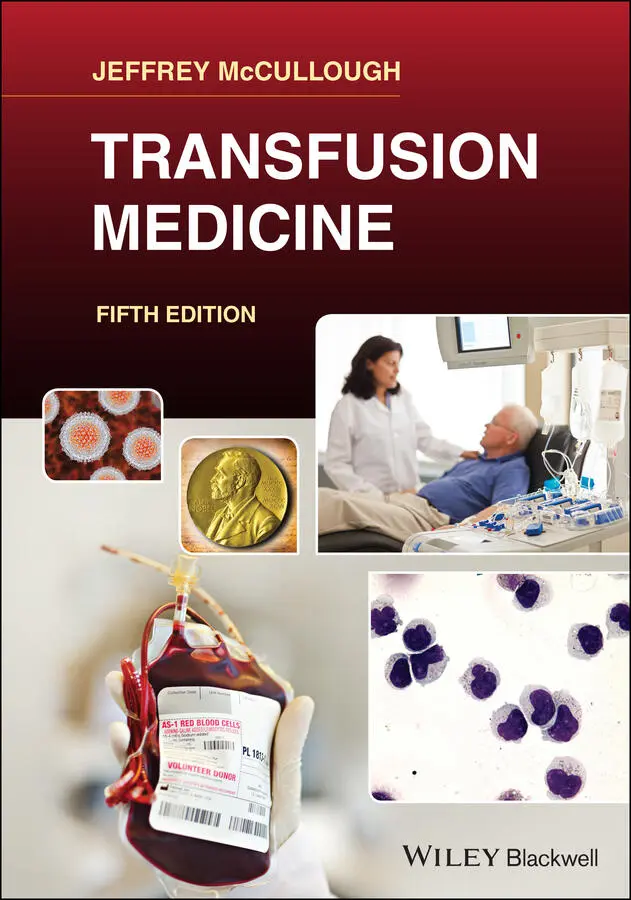
- Название:Transfusion Medicine
- Автор:
- Жанр:
- Год:неизвестен
- ISBN:нет данных
- Рейтинг книги:3 / 5. Голосов: 1
-
Избранное:Добавить в избранное
- Отзывы:
-
Ваша оценка:
Transfusion Medicine: краткое содержание, описание и аннотация
Предлагаем к чтению аннотацию, описание, краткое содержание или предисловие (зависит от того, что написал сам автор книги «Transfusion Medicine»). Если вы не нашли необходимую информацию о книге — напишите в комментариях, мы постараемся отыскать её.
The Fifth Edition of
delivers a succinct, thorough, clinically focused, practical and authoritative treatment of a full range of topics in transfusion therapy. This ranges from issues with the blood supply, recruitment of both whole blood and apheresis donors, blood collection and storage, blood testing, blood safety, and transmissible diseases. This edition has been fully updated and revised to include exciting cellular therapies for cancer, transplantation of both hematopoietic cells and solid organs, infectious diseases and regenerative medicine.
The Fifth Edition includes new authors with highly relevant content that provides a solid grounding for readers in the field. The book:
Is an approachable comprehensive guide to the field of blood banking and transfusion medicine Provides complete and timely perspective on crucial topics, including the HLA system in transfusion medicine and transplantation and quality programs in blood banking and transfusion medicine Is extensively referenced, making it simple for readers to conduct further research on the topics of interest to them Includes new chapters on pediatric transfusion medicine and pathogen reduction Has an expended chapter on patient blood management Provides extensive discussions of the clinical use of blood transfusion in a wide variety of clinical situations including recent development In the management of acute traumatic blood loss Provides updated information about blood groups and molecular testing making inroads into clinical practice along with discussions of laboratory detection of blood groups and provision of red cells Perfect for all those working in the field of blood banking, transfusion medicine and hematology or oncology and fellows in pathology, hematology, surgery and anesthesiology.
is a good introduction for technologists specializing in blood banking and non-medical personnel working in areas related to hematology and transfusion medicine. Transfusion Medicine will also earn a place in the libraries of practicing pathologists with responsibility for blood banks.
Transfusion Medicine — читать онлайн ознакомительный отрывок
Ниже представлен текст книги, разбитый по страницам. Система сохранения места последней прочитанной страницы, позволяет с удобством читать онлайн бесплатно книгу «Transfusion Medicine», без необходимости каждый раз заново искать на чём Вы остановились. Поставьте закладку, и сможете в любой момент перейти на страницу, на которой закончили чтение.
Интервал:
Закладка:
A major factor influencing whether blood donors will make subsequent donations is their experience at each donation. Thus, it is important that the blood collection staff provide a warm, friendly, professional, and efficient environment in which the medical assessment and blood donation can take place.
Registration
When the donor initially presents at the donation site, identifying information is obtained for the permanent record. This includes name, address, telephone number, birth date, social security number (if allowed in that state), and previous donation history, including any names under which previous donations might have been made. To prevent iron depletion, individuals may donate a red cell unit no more often than every 56 days, or 112 days if they are giving a double unit by automated collection. At the time of registration, the prospective donor is given information about blood donation, transmissible disease testing, and factors or behaviors that would preclude blood donation. Information may also describe the agencies that are notified in the event of a positive test result for a transmissible disease. In obtaining the medical history, a staff member asks or reviews donor responses to questions about these factors. Either at the time of registration or before the blood unit is made available for distribution, the identity of each donor must be checked against a registry of individuals known to be unacceptable as blood donors [6]. Although this process is required by the FDA and is widely used throughout the United States, there has never been a thorough study to establish its value, and some registries do not share information that could limit effectiveness.
Table 4.1 Strategies for collecting safe blood.
| Using only volunteer blood donors |
| Questioning donors about their general health before their donation is scheduled |
| Obtaining a medical history before donation |
| Carrying out a physical examination before donation |
| Carrying out laboratory testing of donated blood |
| Checking the donor’s identity against a registry of previously deferred donors |
| Providing a postdonation method for the donor to confidentially designate the unit as unsuitable |
| Providing convenient means for the donor to give postdonation health information that could impact blood safety |
There is no standard maximum age for blood donation. Most blood centers do not have a specific upper age limit and instead evaluate each donor individually. Elderly donors have more medical conditions and medications than younger donors, but they do not experience more adverse reactions to donation [7, 8]. Elderly donors have slightly decreased iron stores, especially if they have been regular donors [9–11], but they can safely contribute to the nation’s blood supply [12]. Although 18 years is typically the age at which individuals can take responsibility for their own actions, the lower age limit for blood donation is usually 17 years, and most states have passed laws that also allow donation of whole blood at the age of 16 with parental consent. These special laws dealing with blood donation enable high school students to donate. However, donor safety concerns regarding possible health effects of iron depletion in this age group have led some blood centers to self‐regulatory steps, such as longer minimal donation intervals (e.g., no more than two times per year) and prohibiting automated collection of double red cell units in females younger than 19 years [13].
Obtaining medical history
The medical history is an extremely important part of the selection of donors because it can reveal reasons why donation might not be wise for the donor or reasons why the donor’s blood might pose increased risk for the patient. Because most blood organizations now use the computerized self‐administered history, the interview usually takes less than 10 minutes. Many blood organizations provide the opportunity for the donor to do this online in advance. In addition to obtaining responses to these specific questions ( Table 4.2), the interviewer attempts to assess whether the donor is in good general health, is not under the influence of drugs, and is able to give informed consent for the donation. The interview must occur in a setting that provides privacy for the donor. Although complete visual privacy is not always possible, visual distractions should be minimized, and the donor’s answers must not be audible to others. The interviewer reviews the response in the computer‐assisted donor history and then asks specific questions. The varied levels of computer‐assisted donor screening seem to be acceptable to donors and may decrease errors [14].
An interagency task force developed a standard donor history questionnaire (DHQ) that is approved by the FDA ( https://www.fda.gov/vaccines‐blood‐biologics/guidance‐compliance‐regulatory‐information‐biologics/biologics‐guidances) and is used as a template by most blood banks. There is supplemental material for the DHQ regarding responses to each question, together with a flow chart defining need for and duration of deferral ( http://www.aabb.org/tm/questionnaires/Documents/dhq/v2‐1/DHQ‐v2‐1‐Implementation‐Toolkit.pdf). The DHQ can be self‐administered by the donor or combined with direct questioning and is easily put in a computer‐assisted format. The questions designed to protect the safety of the donor include those regarding medications and whether the donor has a history of heart or lung disease, present or recent pregnancy, recent donation of blood or plasma, or bleeding condition. Questions pertaining to recipient safety include inquiry to the donor’s general health; the presence of a bleeding disorder, Chagas’ disease (although the question is not helpful) [15], or babesiosis; the injection of drugs; blood transfusion; tattoo or ear or body piercing; organ or tissue transplant; travel to areas endemic for malaria, Ebola, or Zika; recent immunizations; contact with persons with hepatitis or other transmissible diseases; ingestion of medications, especially aspirin; or previous notice of a positive test for human immunodeficiency virus/acquired immune deficiency virus (HIV/AIDS).
Individuals who have spent more than 3 months in the United Kingdom from 1980 to 1996 are deferred because of possible exposure to the causative agent of variant Creutzfeldt–Jakob disease, as are those who have spent 5 or more years in selected European countries. Based on studies in the United States and Canada, which have modified restrictions, 1–2% donor loss has been estimated because some form of this question has been included on the questionnaire [16–18].
Table 4.2 Complete list of medical history questions for blood donors.
Source : Fung MK, Eder AF, Spitalnik S, Westhoff CM, eds. Technical Manual, 19th edn. Arlington, VA: American Association of Blood Banks, 2017.
| Are you |
| Feeling healthy and well today? |
| Currently taking an antibiotic? |
| Currently taking any other medication for an infection? |
| Please read the Medication Deferral List |
| Have you taken any medications on the Medication Deferral List in the time frames indicated? (Review the Medication Deferral List.) |
| Have you read the educational materials today? |
| In the past 48 hours, |
| Have you taken aspirin or anything that has aspirin in it? |
| Female donors: Have you been pregnant or are you pregnant now? (Males: check “I am male”) |
| In the past 8 weeks, have you |
| Donated blood, platelets, or plasma? |
| Had any vaccinations or other shots? |
| Had contact with someone who was vaccinated for smallpox in the past 8 weeks? |
| In the past 16 weeks, have you |
| Have you donated a double unit of red cells using an apheresis machine? |
| In the past 12 months, have you |
| Had a blood transfusion? |
| Had a transplant such as organ, tissue, or bone marrow? |
| Had a graft such as bone or skin? |
| Come into contact with someone else’s blood? |
| Had an accidental needle‐stick? |
| Had sexual contact with anyone who has HIV/AIDS or has had a positive test for the HIV/AIDS virus? |
| Had sexual contact with a prostitute or anyone else who takes money or drugs or other payment for sex? |
| Had sexual contact with anyone who has ever used needles to take drugs or steroids, or anything not prescribed by their doctor? |
| Male donors: Had sexual contact with another male? |
| Female donors: Had sexual contact with a male who had sexual contact with another male in the past 12 months? |
| Had sexual contact with a person who has hepatitis? |
| Lived with a person who has hepatitis? |
| Had a tattoo? |
| Had ear or body piercing? |
| Had or been treated for syphilis or gonorrhea? |
| Been in juvenile detention, lockup, jail, or prison for more than 72 consecutive hours? |
| In the past 3 years, have you |
| Been outside the United States or Canada? |
| From 1980 through 1996 |
| Did you spend time that adds up to 3 months or more in the United Kingdom? (Review list of countries in the UK) |
| Were you a member of the U.S. military, a civilian military employee, or a dependent of a member of the U.S. military? |
| From 1980 to the present, did you |
| Spend time that adds up to 5 years or more in Europe? (Review list of countries in Europe.) |
| Receive a blood transfusion in the United Kingdom or France? (Review country lists.) |
| Have you ever |
| Female donors: Been pregnant or are you pregnant now? |
| Had a positive test for the HIV/AIDS virus? |
| Used needles to take drugs, steroids, or anything not prescribed by your doctor? |
| Received money, drugs, or other payment for sex? |
| Had malaria? |
| Had Chagas’ disease? |
| Had babesiosis? |
| Received a dura mater (or brain covering) graft or xenotransplantation product? |
| Had any type of cancer, including leukemia? |
| Had any problems with your heart or lungs? |
| Had a bleeding condition or a blood disease? |
| Have any of your relatives had Creutzfeldt–Jakob disease? |
Potential donors who have resided in or traveled to malaria‐endemic areas are deferred for 12 months. However, most transfusion‐transmitted malaria is associated with lengthy residence in malaria‐endemic areas rather than routine or short‐term travel, especially when short‐term travel is concentrated in tourist areas that may have little or no risk [19].
Читать дальшеИнтервал:
Закладка:
Похожие книги на «Transfusion Medicine»
Представляем Вашему вниманию похожие книги на «Transfusion Medicine» списком для выбора. Мы отобрали схожую по названию и смыслу литературу в надежде предоставить читателям больше вариантов отыскать новые, интересные, ещё непрочитанные произведения.









Обсуждение, отзывы о книге «Transfusion Medicine» и просто собственные мнения читателей. Оставьте ваши комментарии, напишите, что Вы думаете о произведении, его смысле или главных героях. Укажите что конкретно понравилось, а что нет, и почему Вы так считаете.