Jeffrey McCullough - Transfusion Medicine
Здесь есть возможность читать онлайн «Jeffrey McCullough - Transfusion Medicine» — ознакомительный отрывок электронной книги совершенно бесплатно, а после прочтения отрывка купить полную версию. В некоторых случаях можно слушать аудио, скачать через торрент в формате fb2 и присутствует краткое содержание. Жанр: unrecognised, на английском языке. Описание произведения, (предисловие) а так же отзывы посетителей доступны на портале библиотеки ЛибКат.
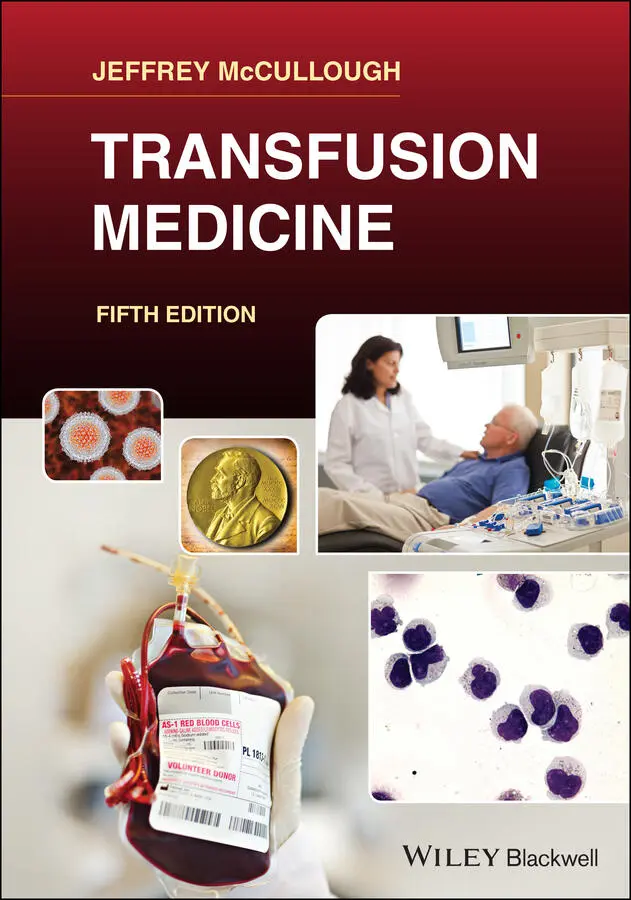
- Название:Transfusion Medicine
- Автор:
- Жанр:
- Год:неизвестен
- ISBN:нет данных
- Рейтинг книги:3 / 5. Голосов: 1
-
Избранное:Добавить в избранное
- Отзывы:
-
Ваша оценка:
Transfusion Medicine: краткое содержание, описание и аннотация
Предлагаем к чтению аннотацию, описание, краткое содержание или предисловие (зависит от того, что написал сам автор книги «Transfusion Medicine»). Если вы не нашли необходимую информацию о книге — напишите в комментариях, мы постараемся отыскать её.
The Fifth Edition of
delivers a succinct, thorough, clinically focused, practical and authoritative treatment of a full range of topics in transfusion therapy. This ranges from issues with the blood supply, recruitment of both whole blood and apheresis donors, blood collection and storage, blood testing, blood safety, and transmissible diseases. This edition has been fully updated and revised to include exciting cellular therapies for cancer, transplantation of both hematopoietic cells and solid organs, infectious diseases and regenerative medicine.
The Fifth Edition includes new authors with highly relevant content that provides a solid grounding for readers in the field. The book:
Is an approachable comprehensive guide to the field of blood banking and transfusion medicine Provides complete and timely perspective on crucial topics, including the HLA system in transfusion medicine and transplantation and quality programs in blood banking and transfusion medicine Is extensively referenced, making it simple for readers to conduct further research on the topics of interest to them Includes new chapters on pediatric transfusion medicine and pathogen reduction Has an expended chapter on patient blood management Provides extensive discussions of the clinical use of blood transfusion in a wide variety of clinical situations including recent development In the management of acute traumatic blood loss Provides updated information about blood groups and molecular testing making inroads into clinical practice along with discussions of laboratory detection of blood groups and provision of red cells Perfect for all those working in the field of blood banking, transfusion medicine and hematology or oncology and fellows in pathology, hematology, surgery and anesthesiology.
is a good introduction for technologists specializing in blood banking and non-medical personnel working in areas related to hematology and transfusion medicine. Transfusion Medicine will also earn a place in the libraries of practicing pathologists with responsibility for blood banks.
Transfusion Medicine — читать онлайн ознакомительный отрывок
Ниже представлен текст книги, разбитый по страницам. Система сохранения места последней прочитанной страницы, позволяет с удобством читать онлайн бесплатно книгу «Transfusion Medicine», без необходимости каждый раз заново искать на чём Вы остановились. Поставьте закладку, и сможете в любой момент перейти на страницу, на которой закончили чтение.
Интервал:
Закладка:
Low or absent iron stores occur in a significant percentage of frequent blood donors. Suggested approaches include further restrictions on the frequency of blood donation and/or providing iron supplementation. There is no uniform approach to donors deferred because of low hemoglobin. Approaches have included temporary deferral for 6 months, 3 days to 3 months, or variable length of deferral depending on the hemoglobin. There are no standard recommendations regarding serum ferritin testing and whether to provide iron supplementation or merely recommend this to the donors [39, 40]. Some blood centers have implemented programs to perform ferritin testing, which is considered a more reliable indication of iron status. These programs often focus on young donors, especially females who may be most susceptible to the effects of iron depletion [41, 42]. Two studies [43, 44] support the value of iron therapy in women without anemia.
Even in the absence of anemia, iron deficiency can have clinical effects, such as fatigue, decreased exercise capacity, and cognitive performance [45]. Strategies ranging from physician referral to providing educational material or even providing iron supplements have been tried, but no standard approach is in wide use. This has been an issue for years and could have major implications for donor availability [38, 39, 45].
Special blood donations
There are several situations involving blood donation in which the blood may be collected by the donor center but will not be used as part of the community’s general blood supply. Examples of these include autologous donation, directed donation, patient‐specific donation, and therapeutic bleeding. In some of these situations, the FDA requirements for blood donation may not apply. However, if directed donations are not needed by the designated patient and would otherwise meet criteria for general blood supply use, it is possible for a hospital to make these units available for others to use.
4.3 Collection of whole blood
The time during blood collection is another opportunity for the blood center staff to interact with the donor, to reinforce their professionalism, and to provide conditions that increase donor willingness to return for subsequent donations. In a way this becomes the first step in the recruitment of the donor for the next donation (see Chapter 3).
Labeling
The first step in the collection process is labeling of all containers, tubes, and related materials. This is an extremely important step because it relates all tubes, specimens, documents, and components to the identity of the donor. Virtually all blood banks use bar‐coded labels that are intended to meet international industry standards for labeling (ISBT 128) consistent with FDA and AABB requirements [46]. Related tracking of specimens, test results, and individual components can be managed by computers using these labels. Computer systems are generally used to accumulate all data relevant to the individual donation to determine whether the components are suitable for transfusion and can be released into usable inventory. Thus, there are detailed and specific steps in the process at the donor bedside to ensure the accuracy of all labels.
Blood bags
Blood must be collected into FDA‐licensed containers, each of which is sterile and can be used only once. The containers are made of plasticized material that is biocompatible with blood cells and allows diffusion of gases to provide optimal cell preservation (see Chapter 5). These blood containers are combinations of multiple bags connected by tubing so that components can be transferred between bags without being exposed to air. This is referred to as a “closed system.” This system of separation of the whole blood into its components in a closed system thus minimizes the chance of bacterial contamination while making it possible to store each component under the conditions and length of time that are optimum for that component. Because some bacteria can enter the blood bag from skin at the venipuncture, most blood collection sets now contain a small pouch for diversion of the first few milliliters of blood, which is used for many standard tests. Diversion of the first few milliliters of blood collected can reduce the bacterial contamination rate from 46% to 71% [47, 48].
Anticoagulant preservative solutions
Several anticoagulant preservative solutions are available. The anticoagulants are various formulas of citrate solutions. The blood may be stored in these solutions and used for transfusion, or most of the supernatant may be removed and the cells stored in other “additive” solutions. The composition and effects of these anticoagulant and preservative solutions are discussed more completely in Chapter 5.
Selection of the vein and preparation of the venipuncture site
Blood is drawn from a vein in the antecubital fossa. The vein selected should be large enough to accommodate approximately a 16‐gauge needle. Careful selection of the vein makes the venipuncture quick and easy, thus providing good blood flow and a quality component but also minimizing the discomfort to the donor and making the donation experience as pleasant as possible. The choice of the vein will also minimize the likelihood of inadvertently damaging a nerve or puncturing an artery (see the later Adverse Reactions section). A blood pressure cuff is usually used to impede venous return and distend the vein.
To minimize the chance of bacterial contamination, the blood must be drawn from an area free of skin lesions, and the phlebotomy site must be properly cleansed ( Table 4.3). It is not possible to sterilize the skin, but steps are taken to greatly reduce the level of skin flora. A one‐step skin preparation using a chlorohexidine solution in 70% isopropanol is now recommended. Alternatively, a two‐step prep—scrubbing with a soap solution, followed by tincture of iodine or iodophor complex solution—may be used [1, 49, 50]. Preference for the prep method is often dependent on any history of donor allergies or previous reactions to the scrub. The selection of the venipuncture site and its sterilization are very important steps, because bacterial contamination of blood can be a serious, even fatal complication of transfusion (see Chapter 16).
Table 4.3 General procedure: donor arm preparation for blood collection.
Source : World Health Organization. WHO Guidelines on Drawing Blood: Best Practices in Phlebotomy . Geneva: World Health Organization, 2010. © 2010 World Health Organization.
| Apply tourniquet or blood pressure cuff. Identify venipuncture site; then release tourniquet or cuff.Use a product combining 2% chlorhexidine gluconate in 70% isopropyl alcohol. Cover the whole area and ensure that the skin area is in contact with the disinfectant for at least 30 seconds.Allow the area to dry completely, or for a minimum of 30 seconds by the clock or as directed by the manufacturer.Whichever procedure is used, DO NOT touch the venipuncture site once the skin has been disinfected. |
Venipuncture
Most blood collection equipment uses 16‐ or 17‐gauge needles, and the entire set is closed and connected so that the needle is integral. The venipuncture is done with a needle that can be used only once to avoid contamination. The phlebotomist must be aware of the needle placement to minimize the likelihood of puncturing a nerve or artery.
Blood collection
Usually the blood container is placed on a scale, which may have a device to cut off the flow when the container reaches a set weight indicating that the desired volume of blood has been collected. The blood must flow freely and be mixed with anticoagulant frequently as it fills the container to avoid the development of small clots. Blood banks often use mechanical devices that continuously mix the blood and anticoagulant during phlebotomy. No more than 15% of the donor’s estimated blood volume should be collected, and the limit of 10.5 mL/kg body weight [1] is intended to meet this limit. In addition, the volume of blood in the container should be between 405 and 550 mL (i.e., 450 or 500 mL ± 10%). Thus, including specimens for testing, the amount of blood drawn could total 575 mL. Units containing 300–404 mL can be used for transfusion but must be labeled as low‐volume units. The amount of blood withdrawn must be within prescribed limits to be in the proper ratio with the anticoagulant, otherwise the blood cells may be damaged or anticoagulation may not be satisfactory (see Chapter 5).
Читать дальшеИнтервал:
Закладка:
Похожие книги на «Transfusion Medicine»
Представляем Вашему вниманию похожие книги на «Transfusion Medicine» списком для выбора. Мы отобрали схожую по названию и смыслу литературу в надежде предоставить читателям больше вариантов отыскать новые, интересные, ещё непрочитанные произведения.










Обсуждение, отзывы о книге «Transfusion Medicine» и просто собственные мнения читателей. Оставьте ваши комментарии, напишите, что Вы думаете о произведении, его смысле или главных героях. Укажите что конкретно понравилось, а что нет, и почему Вы так считаете.