Cameron M. Smith - Anthropology For Dummies
Здесь есть возможность читать онлайн «Cameron M. Smith - Anthropology For Dummies» — ознакомительный отрывок электронной книги совершенно бесплатно, а после прочтения отрывка купить полную версию. В некоторых случаях можно слушать аудио, скачать через торрент в формате fb2 и присутствует краткое содержание. Жанр: unrecognised, на английском языке. Описание произведения, (предисловие) а так же отзывы посетителей доступны на портале библиотеки ЛибКат.
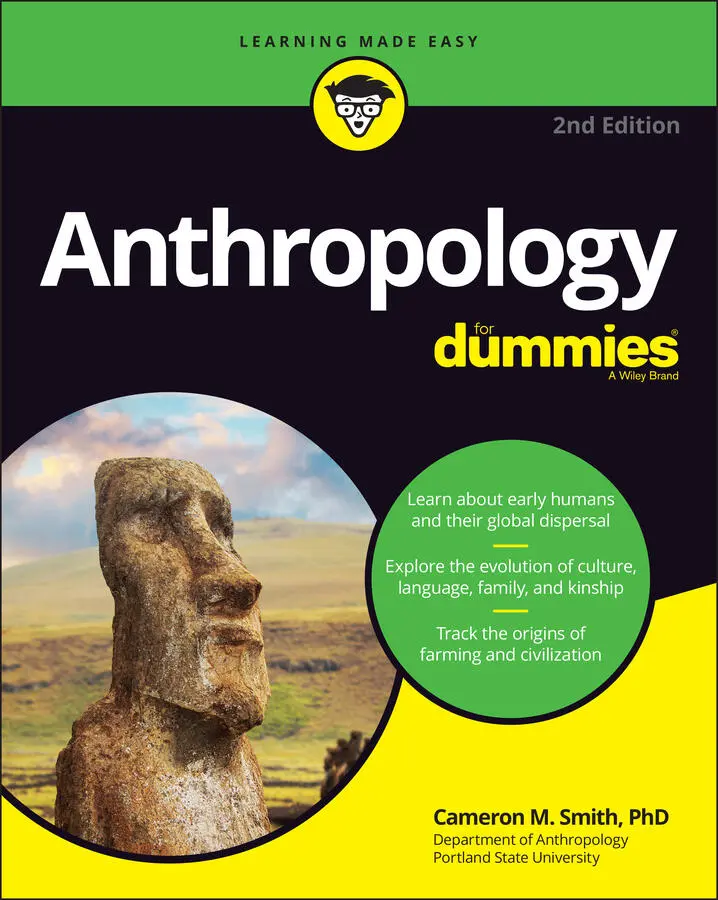
- Название:Anthropology For Dummies
- Автор:
- Жанр:
- Год:неизвестен
- ISBN:нет данных
- Рейтинг книги:5 / 5. Голосов: 1
-
Избранное:Добавить в избранное
- Отзывы:
-
Ваша оценка:
Anthropology For Dummies: краткое содержание, описание и аннотация
Предлагаем к чтению аннотацию, описание, краткое содержание или предисловие (зависит от того, что написал сам автор книги «Anthropology For Dummies»). Если вы не нашли необходимую информацию о книге — напишите в комментариях, мы постараемся отыскать её.
gives you a panoramic view of the fascinating fieldwork and theory that seeks to answer these questions—and helps you view the human world through impartial, anthropological eyes.
Keeping the jargon to a minimum,
explores the four main subdivisions of the discipline, from the adventurous Indiana Jones territory of archaeology and the hands-on biological insights provided by our physical nature to the studious book-cracking brainwork of cultural and linguistic investigation. Along the way, you’ll journey deep into our prehistory where we begin to differentiate ourselves from our primate relatives—and then fast forward into the possibilities of centuries yet to come.
Explore the history of anthropology and apply its methods Get a deep, scientific take on contemporary debates such as identity Excavate the human past through new fossil discoveries Peer into humanity’s future in space Whether you’re studying anthropology for school or just want to know more about what makes us humans who we are, this is the perfect introduction to humanity’s past and present—and a clue to what we need to build a better future.
Anthropology For Dummies — читать онлайн ознакомительный отрывок
Ниже представлен текст книги, разбитый по страницам. Система сохранения места последней прочитанной страницы, позволяет с удобством читать онлайн бесплатно книгу «Anthropology For Dummies», без необходимости каждый раз заново искать на чём Вы остановились. Поставьте закладку, и сможете в любой момент перейти на страницу, на которой закончили чтение.
Интервал:
Закладка:
One of the most important tools for the cultural anthropologist is the ethnography , a document describing some aspect of some culture, written by a trained observer — a cultural anthropologist who often participates, to some degree, in the culture he’s observing. See Chapter 12for more on ethnographies.
Participant observation
Cultural anthropologists gather their raw data — information about life in traditional societies — in a number of ways, but a major technique is participant observation . This method includes living with or among the people they observe and even taking part in those peoples’ activities, such as foraging or religious ceremonies.
Early anthropologists didn’t spend too much time thinking about how to do this work effectively and were often so scientifically detached from the people they were studying that they came away with inaccurate reports. As the pendulum has swung the other way in the last few decades, some anthropologists became so personally involved with the societies they were investigating that their own reports were too personal and still missed real understanding. Cultural anthropologists must tread a fine line between these extremes if they want to claim any kind of scientific objectivity.
Today, most cultural anthropology graduate students spend a long time studying how to do participant observation before simply heading out to do it. They often study
Effective and respectful ways to introduce themselves to a community they want to study. (How would you react if someone from, say, New Guinea arrived at your doorstep and asked whether she could live with you for a few months, just out of her own curiosity?)
Culturally sensitive ways to negotiate difficulties.
The language(s) of the region they will study.
Everything ever written, filmed, recorded, or speculated about the society they will study.
Once doing actual field research, cultural anthropologists stay on track by maintaining both emic and etic perspectives.
The emic perspective
An emic perspective focuses on how the people being observed think rather than how the cultural anthropologist may think. For example, for an emic understanding of a landscape, an anthropologist may ask a native hunter to draw out his own idea of what the land looks like. This image may be very different from what it looks like on a printed map, but, of course, that map is irrelevant to the hunter’s life.
The etic perspective
An etic perspective focuses on the observer being an objective scientist capable of seeing patterns that even a native of the culture at hand may be unaware of. Anyone who has had the experience of someone telling you how you’re behaving — even if you can’t see it yourself — recognizes the benefit of this perspective. Here, an analysis of the hunter’s movement across the landscape might focus on the map derived from a satellite image.
Keep in mind that, increasingly, the emic/etic boundaries are blurred in anthropological works authored by people of the culture they’re studying. They apply the “distance” of the scientific perspective to the culture they’re studying but add their own, internal perspectives as well. This leads to debate about just how “etic” one can be about one’s own culture!
NOTES FROM THE FIELD
My colleague, Dr. Evan Davies, spent months with the BaAka of central Africa. His doctoral dissertation, describing his experiences, is a combination of emic and etic descriptions. Following is an etic description of the phenomenon of social fission as an example of what anthropologists can learn from fieldwork:
There are two major seasonal changes throughout Central Africa that affect the subsistence strategies of the BaAka, the rainy season which lasts roughly from to April to October and the dry season, which runs the rest of the year with the exception a few brief periods of rain during the winter months. During the dry season, the game animals in the forest must congregate around the major water sources (rivers and their tributaries) in the forest, and are hunted with relative ease by the BaAka. During this time, the BaAka live in semi-permanent villages close to towns and embark into the forest on day hunts. They are usually able to catch enough game during a day spent hunting to last them several days. A village sized band of approximately 75 people may therefore spend the months of the dry season hunting every fifth day or so, and the rest of the time will be spent in their village cooking, eating and resting, repairing their dwellings and their tools.
With the advent of the rains in the spring, the game animals hunted by the BaAka have more water sources available to them, and so are no longer forced to frequent the perennial sources of water that as they did during the dry season. Because the animals are more dispersed in the forest, the BaAka must travel further into the forest and remain for longer periods of time to catch enough to feed themselves.
For this reason, it is no longer advantageous for these hunter gatherers to travel in a large single group as they did during the dry season, when game was plentiful. It is more helpful for members of the group to fragment into smaller, nuclear family sized groups and spread out into the forest much as the game they are hunting, and so, during the rainy season we witness social fission among the BaAka.
Applied anthropology and global culture
Applied anthropology is a kind of cultural anthropology that applies what’s known about human culture to various pressing, real-world issues such as discrimination against women, the implementation of Developing World (once known as Third-World) aid programs, or child-labor issues. For at least the last two decades, about half of cultural anthropology PhDs haven’t gone into academics but rather into agencies such as the UN to assist in improving culturally sensitive communications worldwide.
The Society for Applied Anthropology ( www.sfaa.net ) lists its mission as promoting “… interdisciplinary scientific investigation of the principles controlling the relations of human beings to one another, and the encouragement of the wide application of these principles to practical problems.” Essentially, this means applying what anthropologists have learned about human culture at large — and the culture in question specifically — to policy statements and implementation. In effect, applied anthropology remedies the solution of distant bureaucrats making momentous decisions about a culture’s way of life from on high. Rather, this bottom-up approach recognizes that simply imposing change is less effective and respectful than working with people to stimulate change that works for them.
Anthropologists have played important roles in all kinds of applications of their knowledge, but serious ethical considerations inevitably come into play when researching human beings and applying the information gathered. In the 1960s, the U.S. Army commissioned anthropologists to study and explain how warfare was carried out in Central America. Many anthropologists objected that this information would be little more than intelligence used to better plot warfare in the interest of the United States, and the ensuing Camelot Affair drove the American Anthropological Association to draft its first Statement on Ethics in 1967.
On the other hand, many anthropologists have been pivotal in using anthropology to better human life. You can find out more about these issues throughout Part 4of this book.
Part 2
Physical Anthropology and Archaeology
IN THIS PART …
Explore the primate family tree.
Читать дальшеИнтервал:
Закладка:
Похожие книги на «Anthropology For Dummies»
Представляем Вашему вниманию похожие книги на «Anthropology For Dummies» списком для выбора. Мы отобрали схожую по названию и смыслу литературу в надежде предоставить читателям больше вариантов отыскать новые, интересные, ещё непрочитанные произведения.












Обсуждение, отзывы о книге «Anthropology For Dummies» и просто собственные мнения читателей. Оставьте ваши комментарии, напишите, что Вы думаете о произведении, его смысле или главных героях. Укажите что конкретно понравилось, а что нет, и почему Вы так считаете.