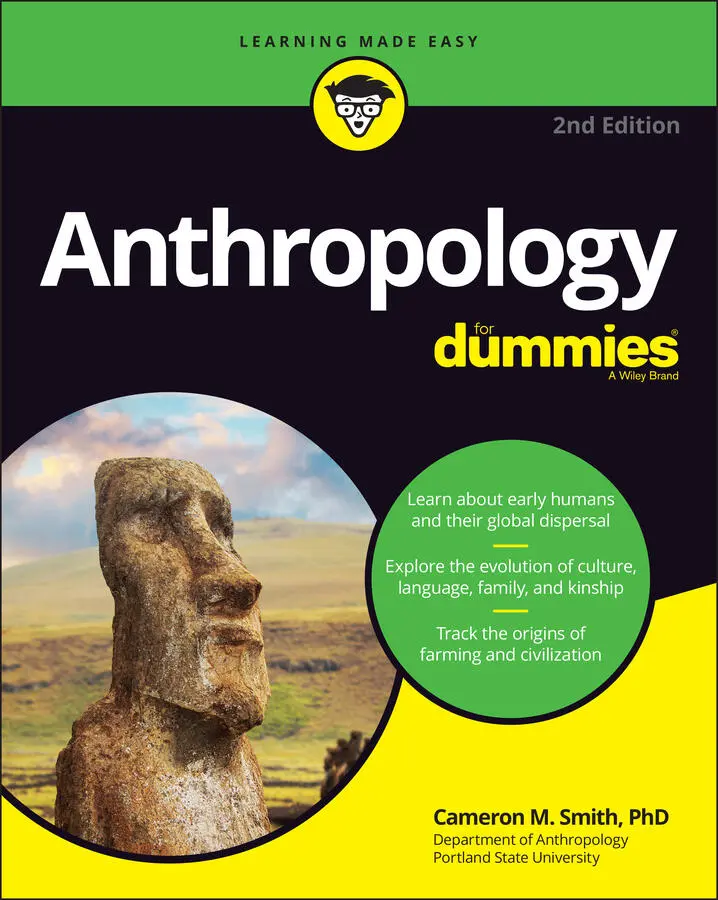
Cameron M. Smith - Anthropology For Dummies
Здесь есть возможность читать онлайн «Cameron M. Smith - Anthropology For Dummies» — ознакомительный отрывок электронной книги совершенно бесплатно, а после прочтения отрывка купить полную версию. В некоторых случаях можно слушать аудио, скачать через торрент в формате fb2 и присутствует краткое содержание. Жанр: unrecognised, на английском языке. Описание произведения, (предисловие) а так же отзывы посетителей доступны на портале библиотеки ЛибКат.
- Название:Anthropology For Dummies
- Автор:
- Жанр:
- Год:неизвестен
- ISBN:нет данных
- Рейтинг книги:5 / 5. Голосов: 1
-
Избранное:Добавить в избранное
- Отзывы:
-
Ваша оценка:
Anthropology For Dummies: краткое содержание, описание и аннотация
Предлагаем к чтению аннотацию, описание, краткое содержание или предисловие (зависит от того, что написал сам автор книги «Anthropology For Dummies»). Если вы не нашли необходимую информацию о книге — напишите в комментариях, мы постараемся отыскать её.
gives you a panoramic view of the fascinating fieldwork and theory that seeks to answer these questions—and helps you view the human world through impartial, anthropological eyes.
Keeping the jargon to a minimum,
explores the four main subdivisions of the discipline, from the adventurous Indiana Jones territory of archaeology and the hands-on biological insights provided by our physical nature to the studious book-cracking brainwork of cultural and linguistic investigation. Along the way, you’ll journey deep into our prehistory where we begin to differentiate ourselves from our primate relatives—and then fast forward into the possibilities of centuries yet to come.
Explore the history of anthropology and apply its methods Get a deep, scientific take on contemporary debates such as identity Excavate the human past through new fossil discoveries Peer into humanity’s future in space Whether you’re studying anthropology for school or just want to know more about what makes us humans who we are, this is the perfect introduction to humanity’s past and present—and a clue to what we need to build a better future.
Anthropology For Dummies — читать онлайн ознакомительный отрывок
Ниже представлен текст книги, разбитый по страницам. Система сохранения места последней прочитанной страницы, позволяет с удобством читать онлайн бесплатно книгу «Anthropology For Dummies», без необходимости каждый раз заново искать на чём Вы остановились. Поставьте закладку, и сможете в любой момент перейти на страницу, на которой закончили чтение.
Интервал:
Закладка:
History, as the saying goes, is written by the winners, which is another way of saying that each story has (at least) two sides. The use of propaganda, the convenient omission of inconvenient facts from state records, and the wholesale creation of “facts” by those who control the written records, are nothing new; these occurred in every ancient civilization, from Sumer to the Incan empire. Unless you’re happy to simply believe what ancient governmental records tell you about their illustrious (and they’re always illustrious) leaders, historic archaeology is a good way to test that written record against artifacts in the ground. Words describe policy; artifacts show what was really built, or not.
Similarly, written records of the ancient world often dealt with the royalty and their activities, military conquests, or religious ceremonies and ideas, but they rarely discussed the common people — the peasants — who formed the bulk of the population of every ancient civilization. And unless you’re directly descended from royalty — and I mean without a drop of commoner’s blood in your veins, which is pretty unlikely — the history of the common person is partly your history. Historical archaeology sometimes focuses on these forgotten ancestors, fleshing out the history books with a fuller picture of the ancient world.
Linguistic Anthropology
Linguistic anthropology studies human language, the animal kingdom’s most uniquely powerful — and at the same time subtle — system of communication between individuals.
Language is basically a system of information transmission and reception; humans communicate these messages by sound (speech), by gesture (body language), and in other visual ways such as writing. Because language is one of humanity’s most distinctive characteristics, I devote all of Chapter 13to a detailed examination of what language is and what we know about how it evolved.
Linguistic anthropology traditionally focuses on several key issues, each resulting from a new research paradigm developed over the last 60 or so years. Interestingly, these interests haven’t steamrolled the previous ones but rather incorporated and complemented earlier types of investigations. The following list details some of those key issues:
Classification of languages, to identify which languages evolved when and where
Understanding of language structure, units, and grammar
Identification of the ways language constructs and reflects identity, ideology, and narratives
Another topic of considerable interest has been when, where, and among what species language first appeared, and how it subsequently evolved. This is one of the great questions of anthropology, but it’s such a massively complex topic that all you really need to know at this level is that, at present, no single model or theory has convinced all anthropologists just how language first evolved. People have presented some compelling theories, but anthropologists are still evaluating them. You can read more about these theories in Chapters 7and 13.
Nonhuman animal communication
Nonhuman animals also communicate; this reminds humanity that we’re not as different from other animals as people often like to think.
 Although chimpanzees and gorillas have been taught several varieties of basic sign-language and can use these signs to assemble basic sentences — on the order, generally speaking, of a three-year-old human’s sentences — it’s important to remember that chimps and gorillas haven’t invented or evolved language on their own in the wild. This fact suggests that the capacity to do something (learn language) doesn’t necessarily indicate that it will occur in the wild.
Nonhuman animal communication is different from human communication and language, though, in certain ways:
Nonhuman language is symbolically simple. A monkey’s screech for “hawk” (an aerial predator) is surely distinct from a squawk for “python” (a ground predator), but “hawk” or “python” are ALL these sounds can mean. On the other hand, humans can use language to say “That guy is a real snake,” attributing snake-like qualities to a person.
Nonhuman words are phonemically simple. That is, although human words can be constructed from many sounds (like the word constitutional ) nonhuman “words” are usually formed of two or fewer sounds (each distinct sound of a language is called a phoneme ).
Nonhuman language is grammatically simple. Although human sentences can be constructed from many words (like “I broke the glass, that was sitting on the edge of the table, before I slipped on a banana peel!”), nonhuman “sentences” are very rare and short (normally no more than two sounds made one after another), and grammatical rules for their assembly are simple.
Spoken language
Human spoken language, in contrast to nonhuman communication, has the following characteristics:
Human language is extraordinarily fast, communicating information at a high speed.
Human language is extraordinarily dense, communicating a lot of information per unit of time.
Human language is extraordinarily subtle, with the use of metaphor being common and radically multiplying the potential meaning of any word, sentence, or even idea.
THE BOY WHO CRIED WHORF
One of the most fascinating and controversial concepts in linguistic anthropology is the Sapir-Whorf hypothesis, forwarded in the 1930s by linguists Edward Sapir and Benjamin Whorf. The two argued that language does as much to create human reality as it does to reflect the real world.
In 1940, Whorf wrote, “We dissect nature along lines laid down by our native languages. The categories and types that we isolate from the world of phenomena we do not find there because they stare every observer in the face; on the contrary, the world is presented in a kaleidoscopic flux of impressions which has to be organized by our minds — and this means largely by the linguistic systems by our minds. We cut nature up, organize it into concepts, and ascribe significances as we do, largely because we are parties to an agreement to organize it in this way — an agreement that holds throughout our speech community and is codified in the patterns of our language. The agreement is, of course, an implicit and unstated one, but its terms are absolutely obligatory; we cannot talk at all except by subscribing to the organization and classification of data which the agreement decrees.”
In other words, although an objective reality exists — jump off a cliff and you will die, whether you call it “flying” or “dying” — your impressions of that world are strongly shaped by the vocabulary you have to describe that world. For me, the lesson is to increase your vocabulary, and to learn other languages or at least words from other languages — you never know what new things you may find in the world.
Gesture and body language
In addition to spoken human language, we also use gesture, or what Adam Kendon, editor of the scholarly journal Gesture, has called “visible action as utterance.” Gesture isn’t exactly the same as a word; it’s more of a reinforcement of what you’re saying aloud. And it’s very important. You can imagine how using the wrong gestures in the wrong circumstances could cost you heavily!
Gestures vary widely worldwide, but some common patterns occur; gestures are used globally to point, indicate a state of mind, reinforce a verbal statement, negate a verbal statement (for example, to indicate sarcasm, maybe by using “air quotes”), or to mark beginning or ending points in a conversation.
Читать дальшеИнтервал:
Закладка:
Похожие книги на «Anthropology For Dummies»
Представляем Вашему вниманию похожие книги на «Anthropology For Dummies» списком для выбора. Мы отобрали схожую по названию и смыслу литературу в надежде предоставить читателям больше вариантов отыскать новые, интересные, ещё непрочитанные произведения.












Обсуждение, отзывы о книге «Anthropology For Dummies» и просто собственные мнения читателей. Оставьте ваши комментарии, напишите, что Вы думаете о произведении, его смысле или главных героях. Укажите что конкретно понравилось, а что нет, и почему Вы так считаете.