Teaching Transhumanism
Здесь есть возможность читать онлайн «Teaching Transhumanism» — ознакомительный отрывок электронной книги совершенно бесплатно, а после прочтения отрывка купить полную версию. В некоторых случаях можно слушать аудио, скачать через торрент в формате fb2 и присутствует краткое содержание. Жанр: unrecognised, на английском языке. Описание произведения, (предисловие) а так же отзывы посетителей доступны на портале библиотеки ЛибКат.
- Название:Teaching Transhumanism
- Автор:
- Жанр:
- Год:неизвестен
- ISBN:нет данных
- Рейтинг книги:5 / 5. Голосов: 1
-
Избранное:Добавить в избранное
- Отзывы:
-
Ваша оценка:
Teaching Transhumanism: краткое содержание, описание и аннотация
Предлагаем к чтению аннотацию, описание, краткое содержание или предисловие (зависит от того, что написал сам автор книги «Teaching Transhumanism»). Если вы не нашли необходимую информацию о книге — напишите в комментариях, мы постараемся отыскать её.
Teaching Transhumanism — читать онлайн ознакомительный отрывок
Ниже представлен текст книги, разбитый по страницам. Система сохранения места последней прочитанной страницы, позволяет с удобством читать онлайн бесплатно книгу «Teaching Transhumanism», без необходимости каждый раз заново искать на чём Вы остановились. Поставьте закладку, и сможете в любой момент перейти на страницу, на которой закончили чтение.
Интервал:
Закладка:
4. Teaching the Posthuman: Literary Learning without Literature
Literary learning is more than critical analysis, however. Research on the reception of fiction as well as competence frameworks that include volitional, intercultural, and self-reflective components point to the relevance of emotional or affective, largely empathetic elements as prerequisite of understanding literature as well as others (Volkmann 2015). This concern will now be in the centre of attention – but with the twist that I will approach the post- and transhumanist dimensions of digitisation by suggesting forms of literary learning without any traditional literary text. If this is meant to be more than a witty paradox, we need to be more precise about the meaning of the expression “literary learning” of course. That aesthetic experiences are to be had with media other than novels or plays is nothing new for sure. However, and the current situation of remote education puts this into sharp relief once more, what we have to acknowledge and better understand in the future is that the change brought about by digitisation and digital media in particular not only changes human subjectivities but also ways of learning and engaging with knowledge. Some of this may be lamentable – think of “digital dementia” (Spitzer 2012), “existential displacement” and “absent presence” (Turkle 2011 and 2015), or the false promises of the “global village” (Robson 2014). Some of it, however, might be important and noteworthy for educators. In particular, I am referring to practices of empathy and connectivity – relatability-requiring stuff, in other words – which digital media afford and engender, and I want to see if those can be utilised in the context of concerns of understanding the other as developed in literature pedagogy (Nünning 2007). What we need to understand for this is that for a text to offer such moments of connection and aesthetic experience, it needs to be perceived as having no direct purpose, as being responsive to interpretation, and as being semantically overdetermined (cf. Brune 2020). We find these factors realised in literature fiction for sure. Yet we also find them in – memes.
Highly popular amongst many learners but so far little attented to by pedagogical research (but see Höfler 2021), memes fit the literary and cultural curriculum because of what they have to say about meaning-making and relatability in (sub-)cultures. Their significance in this regard becomes clearer if we remind ourselves of their conceptual origin, not as internet images but, as Richard Dawkins argued in 1976, as a concept for how cultural ideas spread from individual to individual via media transmission rather than genetic information exchange. Memes, in other words, set out as a concept in neurobiology before they became a popular text type in digital communication – and they have retained some of the former’s potential for collective cultural meaning-making. It is this aspect I want to focus on in the following. Two observations are relevant in this regard, one assuringly old-fashioned, the other surprisingly novel.
Generally speaking, a meme combines an image that has semantic surplus value because it has been shared repeatedly and therefore has acquired iconic status with a caption that is highly formalised. A certain bear image stands for confessions, for instance, and a seal captioned with the phrase “When you …” recounts awkward moments. Like other forms of the literary, their meaning relies to a large extent on belonging to a certain interpretive community: you have to know them to understand them. Unlike other such forms, however, they are in constant flux and demand active participation: memes are constantly created, critiqued by new memes and recreated in a context of communicative participation. They thus stand as instances of participation in a larger cultural field, by way of their multimodality as well as by their bridging of moments of reception with moments of production. It is easy to see how they thus also offer differentiated educational potential.
It is important to note, however, that a meme’s formal structure is not so new after all but can be linked to other forms of multicodal, age-old communication (such as the emblem). And here comes the first observation: with memes, we are still on safe cultural-historical terrain and might use their form for cultural-critical, comparative analyses in the classroom. Just as the emblem knew lemma, icon, and epigram, a meme is built on similar structures. Students recreating these structures unknowingly when engaging with memes participate in a historical tradition of art, which teachers might want to utilise for analytical as well as creative educational purposes (see fig. 2).
The other, more novel idea concerning memes has to do with the modes of reception and production required for understanding them. Memes are usually grouped by thematic concerns – confession, as mentioned above, or outrage, cheeky observation, nostalgia and “first-world problems” – and demand students to be able to identify these concerns in order to relate. The “most hated neologism” is really helpful now when we try to understand how the relatively necent form of aesthetic and communicative pleasure of memes works: it is by creating links of relationality amongst users and by requiring but also engendering empathetic identification. Every “When you …”-mini-narrative requires identification and perspective taking, and every abstract visualisation of awkward moments or confession necessitates perspective coordination.1
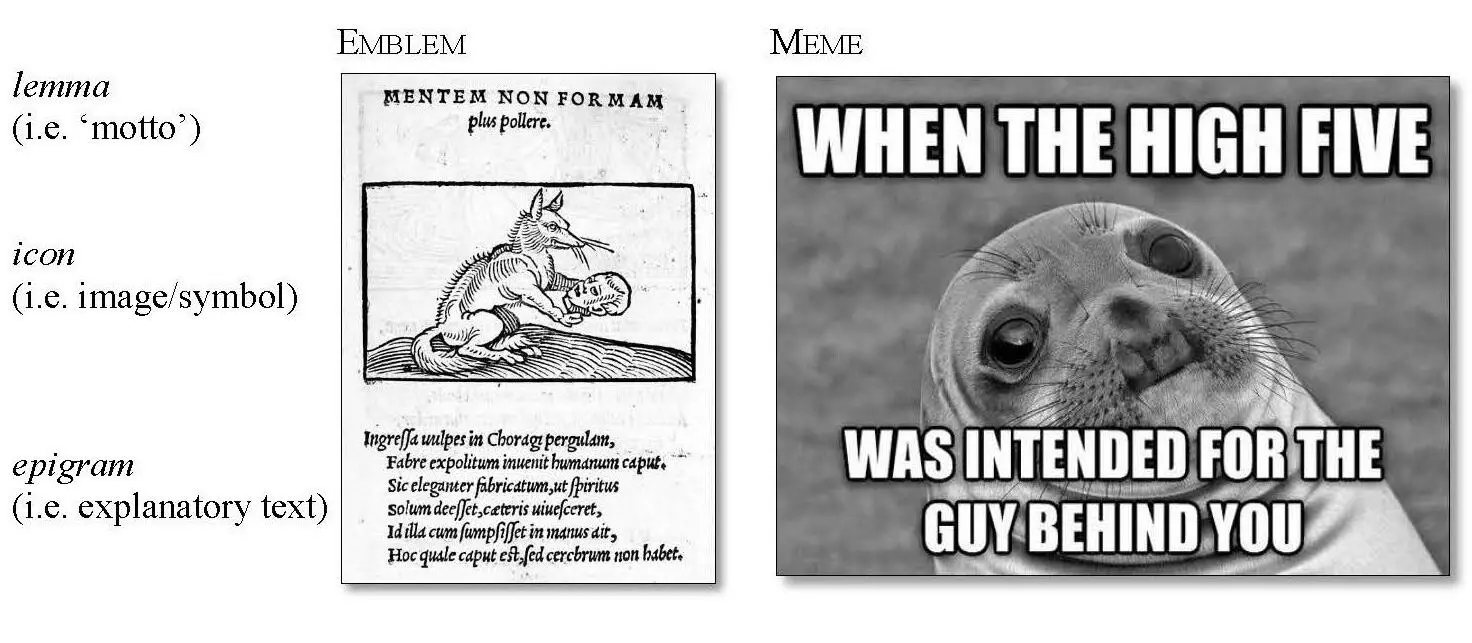 Fig. 2:
Emblem and Meme (see also Bartosch 2016). Emblem “Mentem non formam plus pollere”, taken from the Emblematum Liber , Augsburg 1531 (Wikimedia Commons).
This is of course a cognitive and affective operation well known in literature pedagogy. Educators often teach literary fiction with an eye on moments of empathy and identification – and they are certainly well-advised to pay heed to the fact that similar concerns motivate contemporary usage of digital communications. Memes therefore not only tie in with established concepts in literary and cultural learning. They moreover point to an aspect of digital communication sometimes overlooked in educational debates which understand digitisation as a methodological project rather than a question of subject formation and interaction in complex media environments. If anything, thinking about posthumanism in education underlines how important such questions are, however. Instead of the digital methodocentrism to be found in policy documents and “innovative” suggestions for what ultimately is little more than sugar-coated behaviourist rote learning of vocab and grammar, thinking about memes thus asks us to think about posthumanist potentials rather than transhumanist enhancements (of the teaching situation and the educator’s role and proficiency). Learning with memes points to lessons in relatability: a lesson worth learning under the new posthuman dispensation, it seems.
5. Outlook: Posthumanism, Post-Covid
Apropos “new dispensation”: It is difficult to speak of post- or transhumanist imaginaries as if Covid-19 did not exist. After all, much of what some years ago would have been discussed as either post- or transhumanist future fantasy has become reality for a global community of learners. This includes biopolitical control and media-enhanced surveillance, on the one hand, and increased vulnerability, pandemic risks of death and disease, but also solidarity and moments of reflection and deceleration, on the other. One can correlate these developments with the posthumanism/transhumanism illustration I have drawn upon in this chapter, and it is likewise possible to understand people’s reactions to the current crisis via the notions of relatability and stubborn subjectivity, respectively. If we accede that posthumanism seeks to decentre the human(ist) notion that we are the measure of all things and that transhumanism underlines that very notion via technological determinism, posthumanist learning after Covid-19 would be more-than-human, yet humane. It would rethink educational practices and the value of solidarity, community and collaboration. Transhumanist learning, by contrast, celebrates the new digital realities, takes remote education for granted and dreams of its economic potentials. And this is where posthumanism comes in just as much as the many experiences of educators all around the world: Transhumanising technology, understood as prosthetic enhancement just as well as tablet-based remote learning, exacerbates social injustice, privileges the privileged while it disenfranchises the disenfranchised, as school lockdowns everywhere have shown. It lacks in social warmth and, yes, relatability, but abets instrumentalising and algorithmic teaching procedures. The main reason why so many teachers have been and still are exhausted and frustrated is not because it is hard or impossible to scan and send around a worksheet. It is knowing that this is only a tiny fraction of educational practice, which overlooks meaningful interaction and communication. No wonder we find new cultural practices in online communication which centre on exactly this kind of interaction. A posthumanist lesson in relatability if ever there was one!
Читать дальшеИнтервал:
Закладка:
Похожие книги на «Teaching Transhumanism»
Представляем Вашему вниманию похожие книги на «Teaching Transhumanism» списком для выбора. Мы отобрали схожую по названию и смыслу литературу в надежде предоставить читателям больше вариантов отыскать новые, интересные, ещё непрочитанные произведения.




Обсуждение, отзывы о книге «Teaching Transhumanism» и просто собственные мнения читателей. Оставьте ваши комментарии, напишите, что Вы думаете о произведении, его смысле или главных героях. Укажите что конкретно понравилось, а что нет, и почему Вы так считаете.