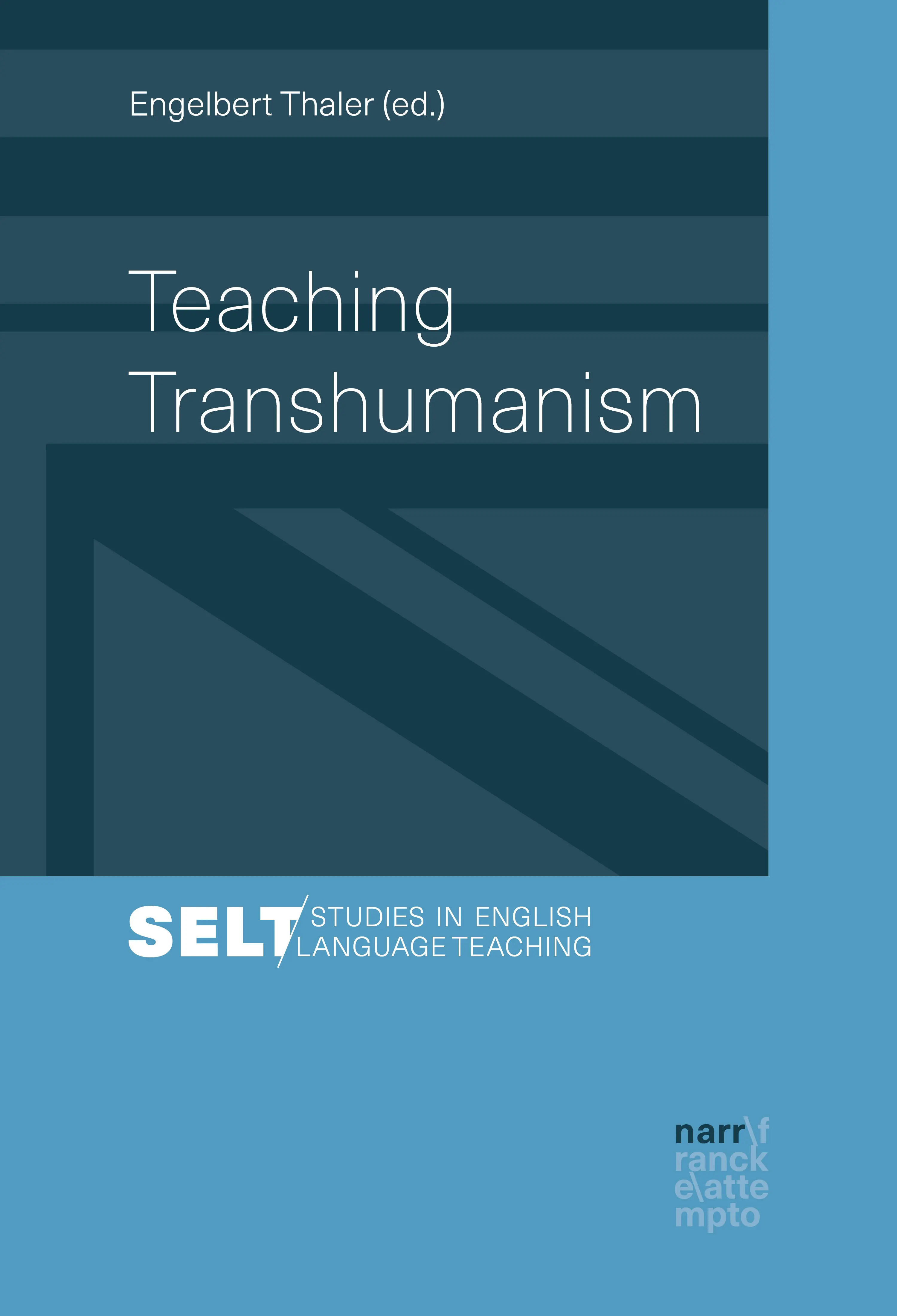
Teaching Transhumanism
Здесь есть возможность читать онлайн «Teaching Transhumanism» — ознакомительный отрывок электронной книги совершенно бесплатно, а после прочтения отрывка купить полную версию. В некоторых случаях можно слушать аудио, скачать через торрент в формате fb2 и присутствует краткое содержание. Жанр: unrecognised, на английском языке. Описание произведения, (предисловие) а так же отзывы посетителей доступны на портале библиотеки ЛибКат.
- Название:Teaching Transhumanism
- Автор:
- Жанр:
- Год:неизвестен
- ISBN:нет данных
- Рейтинг книги:5 / 5. Голосов: 1
-
Избранное:Добавить в избранное
- Отзывы:
-
Ваша оценка:
Teaching Transhumanism: краткое содержание, описание и аннотация
Предлагаем к чтению аннотацию, описание, краткое содержание или предисловие (зависит от того, что написал сам автор книги «Teaching Transhumanism»). Если вы не нашли необходимую информацию о книге — напишите в комментариях, мы постараемся отыскать её.
Teaching Transhumanism — читать онлайн ознакомительный отрывок
Ниже представлен текст книги, разбитый по страницам. Система сохранения места последней прочитанной страницы, позволяет с удобством читать онлайн бесплатно книгу «Teaching Transhumanism», без необходимости каждый раз заново искать на чём Вы остановились. Поставьте закладку, и сможете в любой момент перейти на страницу, на которой закончили чтение.
Интервал:
Закладка:
Marshall-Griffith, Linda. 2016. Charlotte Brontë’s Village Re-imagined .
3.4 Short Stories
Buckell, Tobias. 2004. Necahual .
Hulme, Keri. 2004. Floating Words .
Stiegler, Marc. 1989. The Gentle Seduction .
3.5 Poems
Bot or Not . http://botpoet.com/.
This poem is a Turing test for poetry: The reader has to guess whether the poem they are reading is written by a human or by a computer.
Brautigan, Richard. 1967. All Watched Over by Machines of Loving Grace .
I like to think
(and the sooner the better!)
of a cybernetic meadow
where mammals and computers
live together in mutually
programming harmony
like pure water
touching clear sky …
Burke, Ben. 2015. The Transhumanist’s Lament . https://ideas.ted.com/a-poem-from-the-future/(audio + verse).
… The wallpaper can see that you’re stressed,
So it turns a lovely shade of blue
The thermostat has thought things over
And is ready to have a word with you …
And Doctor mailman robot
Printed your pills in quite a hurry
Your vitamins were running low
Now there’s B12 in your curry …
3.6 Non-Fictional Texts
H+Pedia . https://hpluspedia.org/wiki/Main_Page.
Harari, Yuval Noah. 2015. Homo Deus. A Brief History of Tomorrow .
In his new cult book, the author of Sapiens examines the future of Homo sapiens. He realizes that during the 21st century, humanity may gain immortality and God-like powers ( homo deus ), but he closes with the following question: “What will happen to society, politics and daily life when non-conscious but highly intelligent algorithms know us better than we know ourselves?”
Kurzweil, Ray. 2005. The Singularity Is Near: When Humans Transcend Biology .
More, Max/Natasha Vita-More (eds.). 2013. The Transhumanist Reader .
Pottbäcker, Kirsten. 2006. Science (Fiction) in the Third Millennium . “Challenges” series.
3.7 Movies
Avatar . 2009ff.
Bladerunner . 1982.
Her . 2013.
This American sci-fi romantic drama movie directed by Spike Jonze satirizes digital affairs in a techno-perfect future world. It is centred around the relationship between an introverted man (acted by Joaquin Phoenix) and an artificially intelligent virtual assistant with a female voice.
Gattaca . 1997.
“I not only think that we will tamper with Mother Nature,
I think Mother wants us to.” (Willard Gaylin, Gattaca )
I, Robot . 2004.
Matrix . 1999.
RoboCop . 1987.
The Hunger Games . 2012ff.
Transformers . 2007ff.
Transcendence . 2013.
X-Men . 2000ff.
3.8 TV Series
Black Mirror . 2011ff.
Life after People . 2009/10.
Orphan Black . 2013ff.
Stargate SG-1 . 1997ff.
Westworld . 2016ff.
Years and Years . 2019ff.
3.9 Documentaries
Fixed: The Science/Fiction of Human Enhancement . 2013.
How Would Immortality Change the Way We Live? 2017 (6 min.).
Ray Kurzweil: The Coming Singularity. www.youtube.com/watch?v=1uIzS1uCOcE
Transcendent Man. 2009.
This docu chronicles the life and visions of Ray Kurzweil, an American futurist, hailed by Forbes as “the ultimate thinking machine”. It also presents his daring vision of the Singularity, i.e. a point in the near future when technology will be changing so quickly that we will need to enhance ourselves with artificial intelligence to keep up.
Transhumanism . 2019.www.youtube.com/watch?v=RmS_aL-cKxU
Visions of the Future: Science and Technology . 2018.
This is a collection of 6 x 5–7-minute clips on regenerative medicine, genetic match-making, the city car, the bionic boot, etc.
3.10 Music Videos
A Capella Science. 2016. CRISPR-Cas9
This hilarious Mr. Sandman parody satirizes the Nobel Prize (2020) winning genetic engineering technique by which the genomes of living organisms can be modified:
(lyrics) … Cas9
Cheap and precise
Rewriting genomes from microbes to mice
And soon the humble human being
CRISPR-Cas9 bring me a gene …
Dorian Electra. 2015. Forever Young: A Love Song to Ray Kurzweil .
Lady Gaga. 2011. Born This Way .
Lady Gaga plays with identity in a post-/transhumanist manner (Miller 2020):
is an alien goddess, a zombie, a dancer, an evil goddess, a humanoid life form; video cuts between shots of her different roles ▶ her identity is constantly changing
common binaries are broken down: good/evil (“How can I protect something so perfect without evil?”), male/female, white/nonwhite (backup dancers in shadow ▶ gender and racial distinctions obscure), human/non-human (new creatures: “a race within the human race”, “bears no prejudice, no judgment” ▶ transhumanist ideas: more than human, human enhancement)
lyrics: “I was born this way” ▶ contradiction to posthuman message (universal and constant nature in each person) or emphasis of posthumanism (“same DNA” ▶ breakdown of binaries)?
music: autotuning, electronically manipulating the human voice ▶ a hybrid human-robotic sound ▶ distinction between human and machine distorted.
Katy Perry. 2011. E.T .
3.11 Songs
Coldplay. 2005. Talk.
Grimes. 2012. Be a Body .
Neurotech. 2014. Transhuman .
Post Human Era. 2011. Building the Machine .
Queen. 1986. Who Wants to Live Forever .
The Lisps. 2011. Singularity .
3.12 Computer Games
Deus Ex . 2000ff.
Fallout 4 . 2015.
BioShock . 2007ff.
4. Scenarios
Apart from the impulses given in the section above, teachers could be inspired by the following lesson sequences:
Carrying out a blog project discussing the question “What makes us human?”, including a class blog and individual student blogs (Herbrechter 2019)
Studying representations of posthumans in visual literature, making use of picture books and graphic novels, and finally having pupils design their own posthumans (Ludwig/Shipley 2019)
Organizing debates on the pros and cons of certain transcultural technologies, e.g. cryonics
Planning an intermedial sequence on Ray Kurzweil with the help of his book on singularity, a documentary and a music video (see above)
Addressing the ethical dilemmas of cloning by reading a novel by Ishiguro and a play by Churchill (Boller/Voigts 2019)
Focusing the concept of otherness by treating a theatre play, a TV series and a novel (Hoydis 2019)
Discussing quotations, e.g.▷ It may be that our role on this planet is not to worship God – but to create him . (Arthur C. Clarke)▷ It is a postmodern truth universally acknowledged that today’s parody is tomorrow’s reality . (Csicsery-Ronay)▷ L’existence précède essence . (Jean Paul Sartre)
5. Potential
All these teaching scenarios already hint at the benefits of this topic in TEFL. Trans- and posthumanism are themes of timeless topicality and existential relevance. Motifs such as the striving for immortality can be found in the Gilgamesh Epic and the historical search for the source of eternal youth. In addition, are there more important questions than “What is man?” and “What can/should/must/may he/she be?”?
Читать дальшеИнтервал:
Закладка:
Похожие книги на «Teaching Transhumanism»
Представляем Вашему вниманию похожие книги на «Teaching Transhumanism» списком для выбора. Мы отобрали схожую по названию и смыслу литературу в надежде предоставить читателям больше вариантов отыскать новые, интересные, ещё непрочитанные произведения.


Обсуждение, отзывы о книге «Teaching Transhumanism» и просто собственные мнения читателей. Оставьте ваши комментарии, напишите, что Вы думаете о произведении, его смысле или главных героях. Укажите что конкретно понравилось, а что нет, и почему Вы так считаете.