Teaching Transhumanism
Здесь есть возможность читать онлайн «Teaching Transhumanism» — ознакомительный отрывок электронной книги совершенно бесплатно, а после прочтения отрывка купить полную версию. В некоторых случаях можно слушать аудио, скачать через торрент в формате fb2 и присутствует краткое содержание. Жанр: unrecognised, на английском языке. Описание произведения, (предисловие) а так же отзывы посетителей доступны на портале библиотеки ЛибКат.
- Название:Teaching Transhumanism
- Автор:
- Жанр:
- Год:неизвестен
- ISBN:нет данных
- Рейтинг книги:5 / 5. Голосов: 1
-
Избранное:Добавить в избранное
- Отзывы:
-
Ваша оценка:
Teaching Transhumanism: краткое содержание, описание и аннотация
Предлагаем к чтению аннотацию, описание, краткое содержание или предисловие (зависит от того, что написал сам автор книги «Teaching Transhumanism»). Если вы не нашли необходимую информацию о книге — напишите в комментариях, мы постараемся отыскать её.
Teaching Transhumanism — читать онлайн ознакомительный отрывок
Ниже представлен текст книги, разбитый по страницам. Система сохранения места последней прочитанной страницы, позволяет с удобством читать онлайн бесплатно книгу «Teaching Transhumanism», без необходимости каждый раз заново искать на чём Вы остановились. Поставьте закладку, и сможете в любой момент перейти на страницу, на которой закончили чтение.
Интервал:
Закладка:
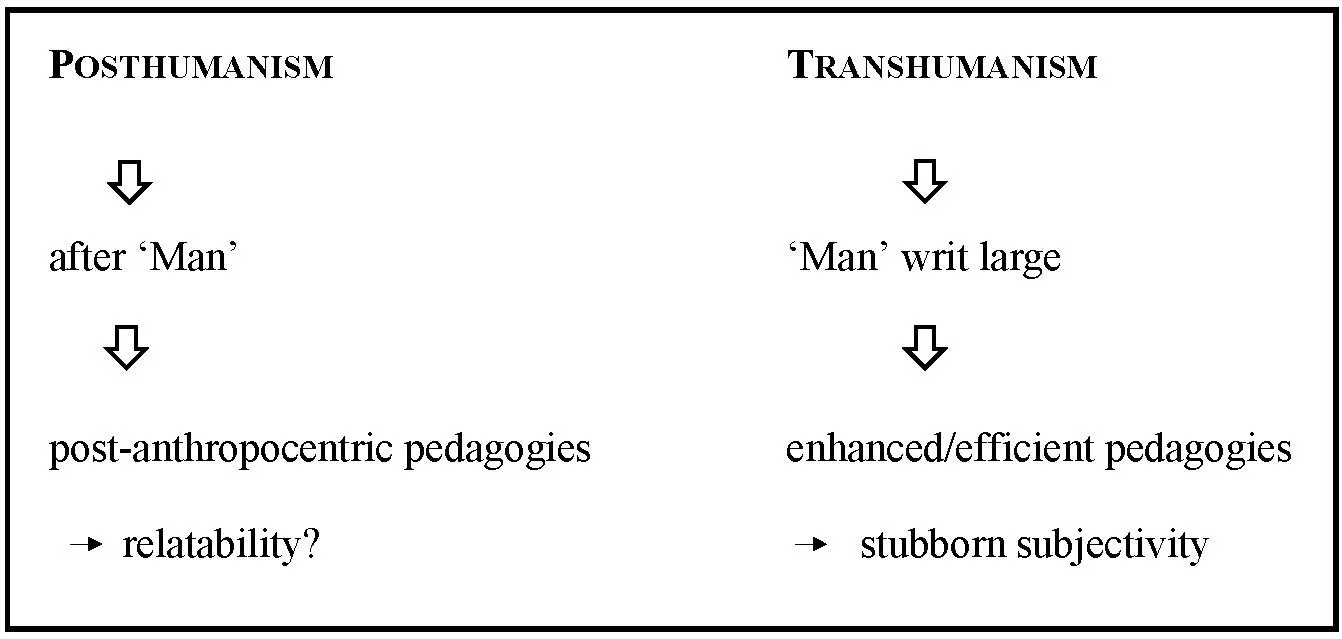 Fig. 1:
Posthumanist vs. Transhumanist Theories and Pedagogies
As it turns out, what could be described as a transhumanist trajectory plays out quite differently. Instead of a position ‘after Man’, it seeks to imagine subjectivites that are ‘more than Man’ or even ‘Man writ large.’ It is, in other words, less critical of, but enthusiastic about the technological possibilities that enhancement technologies and algorithmic efficiency have in store and conceives of technology not as a condition of modernity to be reckoned with in conceptions of what it means to be human, but rather sees it as the very means to arriving at this point of super-humanity. In other words, while posthumanism engages with modernity’s preponderance of technology, transhumanism celebrates it and dreams of uploading human minds onto computers, enhancing abilities through technological implants and such like. Endorsed by figures such as Ray Kurzweil (2005), it is convinced of the need to transcend human limitations with the help of science and technology. As such, it also permeates categories such as the ‘normal’ and the ‘able,’ and, most importantly, the mind-body-dualism posthumanism seeks to challenge: if I can upload my mind and if consciousness and subjectivity are information, then the body is merely a vessel to be done away with or improved through enhancement. In pedagogic contexts, we thus have to ask ourselves: is the current trajectory of educational reforms, geared as it is towards celebrating the digital transformation and a keen embracing of efficiency measures and individualised monitoring of learning outcomes, more likely to set into practice posthumanist, non-anthropocentric thinking? Or does it solidify anthropocentric stubborn subjectivity? And is this, ultimately, a means of realising, consciously or unconsciously, a process of transhumanisation that warrants critique because it gives way to conservative, dystopian renderings of the posthuman condition and future that we also find explored in series such as Black Mirror or Upload and novels from Brave New World to The Circle . Which leads me directly to the question: What does this all mean for literature pedagogy?
3. Teaching the Posthuman: Media Competence without New Media
In educational contexts, we can use texts to critically reflect on developments described as either post- or transhumanism; or we can look for moments of literary and cultural learning within the new technocultural environments of the twenty-first century (cf. Bartosch 2019). Both educational takes can be organised around the distinction between post- and transhumanism that, in turns, relates to the notions of relatability and stubborn subjectivity , mentioned at the beginning of this chapter and displayed above. As posthumanism displaces the image of the human as the measure of all things and places emphases on human-animal, human-machine, and mind-body relations, the “most hated neologism” that Garrard speaks of – relatability – might be indicative of a posthumanist endeavour to think beyond the merely human. Transhumanism’s techno-utopian fantasies of transcending the human, by contrast, are a form of stubborn subjectivity writ large – and, as Jürgen Kreft has argued, it is stubborn subjectivity literary learning helps overcome. Such alignment of theoretical positioning and educational realisation will have to bring posthumanism into proximity with related pedagogical concepts such as have been formulated in sustainability and digital education. Then, we see that The Circle , mentioned above, provides space for reflecting on digitisation and digital media, which is why Daniel Becker in a brilliant essay suggests using it in contexts of education for global digital citizenship (Becker 2019). What makes it relevant for posthumanist debate is that it goes beyond simply telling stories about technology. It rather registers how through digital technology, subjectivity and, indeed, “human form […] may be changing radically, and thus must be re-envisioned”, to quote Hassan’s phrasing from 1977. The novel follows young college graduate Mae, who begins working at a major tech firm, called The Circle (but easily recognisable as a mix of Facebook and Google). Its working routines and social protocols among workers increasingly become cult-like and deliberately use the employees’ social media accounts as constant surveillance apparatuses – not only for themselves but also against those who would rather refrain from using them. Such social and economic pressures are well-known to so-called digital natives in class and may instigate critical discussion of such developments, especially with regard to scenes that dramatize them significantly.
In one such remarkable scene, an online community chases down Mercer, one of the protagonist’s former friends, and drives him to suicide. All this happens against the backdrop of social anxiety and pressure, exacerbated by the social media accounts of the so-called Circlers and the firm’s eerie desire for “completion”: a moment in which all accounts and technologies become united and immortalised, and that no less eerily echoes Google’s becoming “Alphabet” in the extratextual world. In its linking of the speculative and the actual, and of showing how technology shapes human behaviour and being, the novel is frightfully accurate and therefore pedagogically worthwhile. In Becker’s own words:
As more recent sociological and cultural studies on digital identity show, this instrumental perspective disregards the complex interactions taking place when an individual encounters digital technology. In today’s digital age, individuals do not only shape their digital environment but are, in turn, also shaped and influenced by this very environment. As such, one might argue, a concept of digital citizenship exclusively relying on an instrumental point of view cannot adequately prepare young citizens for the complex digital world they experience daily (2019: 168).
The point Becker so diligently elaborates is that new media significantly shape subjectivity and that literary writing can serve as a means of reflection on such effects of digitisation – although of course a so-and-so-many-pages novel might not be the first thing to come to mind when we think of digital competence.
And yet, this is exactly the point of “media competence without new media”. If part and parcel of critical media education is the ability and willingness to assess the complex influence of digital media on the daily lives and subjectivities of prosumers , then literary fiction – with its indisputable potential for reflection and depragmatised experience of the mental and social worlds of fictional characters – serves us more than well as an analytical tool with which learners can gauge the effects of such transformative processes.
With regard to the nature of post- and transhumanist transformations of selves and societies, there is another significant point to be made for looking at literature (including, of course, film): the negativity of the imaginary visions. If we keep apart post- and transhumanism and say that the former is more concerned with critical analyses of the human condition, while the other is concerned with techno-utopian fantasies of ‘Man’ writ large, we can use this very distinction in our analyses of fiction. Looking at the texts I just mentioned (or any other, really, from The Matrix to Ex Machina ), we can see that they are radically pessimist, or at least thoroughly cautious, when it comes to techno-utopian brave new worlds. This means that we have, vis-à-vis the allure of techno-optimism, the literary texts themselves: they tell a very different story from stakeholders in tech firms as well as players in the educational fields that try to sell us digitisation as panacea for everything, from the cost of teaching materials to student motivation and differentiation in inclusive settings. Story after story, they confront us with the apprehension that these developments inevitably end in dystopia. This is something we must at least acknowledge when we take seriously the truism that we teach literature because it has meaningful things to say about us and our lives. It suggests, in this case, a posthumanist perspective on transhumanist storyworlds. Because these texts are, in the best sense, relatable and ask us to let go of stubborn subjectivity in our attempts to see the potential of fiction for future-oriented speculation and thought experiments, they become meaningful and relevant learning materials that prepare us for a future saturated with, and on the brink of being determined by, digital media. In other words, by providing opportunities for critical distance, literature indeed teaches media competence without new media.
Читать дальшеИнтервал:
Закладка:
Похожие книги на «Teaching Transhumanism»
Представляем Вашему вниманию похожие книги на «Teaching Transhumanism» списком для выбора. Мы отобрали схожую по названию и смыслу литературу в надежде предоставить читателям больше вариантов отыскать новые, интересные, ещё непрочитанные произведения.



Обсуждение, отзывы о книге «Teaching Transhumanism» и просто собственные мнения читателей. Оставьте ваши комментарии, напишите, что Вы думаете о произведении, его смысле или главных героях. Укажите что конкретно понравилось, а что нет, и почему Вы так считаете.