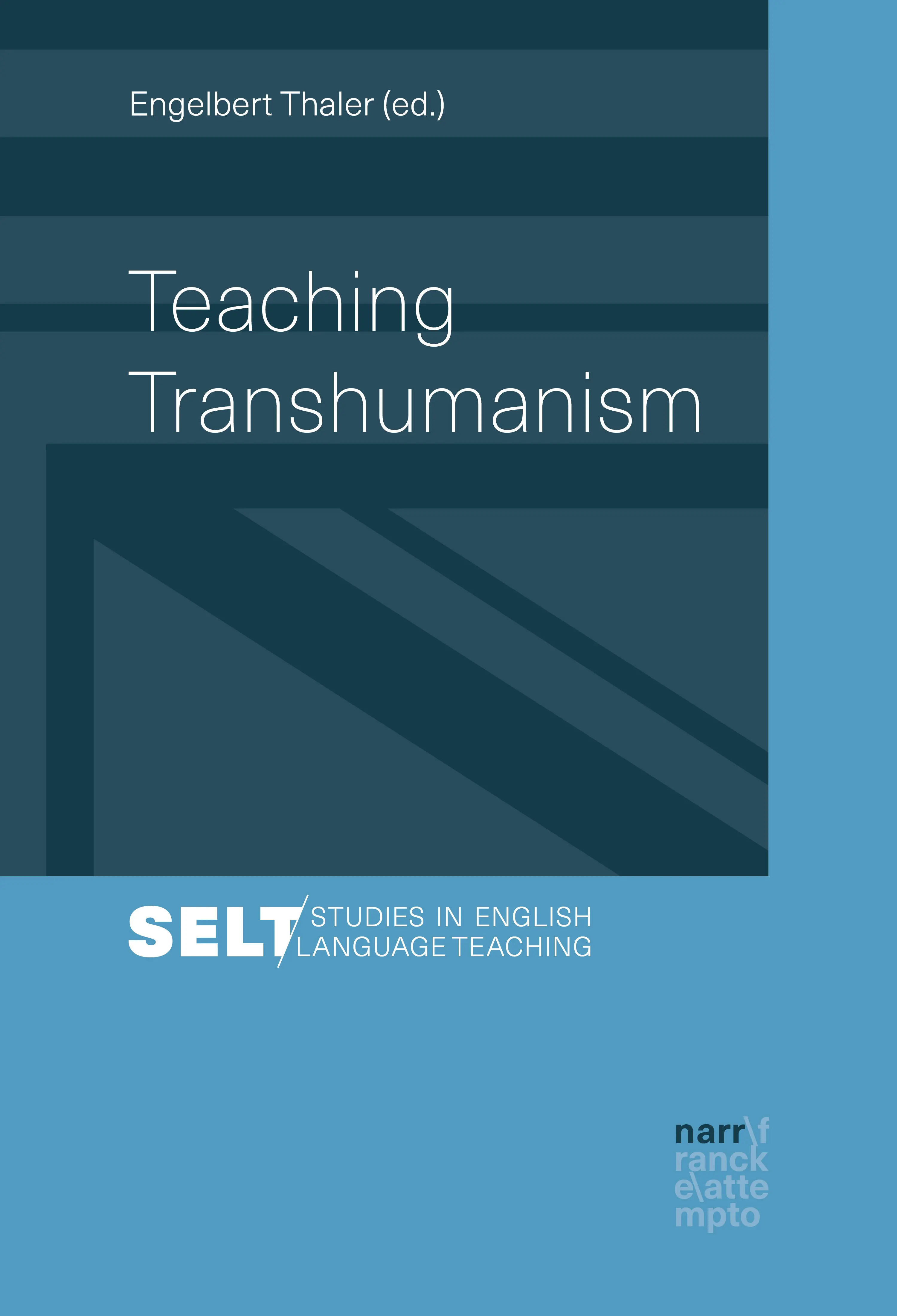
Teaching Transhumanism
Здесь есть возможность читать онлайн «Teaching Transhumanism» — ознакомительный отрывок электронной книги совершенно бесплатно, а после прочтения отрывка купить полную версию. В некоторых случаях можно слушать аудио, скачать через торрент в формате fb2 и присутствует краткое содержание. Жанр: unrecognised, на английском языке. Описание произведения, (предисловие) а так же отзывы посетителей доступны на портале библиотеки ЛибКат.
- Название:Teaching Transhumanism
- Автор:
- Жанр:
- Год:неизвестен
- ISBN:нет данных
- Рейтинг книги:5 / 5. Голосов: 1
-
Избранное:Добавить в избранное
- Отзывы:
-
Ваша оценка:
Teaching Transhumanism: краткое содержание, описание и аннотация
Предлагаем к чтению аннотацию, описание, краткое содержание или предисловие (зависит от того, что написал сам автор книги «Teaching Transhumanism»). Если вы не нашли необходимую информацию о книге — напишите в комментариях, мы постараемся отыскать её.
Teaching Transhumanism — читать онлайн ознакомительный отрывок
Ниже представлен текст книги, разбитый по страницам. Система сохранения места последней прочитанной страницы, позволяет с удобством читать онлайн бесплатно книгу «Teaching Transhumanism», без необходимости каждый раз заново искать на чём Вы остановились. Поставьте закладку, и сможете в любой момент перейти на страницу, на которой закончили чтение.
Интервал:
Закладка:
These questions should also arouse intrinsic interest among our adolescent students. Technological future scenarios generally evoke excitement and creativity in our “digital native” learners.
Furthermore, there is no shortage of fascinating media and materials for a lively discussion of the usually very controversial transhumanist concepts – rather the agony of choice. By now, there are canonical literary texts, for which secondary sources are already available (e.g. Atwood’s Oryx and Crake , Ishiguro’s Never Let Me Go ).
Finally, the discourse on transhumanism in the field of research methods could lead to a critical reflection on the empirical turn , which discriminates against hermeneutic-interpretive methods in favour of quantitative-statistical methods. Snaza/Weaver (2014: 2), for example, attack this “methodocentrism” – “the belief that particular, pre-formed methods can guarantee the validity of an intellectual investigation into the world by factoring out the vicissitudes of the observer’s entanglement with the world.” However, purely empirical methods do not do justice to the complexity of human relationships and learning processes – this “more-than-human world” (Ib.).
6. Challenges
Where there are benefits, there must be problems as well. “Nichts ist ohne sein Gegenteil wahr”, as Martin Walser once claimed, or “Sic et Non” (“Yes and No”), as Peter Abelard, the medieval French scholastic philosopher, stated in the 12th century.
Dealing with trans-/posthumanism in the classroom presents the teacher with two challenges which are anything but insignificant. In terms of discourse evaluation, it is often difficult to distinguish between serious argumentation and fashionable hype. What is catchy neologism, euphoric take-off into dream worlds, sectarian dogmatism, irrational speculation, fanaticism, nihilism, expression of human self-hatred, fear-of-death-driven fantasy? And where are we dealing with scientifically founded and ethically reflected developments? With some advocates of transhumanism, one believes to be able to diagnose symptoms of over-confidence. Hype or hubris?
From a didactic point of view, high demands are put on the teacher’s competence. Who possesses sufficient domain-specific knowledge in artificial intelligence, nanotechnology, biotechnology, information technology, simulated reality, super-intelligence, chemical brain preservation, 3D bio-printing, mind uploading, cryonics? “Dealing with the posthuman as an encounter with alterity on various levels presupposes and requires quite a lot of theoretical knowledge, textual-analytical skills and understanding” (Hoydis 2019: 175). The complexity and heterogeneity of the topic is further exacerbated by partly contradictory positions and intersections between post - and trans -, between humanism and feminism, colonialism, modernism etc.: “One runs the risk of overburdening the curriculum with just one too many ‘-isms’, ‘post-’, and ‘trans-’, each of which, of course, easily warrants instructional consideration and a class (or several) on its own” (Ib.).
7. Conclusion
Well, who is right: Is transhumanism “the most dangerous idea in the world” (Fukuyama 2009) or “the most daring, courageous, visionary and idealistic endeavor of mankind” (Bailey 2004)?
We humans are – and have always been – a work in progress of creation or evolution. “Up till now human life has generally been, as Hobbes described it, ‘nasty, brutish and short’” (Huxley 1957). Are we not called upon “to think beyond humanism, anthropomorphism and anthropocentrism” (Callus et al. 2014: 112)? Bartosch demands a critical discourse “with the future, with global survival and with living together” (2019: 13). To let the biologist, “founder” of transhumanism (and brother of the great writer Aldous) once again have his say: “The human species can, if it wishes, transcend itself” (Huxley 1957) – with Julian Huxley consciously inserting the short conditional clause “if it wishes”.
Bibliography
Abrams, Jerold (2004). “Pragmatism, Artificial Intelligence, and Posthuman Bioethics.” In: Human Studies . 27 (3), 241–258.
Bartosch, Roman/Hoydis, Julia (eds.) (2019). Teaching the Posthuman . Heidelberg: Winter.
Bartosch, Roman/Hoydis, Julia (2019). “Introduction: Teaching Otherwise? Towards Posthuman(ist) Pedagogical Practice.” In: Bartosch, Roman/Hoydis, Julia (eds.), 7–23.
Bailey, Ronald (2004). Transhumanism: The Most Dangerous Idea ? https://reason.com/2004/08/25/transhumanism-the-most-dangero/ (accessed 03/02/2020)
Boller, Alessandra/Voigts, Eckart (2019). “‘What Counts as a Livable Life and a Grievable Death?’ – Critical Posthumanism and Cloning in Kazuo Ishiguro’s Never Let Me Go and Caryl Churchill’s A Number .” In: Bartosch, Roman/Hoydis, Julia (eds.). Teaching the Posthuman . Heidelberg: Winter, 151–174.
Braidotti, Rosi (2014). Posthumanismus. Leben jenseits des Menschen . Frankfurt am Main: Campus.
Callus, Ivan/Herbrechter, Stefan/Rossini, Manuela (2014). “Introduction: Dis/Locating Posthumanism in European Literary and Critical Traditions.” In: European Journal of English Studies 18.2, 103–120.
Csicsery-Ronay, Istvan (1999). “Review: Till We Have Interfaces.” In: Science Fiction Studies 26.2, 312–323.
Dublin, Max (1992). Futurehype: The Tyranny of Prophecy . New York: Plume.
Foucault, Michel (1977). Überwachen und Strafen – Die Geburt des Gefängnisses . Frankfurt: Suhrkamp.
Fukuyama, Francis (2009). Transhumanism . https://foreignpolicy.com/2009/10/23/transhumanism/(accessed 03/02/2020)
Greenfield, Susan (2015). Mind Change. How Digital Technologies Are Leaving Their Mark on Our Brains . London: Rider.
Herbrechter, Stefan (2019). “What Makes Us Human? Teaching Posthumanism in Secondary School.” In: Bartosch, Roman/Hoydis, Julia (eds.), 75–100.
Hassan, Ihab (1977). “Prometheus as Performer: Towards a Posthumanist Culture?” In: The Georgia Review 31.4, 830–850.
Hoydis, Julia (2019). “Posthuman Lessons from the Past and the Future. Narrating Otherness between History, Folklore, and Technology.” In: Bartosch, Roman/Hoydis, Julia (eds.), 175–205.
Huxley, Julian (1957). Transhumanism . https://web.archive.org/web/20160625132722/http://www.transhumanism.org/index.php/WTA/more/huxley (accessed 03/02/2020)
International Theological Commission (2002). Communion and Stewardship: Human Persons Created in the Image of God . www.vatican.va/roman_curia/congregations/cfaith/cti_documents/rc_con_cfaith_doc_20040723_communion-stewardship_en.html(accessed 03/02/2020)
Jones, Steve (1998). Gott und die Gene. Die Berichte der Bibel und die Erkenntnisse der Genetik . Hamburg: Hoffmann und Campe.
McKibben, Bill (2003). Enough: Staying Human in an Engineered Age . New York: Henry Holt.
Ludwig, Christian/Shipley, Elizabeth (2019). “Reading and Creating the Posthuman in the Primary and Secondary Classroom.” In: Bartosch, Roman/Hoydis, Julia (eds.), 45–74.
Miller, Merrill (2020). So, What Are We Now? Posthumanism and Transhumanism in Music Videos. https://webstu.onu.edu/emedia/content/so-what-are-we-now-posthumanism-and-transhumanism-music-videos(accessed 03/02/2020)
More, Max (1990). Transhumanism . https://web.archive.org/web/20110216221306/http://www.maxmore.com/transhum.htm(accessed 03/02/2020)
Nayar, Pramod (2014). Posthumanism . Cambridge: Polity Press.
Newman, Stuart (2003). “Averting the Clone Age: Prospects and Perils of Human Developmental Manipulation.” In: Journal of Contemporary Health Law & Policy , 19 (2), 431–463.
Читать дальшеИнтервал:
Закладка:
Похожие книги на «Teaching Transhumanism»
Представляем Вашему вниманию похожие книги на «Teaching Transhumanism» списком для выбора. Мы отобрали схожую по названию и смыслу литературу в надежде предоставить читателям больше вариантов отыскать новые, интересные, ещё непрочитанные произведения.


Обсуждение, отзывы о книге «Teaching Transhumanism» и просто собственные мнения читателей. Оставьте ваши комментарии, напишите, что Вы думаете о произведении, его смысле или главных героях. Укажите что конкретно понравилось, а что нет, и почему Вы так считаете.