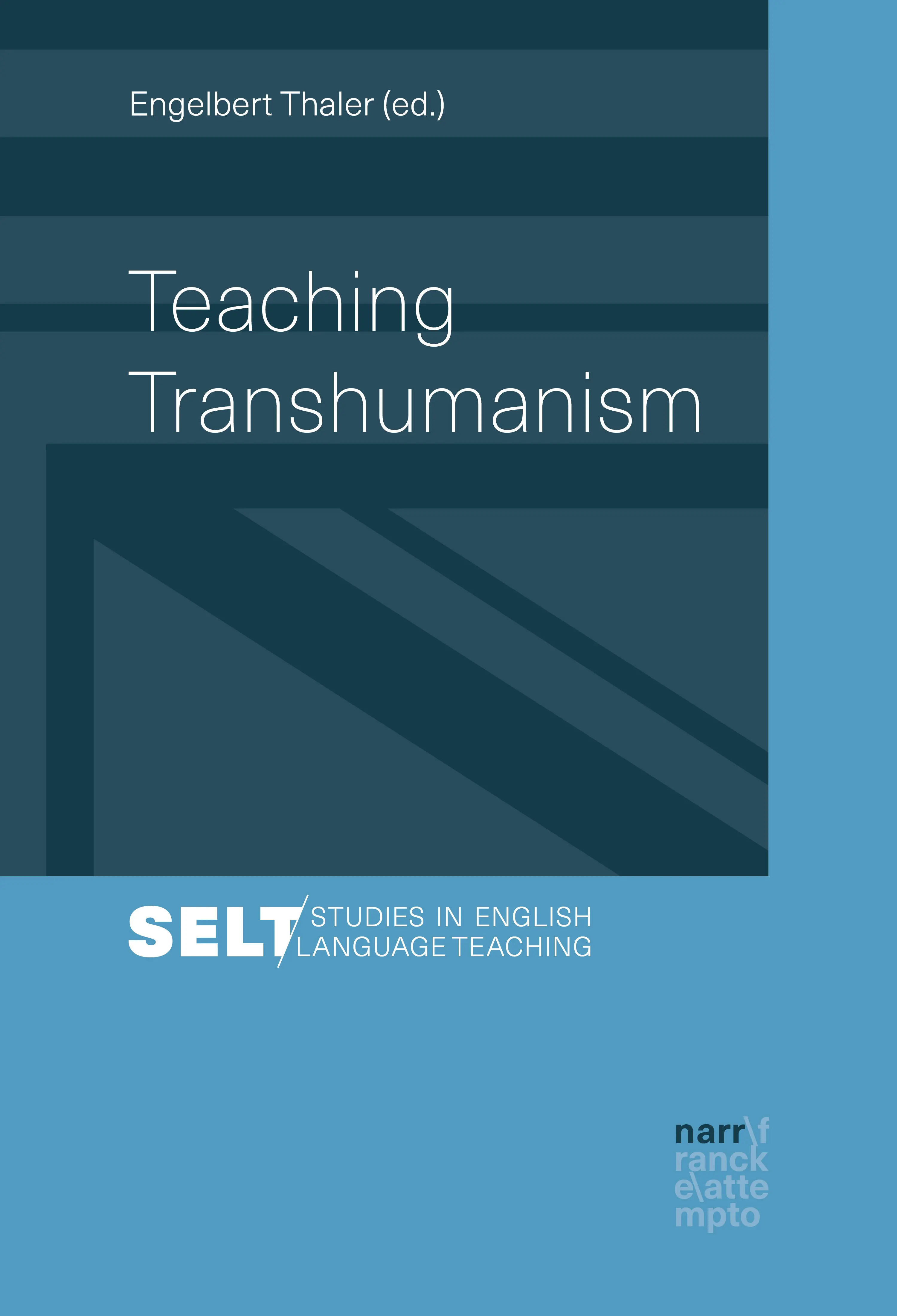
Teaching Transhumanism
Здесь есть возможность читать онлайн «Teaching Transhumanism» — ознакомительный отрывок электронной книги совершенно бесплатно, а после прочтения отрывка купить полную версию. В некоторых случаях можно слушать аудио, скачать через торрент в формате fb2 и присутствует краткое содержание. Жанр: unrecognised, на английском языке. Описание произведения, (предисловие) а так же отзывы посетителей доступны на портале библиотеки ЛибКат.
- Название:Teaching Transhumanism
- Автор:
- Жанр:
- Год:неизвестен
- ISBN:нет данных
- Рейтинг книги:5 / 5. Голосов: 1
-
Избранное:Добавить в избранное
- Отзывы:
-
Ваша оценка:
Teaching Transhumanism: краткое содержание, описание и аннотация
Предлагаем к чтению аннотацию, описание, краткое содержание или предисловие (зависит от того, что написал сам автор книги «Teaching Transhumanism»). Если вы не нашли необходимую информацию о книге — напишите в комментариях, мы постараемся отыскать её.
Teaching Transhumanism — читать онлайн ознакомительный отрывок
Ниже представлен текст книги, разбитый по страницам. Система сохранения места последней прочитанной страницы, позволяет с удобством читать онлайн бесплатно книгу «Teaching Transhumanism», без необходимости каждый раз заново искать на чём Вы остановились. Поставьте закладку, и сможете в любой момент перейти на страницу, на которой закончили чтение.
Интервал:
Закладка:
2.2 Ethical Issues
To what extent do transhumanist positions threaten human values?
The Nobel Prize 2020 for chemistry was awarded for the development of Crispr/Cas 9 , a method of genome editing. With the help of these genetic scissors, the dream of being able to cure inherited diseases may come true. This tool has taken the life sciences into a new era and can bring great benefit to humankind. Yet, what is a promise, can also be a peril. Due to its potential to alter human heredity, Crispr has become one of the most controversial developments in science. In 2018, He Jiankui, a Chinese scientist, announced that he had used the tool to edit the genes of human embryos, which brought forth the world’s first genetically modified infants. His experiments were condemned by many in the scientific community as reckless and risky.
Several biologists reject the intention of interfering with nature by overcoming universal human limitations (ageing, physical and cognitive limits), eliminating the difference between humans and artifacts, and producing human-animal chimeras (McKibben 2003, Rifkin 1993, Newman 2003). However, some personality theorists discard this criticism as anthropomorphobia (Isaac Asimov’s “Frankenstein complex”, i.e. the fear of mechanical men, which produces the “yuck factor”, a reaction of repugnance and distaste), or regard physical self-optimization as a logical consequence of a commercialized hyper-individualism.
This begs the question: Is there still an ontological distinction between human – non-human – inhuman – animal?
2.3 Eugenic Issues
Do genetic engineering experiments lead to eugenic discrimination?
Historical experiences, e.g. Social Darwinism, the survival of the fittest, racial hygiene, the Ayrian race, the Germanic “Übermenschen” master race with its dogmas of life unworthy of life and blood purity, sometimes give rise to visions full of inhuman scenarios.
2.4 Religious Issues
Are human beings allowed to put themselves in the place of God?
What some transhumanists promise us for this world (“heaven on earth”), Christian theologians expect only in the hereafter: the end of suffering and eternal life (International Theological Commission 2002).
2.5 Political Issues
Does transhumanism undermine the ideals of liberal democracy?
Fukuyama (2009), for example, fears a fundamental change in human nature and equality (”… we all possess a human essence”).
2.6 Socio-Economic Issues
Will the gap between rich and poor become even wider?
Especially the wealthy classes can afford the emerging enhancement technologies, which could lead to a “genetic divide” (McKibben 2003) and a two-tier society of genetic “haves” versus “have nots” (see the film Gattaca , 1997).
2.7 Existential Issues
Do modern technologies threaten human survival?
British astrologer Rees (2003), for example, claims that new technologies pose an immense risk to Earth and that the probability of humanity’s demise before 2100 is 50 %. In contrast, the so-called “precautionary principle” suggests that humans are cautious in preventing potential dangers, despite a patchy knowledge base.
2.8 Cultural-Aesthetic Issues
In his concept of panoptism , Michel Foucault (1977) already noted the social conformity of the individual resulting from increasing surveillance mechanisms. Society controls human bodies by making them feel that they are observed permanently; accordingly they stage themselves aesthetically. Against the background of AI and posthuman bioethics, Abrams (2004) fears the elimination of differences in favour of uniformity.
2.9 Technological Issues
How can we weigh the pros and cons of all the individual transhumanistic techniques?
Does a hybrid fusion of human bodies with intelligent machines make sense (chip implantation, cyborgs)? Or the freezing of the body/brain for later reanimation (cryonics)? Or the transfer of one’s own consciousness to an external medium (mind uploading) (e.g. Greenfield 2015)?
2.10 Media-Educational Issues
Should digital media in education be assessed more critically?
At least representatives of a critical posthumanism ask themselves this question. “In education, however, the rather uncritical endorsement of a narrative of digitalisation as a means of progress and a blessing merely and rather unreflectedly underlines the dominance of technology that a critical posthumanism calls into question” (Bartosch 2019: 15). In the “brave new world of digital learning”, a critical reflection of the narrative of innovation should also take into account the underlying interests of business groups, and change the question of “what works” to “works for what”.
3. Media
“The medium is the message”, as the Canadian communication theorist Marshall McLuhan once claimed – or is it the massage? Does a movie, or a novel, or a computer game relieve or sharpen our pain of transhumanism?
The following selection can only offer a small part of the large reservoir of media with transhumanistic motifs, which may be suitable for the foreign language classroom (cf. i.a. Thaler 2018, 2016, 2014, 2012, 2008).
3.1 Visual Fiction
Miller, Frank et al. 2013. RoboCop .
Rosenberg, Louis. 2008. Upgrade .
Rosenberg, Louis. 2014. Monkey Room .
Tan, Shaun. 2006. The Arrival .
Thomas, Valerie. 2016. Winnie’s Big Bad Robot .
In this picture book, Winnie the Witch makes a cardboard robot and decides to turn it into a real robot. That, however, is a BIG mistake! Winnie and Wilbur soon discover that the Big Bad Robot is trouble, especially when it grabs Winnie’s magic wand.
3.2 Novels
Atwood, Margaret. 2003. Oryx and Crake .
Brown, Dan, 2013. Inferno .
Coetzee, J.M. 1999. The Lives of Animals .
DeLillo, Don. 2016. Zero K .
Egan, Greg. 1995. Distress .
Ghosh, Amitav. 1995. The Calcutta Chromosome .
Gibson, William 1984. Neuromancer .
The Sprawl trilogy is Gibson’s first set of novels, composed of Neuromancer (1984), Count Zero (1986), and Mona Lisa Overdrive (1988). It is set in a near-future world dominated by ubiquitous technology and powerful corporations, and guided by mind-machine interface (MMI), emerging machine intelligence, and global information space (“cyberspace”).
Huxley, Aldous. 1932. Brave New World .
Hornung, Eva. 2009. Dog Boy .
Ishiguro, Kazuo. 2005. Never Let Me Go .
Lanchester, John. 2019. The Wall .
In his latest novel, the author of The Capital (2012) recounts a dystopian story after a climatic event, when movement between countries is outlawed, and the UK has turned into a fortress, which is walled in concrete and controlled by British youngsters looking for “Others”. Lanchester’s disquieting environmental anti-utopia was longlisted for the Booker Prize 2019.
Lowry, Lois. 1993. The Giver (Film: 2015)
Shelley, Mary. 1818. Frankenstein .
Simmons, Dan. 1991. Hyperion .
Wells, Herbert George. 1896. The Island of Dr. Moreau .
3.3 Plays
Churchill, Caryl. 2008. A Number .
In this drama, the English playwright treats the topic of human identity and cloning, in particular nature versus nurture. Exploring the risks of artificial creation, the play is centred around the conflict between a father and his three sons, two of whom are clones of the first one.
Читать дальшеИнтервал:
Закладка:
Похожие книги на «Teaching Transhumanism»
Представляем Вашему вниманию похожие книги на «Teaching Transhumanism» списком для выбора. Мы отобрали схожую по названию и смыслу литературу в надежде предоставить читателям больше вариантов отыскать новые, интересные, ещё непрочитанные произведения.



Обсуждение, отзывы о книге «Teaching Transhumanism» и просто собственные мнения читателей. Оставьте ваши комментарии, напишите, что Вы думаете о произведении, его смысле или главных героях. Укажите что конкретно понравилось, а что нет, и почему Вы так считаете.