John E. Boylan - Intermittent Demand Forecasting
Здесь есть возможность читать онлайн «John E. Boylan - Intermittent Demand Forecasting» — ознакомительный отрывок электронной книги совершенно бесплатно, а после прочтения отрывка купить полную версию. В некоторых случаях можно слушать аудио, скачать через торрент в формате fb2 и присутствует краткое содержание. Жанр: unrecognised, на английском языке. Описание произведения, (предисловие) а так же отзывы посетителей доступны на портале библиотеки ЛибКат.
- Название:Intermittent Demand Forecasting
- Автор:
- Жанр:
- Год:неизвестен
- ISBN:нет данных
- Рейтинг книги:5 / 5. Голосов: 1
-
Избранное:Добавить в избранное
- Отзывы:
-
Ваша оценка:
Intermittent Demand Forecasting: краткое содержание, описание и аннотация
Предлагаем к чтению аннотацию, описание, краткое содержание или предисловие (зависит от того, что написал сам автор книги «Intermittent Demand Forecasting»). Если вы не нашли необходимую информацию о книге — напишите в комментариях, мы постараемся отыскать её.
The first text to focus on the methods and approaches of intermittent, rather than fast, demand forecasting
Intermittent Demand Forecasting No prior knowledge of intermittent demand forecasting or inventory management is assumed in this book. The key formulae are accompanied by worked examples to show how they can be implemented in practice. For those wishing to understand the theory in more depth, technical notes are provided at the end of each chapter, as well as an extensive and up-to-date collection of references for further study. Software developments are reviewed, to give an appreciation of the current state of the art in commercial and open source software.
“Intermittent demand forecasting may seem like a specialized area but actually is at the center of sustainability efforts to consume less and to waste less. Boylan and Syntetos have done a superb job in showing how improvements in inventory management are pivotal in achieving this. Their book covers both the theory and practice of intermittent demand forecasting and my prediction is that it will fast become the bible of the field.” —
, Professor, University of Nicosia, and Director, Institute for the Future and the Makridakis Open Forecasting Center (MOFC).
“We have been able to support our clients by adopting many of the ideas discussed in this excellent book, and implementing them in our software. I am sure that these ideas will be equally helpful for other supply chain software vendors and for companies wanting to update and upgrade their capabilities in forecasting and inventory management.”—
, VP, Research and Development, Blue Yonder.
“As product variants proliferate and the pace of business quickens, more and more items have intermittent demand. Boylan and Syntetos have long been leaders in extending forecasting and inventory methods to accommodate this new reality. Their book gathers and clarifies decades of research in this area, and explains how practitioners can exploit this knowledge to make their operations more efficient and effective.”—
, Professor Emeritus, Rensselaer Polytechnic Institute.
Intermittent Demand Forecasting — читать онлайн ознакомительный отрывок
Ниже представлен текст книги, разбитый по страницам. Система сохранения места последней прочитанной страницы, позволяет с удобством читать онлайн бесплатно книгу «Intermittent Demand Forecasting», без необходимости каждый раз заново искать на чём Вы остановились. Поставьте закладку, и сможете в любой момент перейти на страницу, на которой закончили чтение.
Интервал:
Закладка:
The associated cost of inventories of purchased goods has been estimated to be between 25% and 35% of the value of those goods (e.g. Chase et al. 2006): a firm carrying $20 million in purchased goods inventory would, accordingly, incur additional costs of $5–7 million. These are costs that, once reduced, can significantly improve the firm's net profits (Wallin et al. 2006). The total cost of purchased goods inventory can be quite alarming, calling for innovative approaches to cut it down. Intelligent intermittent demand forecasting offers such opportunities.
In the defence environment, Henry L. Hinton Jr, Assistant Comptroller General, National Security and International Affairs Division, stated, ‘Our work continues to show weaknesses in DoD's inventory management practices that are detrimental to the economy’ (GAO 1999, p. 1). Sixteen years later, only minor improvements were reported (GAO 2015), and public announcements on the poor management of defence inventories and the resulting detrimental impacts on the economy constitute a recurring issue in the news. Similarly, the expansion of the after‐sales industry and the increasing importance of commercial service operations have not been adequately reflected in the development of ERP and supply chain software packages, the functionality of which has often been judged to be inadequate (Syntetos et al. 2009b). In addition to the after‐sales and MRO environment and the military sector, intermittent demand items dominate the inventories in a wide range of industries, calling for improved solutions for their cost‐effective management.
There have been rather minor improvements in practical applications in this area since around 2000, but there have been major improvements in empirically tested theory since that time. Many of these theoretical advancements have not yet been incorporated in commercial software, and hence, there are major opportunities for improving real‐world applications. We hope this book will help towards moving in that direction.
Technical Note
Note 1.1 3D Printing
An alternative form of MTO, enabled by advances in additive manufacturing, is 3D Printing (3DP) an item on demand. In this case, decision‐making relates to the level of investment in 3DP machinery/technology that may ‘print’ the requested number of items upon demand. Potentially, this is very appealing in the case of spare parts and is currently being explored by various organisations seeking to cut down their inventories. For example, in 2018 the Dutch Army initiated a collaboration with the 3DP company DiManEx to examine spare part supply challenges. At the time of writing, there is no empirical evidence on the effect of 3DP on spare parts inventory management and how this compares with MTS approaches.
2 Inventory Management and Forecasting
2.1 Introduction
In the previous chapter, we showed that the management of intermittent demand items is an important task for many organisations. These items require certain operational decisions to be taken at the level of an individual stock keeping unit (SKU) including whether to stock the item at all and, if so, how much to stock. Both of these decisions will be addressed in this chapter. We discuss the major inventory replenishment policies and their appropriateness for intermittent demand items. This is the foundation for inventory forecasting and is an essential component of all software dedicated to inventory management. We also consider what forecasts are important when demand is intermittent. The interface between forecasting and stock control has been rather neglected in the academic literature although it is vital in real‐world inventory applications.
2.2 Scheduling and Forecasting
Before discussing the integration of forecasting and inventory control for intermittent demand items, a distinction needs to be made between the inventory management practices required for dependent and independent demand items.
2.2.1 Material Requirements Planning (MRP)
The design and construction of any physical product is captured in its bill of materials (BoM) which, as illustrated in Figure 2.1, shows the product's assemblies (middle level) and components (bottom level). Demand at the top level, corresponding to the end product, is defined as ‘independent’, whereas demand at lower levels in the hierarchy is dependent on demand at higher levels.
If a company has a ‘make to stock’ policy, then immediate availability and thus shipment of the end products (also known as “finished goods”) is promised to the customers. If a company operates a ‘make to order’ (MTO) policy, then immediate availability of the end products is not offered, but rather a delivery date is promised. In both policies, all the components and assemblies are produced or procured in time for the end product to reach the client by the promised time.
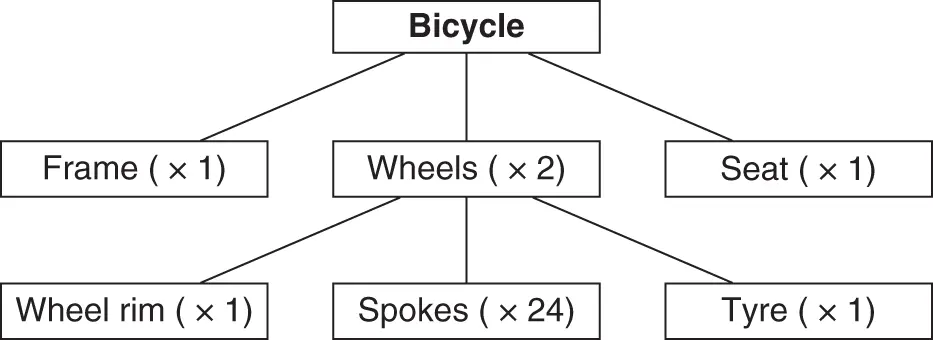
Figure 2.1 Bill of materials (BoM) example.
To meet delivery targets, a scheduling procedure is required and this is the backbone of the principal inventory methodology for dependent demand items, called material requirements planning (MRP) (see, for example, Ptak and Smith 2011). MRP will give a full BoM, showing all the elements needed for the final product, together with the required quantities. This is illustrated in Figure 2.1for the example of a bicycle (end product, highlighted in bold type) comprising a frame, two wheels, and a seat (assemblies) and with each wheel comprising a wheel rim, 24 spokes, and a tyre (components).
MRP will give a full schedule of requirements, including quantities and dates by which all elements of the product must be produced or procured. In the example above, two wheel rims, 48 spokes, and two tyres would be required. Lead times for these components would also be specified, allowing all required delivery dates to be calculated. By following an MRP procedure, it is clear that if we know or can forecast the demand for the end product, then the requirements for all the lower levels can be calculated immediately.
2.2.2 Dependent and Independent Demand Items
In theory, all SKUs that appear at a level below the end product level are dependent demand items and should be treated using MRP‐type procedures. However, there are two exceptions to this rule.
If a company is operating a MTO policy, then everything must be assembled during the time window from receipt of order to the delivery date. Not all the components will necessarily be produced or procured in this time frame, though. Therefore, stocks of the relevant components must be held. Ordering will no longer be based on demand that is completely known over the lead time. Instead, stock levels must be informed by forecasted demand.
The second exception relates to spare parts. Parts may be dependent demand items as far as manufacturing is concerned, but they are independent demand items as far as after‐sales service is concerned. They are subject to unknown demand that varies over time, partly due to chance; such demand is known as ‘stochastic’. Because spare parts demand is not known in advance, it needs to be forecasted, taking into account that spare parts are often subject to intermittent demand.
2.2.3 Make to Stock
Generally, demand is not known in advance in a make to stock environment, where the products need to be in stock when the customer orders are received. The lead time in these cases is expected (as far as the customers are concerned) to be equal to the time taken to ship the product to the customers' premises or, in the retailing sector, the lead time is expected to be zero: it is on‐the‐shelf availability that drives business.
Читать дальшеИнтервал:
Закладка:
Похожие книги на «Intermittent Demand Forecasting»
Представляем Вашему вниманию похожие книги на «Intermittent Demand Forecasting» списком для выбора. Мы отобрали схожую по названию и смыслу литературу в надежде предоставить читателям больше вариантов отыскать новые, интересные, ещё непрочитанные произведения.











Обсуждение, отзывы о книге «Intermittent Demand Forecasting» и просто собственные мнения читателей. Оставьте ваши комментарии, напишите, что Вы думаете о произведении, его смысле или главных героях. Укажите что конкретно понравилось, а что нет, и почему Вы так считаете.