John E. Boylan - Intermittent Demand Forecasting
Здесь есть возможность читать онлайн «John E. Boylan - Intermittent Demand Forecasting» — ознакомительный отрывок электронной книги совершенно бесплатно, а после прочтения отрывка купить полную версию. В некоторых случаях можно слушать аудио, скачать через торрент в формате fb2 и присутствует краткое содержание. Жанр: unrecognised, на английском языке. Описание произведения, (предисловие) а так же отзывы посетителей доступны на портале библиотеки ЛибКат.
- Название:Intermittent Demand Forecasting
- Автор:
- Жанр:
- Год:неизвестен
- ISBN:нет данных
- Рейтинг книги:5 / 5. Голосов: 1
-
Избранное:Добавить в избранное
- Отзывы:
-
Ваша оценка:
Intermittent Demand Forecasting: краткое содержание, описание и аннотация
Предлагаем к чтению аннотацию, описание, краткое содержание или предисловие (зависит от того, что написал сам автор книги «Intermittent Demand Forecasting»). Если вы не нашли необходимую информацию о книге — напишите в комментариях, мы постараемся отыскать её.
The first text to focus on the methods and approaches of intermittent, rather than fast, demand forecasting
Intermittent Demand Forecasting No prior knowledge of intermittent demand forecasting or inventory management is assumed in this book. The key formulae are accompanied by worked examples to show how they can be implemented in practice. For those wishing to understand the theory in more depth, technical notes are provided at the end of each chapter, as well as an extensive and up-to-date collection of references for further study. Software developments are reviewed, to give an appreciation of the current state of the art in commercial and open source software.
“Intermittent demand forecasting may seem like a specialized area but actually is at the center of sustainability efforts to consume less and to waste less. Boylan and Syntetos have done a superb job in showing how improvements in inventory management are pivotal in achieving this. Their book covers both the theory and practice of intermittent demand forecasting and my prediction is that it will fast become the bible of the field.” —
, Professor, University of Nicosia, and Director, Institute for the Future and the Makridakis Open Forecasting Center (MOFC).
“We have been able to support our clients by adopting many of the ideas discussed in this excellent book, and implementing them in our software. I am sure that these ideas will be equally helpful for other supply chain software vendors and for companies wanting to update and upgrade their capabilities in forecasting and inventory management.”—
, VP, Research and Development, Blue Yonder.
“As product variants proliferate and the pace of business quickens, more and more items have intermittent demand. Boylan and Syntetos have long been leaders in extending forecasting and inventory methods to accommodate this new reality. Their book gathers and clarifies decades of research in this area, and explains how practitioners can exploit this knowledge to make their operations more efficient and effective.”—
, Professor Emeritus, Rensselaer Polytechnic Institute.
Intermittent Demand Forecasting — читать онлайн ознакомительный отрывок
Ниже представлен текст книги, разбитый по страницам. Система сохранения места последней прочитанной страницы, позволяет с удобством читать онлайн бесплатно книгу «Intermittent Demand Forecasting», без необходимости каждый раз заново искать на чём Вы остановились. Поставьте закладку, и сможете в любой момент перейти на страницу, на которой закончили чтение.
Интервал:
Закладка:
1.2.5 Summary
More accurate forecasting of intermittent demand presents organisations with a distinct opportunity to reduce costs and address major issues on their environmental agenda. In the after‐sales context, intelligent intermittent demand forecasting is of paramount importance, as many items have demand patterns that are intermittent in nature. Other inventory settings that are dominated by spare parts (e.g. the military, public utilities, and aerospace) would also benefit directly from more accurate intermittent demand forecasting methods.
1.3 Intermittent Demand Forecasting Software
Given the relevance of intelligent forecasting methods in modern organisations, it is vital that they are included in software solutions. The continuous update of software to reflect research developments in the area of intermittent demand forecasting is of great financial and environmental importance. Forecasting software solutions are briefly reviewed in this section and revisited in greater detail in Chapter 15.
1.3.1 Early Forecasting Software
Early forecasting software solutions in the 1950s and 1960s were based on single exponential smoothing (SES) (a method that is discussed in detail in Chapter 6), meaning that intermittent demand items were not treated any differently from fast‐moving items. SES is a method devised for fast‐moving items that exhibit no trend or seasonality. It is a very practical forecasting method for these items, and is included in the vast majority of (inventory) forecasting software applications. It is still used for intermittent demand, although we shall see in Chapter 6that it is not a natural method for these items and it does suffer from some major weaknesses.
1.3.2 Developments in Forecasting Software
Software packages have since moved on, with most, but not all, packages offering methods that are designed for intermittent demand. Croston's (1972) method, for example, was developed specifically for intermittent demand items, and is incorporated in statistical forecasting software packages (e.g. Forecast Pro), and demand planning modules of component based enterprise and manufacturing solutions (e.g. Industrial and Financial Systems, IFS AB). It is also included in integrated real‐time sales and operations planning processes (e.g. SAP Advanced Planning and Optimisation [SAP APO] and SAP Digital Manufacturing).
Similarly, more recent developments in demand categorisation (rules that distinguish between various types of demand patterns and signify when a pattern should be treated as intermittent) have also been adopted in some commercial software (e.g. Blue Yonder, Syncron International), allowing their clients the capability to achieve some dramatic inventory cost reductions (Research Excellence Framework 2014). However, the adoption of recent developments has not been widespread, and there are many software packages that have limited functionality. Overall, there have been rather minor improvements in commercial software since around 2000 despite some major improvements in empirically tested theory since that time.
1.3.3 Open Source Software
Another important development, to be discussed in detail in Chapter 15, is the availability of open source software of recently proposed intermittent demand forecasting methods. This enables companies to incorporate them in their own in‐house developed solutions, or for commercial software companies to extend their repertoire of methods more readily. Furthermore, sophisticated database systems are enabling companies to ‘slice and dice’ their data more easily. This means that data may be examined more readily by segments, such as geographical regions or product groupings, in forecasting and planning software (e.g. Forecast Pro, Smoothie). This provides the groundwork for implementing developments in forecasting at different levels of aggregation (to be discussed in detail in Chapter 6). However, whilst software solutions are moving ahead by embracing slicing and dicing, they do not do so in terms of new forecasting methods (including those that take advantage of slicing and dicing). There are significant opportunities offered by open source software and modern data analytics to improve the forecasting functionality of commercial software.
1.3.4 Summary
There have been some very promising advances in the area of intermittent demand forecasting, some of which have found their way into software applications. However, much still remains to be done in terms of software companies keeping up with important methods that have recently been developed and particularly those that have been empirically tested and shown to yield considerable benefits.
1.4 About this Book
In this section we briefly review the stance taken, the scope of discussion, and the structure of the book.
1.4.1 Optimality and Robustness
Intermittent demand patterns are very difficult to model and forecast. It is the genuine lack of sufficient information associated with these items (due to the presence of zero demands) that may preclude the identification of series' components such as trend and seasonality. Demand histories are also very often limited, which makes things even worse. Demand arrives sporadically and, when it does so, it may be of a quantity that is difficult to predict. The actual demand sizes (positive demands) may sometimes be almost constant or consistently small in magnitude. Alternatively, they may be highly variable, leading to ‘erratic’ demand. Intermittence coupled with erraticness leads to what is known as ‘lumpy’ demand. The graph in Figure 1.1shows examples of intermittent and lumpy demand patterns, based on annual demand history for two service parts used in the aerospace industry.
From Figure 1.1, two things become apparent: (i) the annual demand history contains only five positive demand observations and (ii) variability refers to both the demand arrivals (how often demand arrives) and the size of the demand, when demand occurs. The lack of information associated with intermittent demand patterns coupled with this dual source of variability calls for simplifying assumptions when modelling these patterns. A common simplifying assumption is that the demand is non‐seasonal. Such simplifications may impede the development of solutions that are optimal in a statistical sense, but do allow for the development of methods that potentially are very robust and easy to implement. Robustness is defined here as a ‘sufficiently good’ performance across a wide range of possible conditions. Optimality is defined, for particular conditions, as the ‘best’ performance.
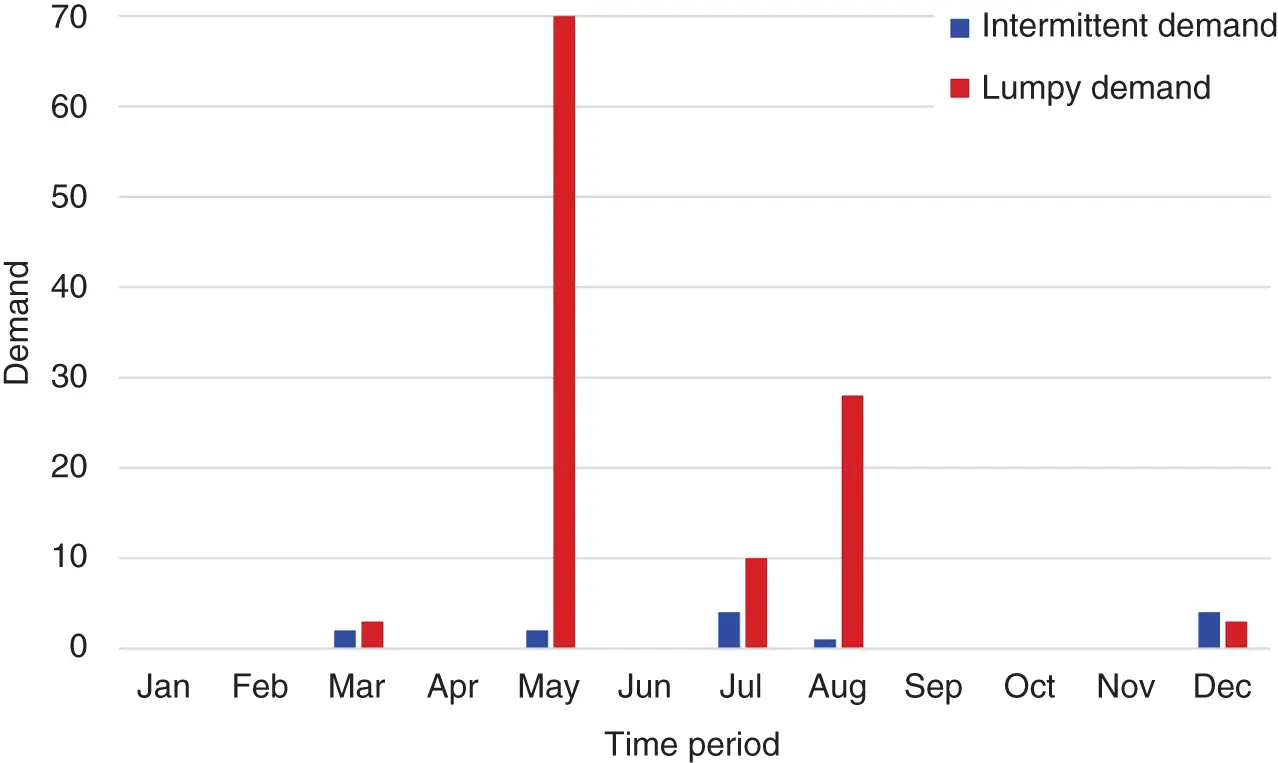
Figure 1.1 Intermittent and lumpy demand.
Source: Boylan and Syntetos (2008). ©2008, Springer Nature.
We shall return to robustness and statistical optimality in later chapters but, for the time being, it is sufficient to say that robustness is essential in practical applications. While optimality is desirable, it should not be at the expense of robustness. Many of the methods to be discussed in this book have been found to be robust by such software companies as Blue Yonder, LLamasoft, Slimstock, and Syncron International, helping their customers to dramatically reduce inventory costs.
1.4.2 Business Context
With robustness in mind, this book presents a range of approaches to intermittent demand forecasting that are applicable in any industrial make to stock (MTS) setting. In addition to an MTS setting, unless otherwise specified, we focus on single stock keeping unit (SKU), single stocking location environments, as explained below.
Читать дальшеИнтервал:
Закладка:
Похожие книги на «Intermittent Demand Forecasting»
Представляем Вашему вниманию похожие книги на «Intermittent Demand Forecasting» списком для выбора. Мы отобрали схожую по названию и смыслу литературу в надежде предоставить читателям больше вариантов отыскать новые, интересные, ещё непрочитанные произведения.











Обсуждение, отзывы о книге «Intermittent Demand Forecasting» и просто собственные мнения читателей. Оставьте ваши комментарии, напишите, что Вы думаете о произведении, его смысле или главных героях. Укажите что конкретно понравилось, а что нет, и почему Вы так считаете.