John E. Boylan - Intermittent Demand Forecasting
Здесь есть возможность читать онлайн «John E. Boylan - Intermittent Demand Forecasting» — ознакомительный отрывок электронной книги совершенно бесплатно, а после прочтения отрывка купить полную версию. В некоторых случаях можно слушать аудио, скачать через торрент в формате fb2 и присутствует краткое содержание. Жанр: unrecognised, на английском языке. Описание произведения, (предисловие) а так же отзывы посетителей доступны на портале библиотеки ЛибКат.
- Название:Intermittent Demand Forecasting
- Автор:
- Жанр:
- Год:неизвестен
- ISBN:нет данных
- Рейтинг книги:5 / 5. Голосов: 1
-
Избранное:Добавить в избранное
- Отзывы:
-
Ваша оценка:
Intermittent Demand Forecasting: краткое содержание, описание и аннотация
Предлагаем к чтению аннотацию, описание, краткое содержание или предисловие (зависит от того, что написал сам автор книги «Intermittent Demand Forecasting»). Если вы не нашли необходимую информацию о книге — напишите в комментариях, мы постараемся отыскать её.
The first text to focus on the methods and approaches of intermittent, rather than fast, demand forecasting
Intermittent Demand Forecasting No prior knowledge of intermittent demand forecasting or inventory management is assumed in this book. The key formulae are accompanied by worked examples to show how they can be implemented in practice. For those wishing to understand the theory in more depth, technical notes are provided at the end of each chapter, as well as an extensive and up-to-date collection of references for further study. Software developments are reviewed, to give an appreciation of the current state of the art in commercial and open source software.
“Intermittent demand forecasting may seem like a specialized area but actually is at the center of sustainability efforts to consume less and to waste less. Boylan and Syntetos have done a superb job in showing how improvements in inventory management are pivotal in achieving this. Their book covers both the theory and practice of intermittent demand forecasting and my prediction is that it will fast become the bible of the field.” —
, Professor, University of Nicosia, and Director, Institute for the Future and the Makridakis Open Forecasting Center (MOFC).
“We have been able to support our clients by adopting many of the ideas discussed in this excellent book, and implementing them in our software. I am sure that these ideas will be equally helpful for other supply chain software vendors and for companies wanting to update and upgrade their capabilities in forecasting and inventory management.”—
, VP, Research and Development, Blue Yonder.
“As product variants proliferate and the pace of business quickens, more and more items have intermittent demand. Boylan and Syntetos have long been leaders in extending forecasting and inventory methods to accommodate this new reality. Their book gathers and clarifies decades of research in this area, and explains how practitioners can exploit this knowledge to make their operations more efficient and effective.”—
, Professor Emeritus, Rensselaer Polytechnic Institute.
Intermittent Demand Forecasting — читать онлайн ознакомительный отрывок
Ниже представлен текст книги, разбитый по страницам. Система сохранения места последней прочитанной страницы, позволяет с удобством читать онлайн бесплатно книгу «Intermittent Demand Forecasting», без необходимости каждый раз заново искать на чём Вы остановились. Поставьте закладку, и сможете в любой момент перейти на страницу, на которой закончили чтение.
Интервал:
Закладка:
Library of Congress Cataloging‐in‐Publication Data applied for
ISBN 978-1-119-97608-0 (hardback); LCCN - 2021011006
Cover Design: Wiley
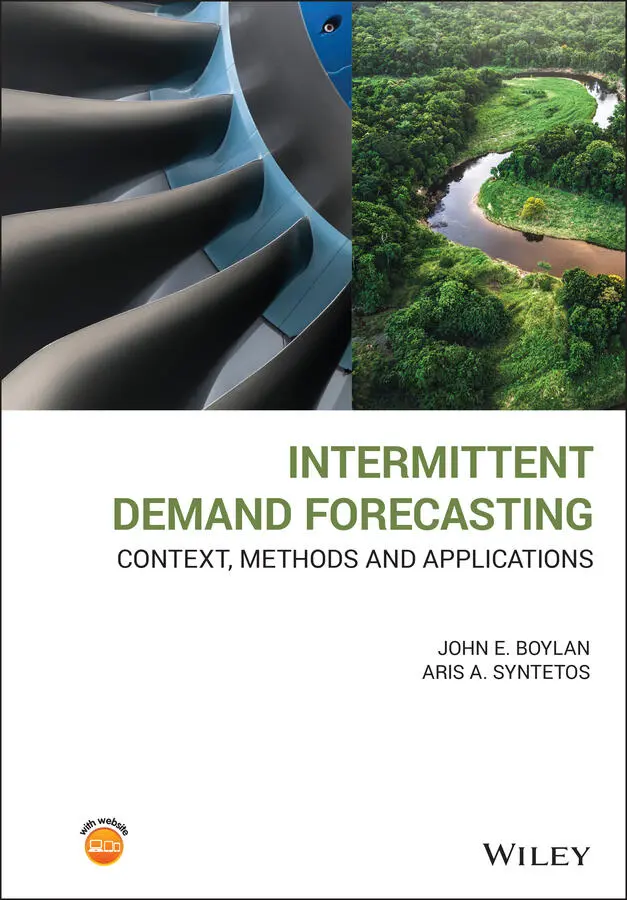
Cover Image: Mata Atlantica - Atlantic Forest in Brazil © FG Trade/Getty Images, Turbine © Brasil2/Getty Images
For Jan and Rachel
Preface
The images on the front of this book highlight a crucial tension for all advanced economies. There is a desire to travel more and consume more, but also a growing awareness of the detrimental effects that this is having on the environment. There is a belated realisation that those of us living in countries with developed economies need to consume less and waste less.
Waste can occur at all stages of the supply chain. Consumers may buy food they never eat or clothes they never wear. Retailers and wholesalers may order goods from manufacturers that never sell. These wastages can be significantly reduced by better demand forecasting and inventory management. Some items conform to regular demand patterns and are relatively easy to forecast. Other items, with irregular and intermittent demand patterns, are much harder.
Wastage can be addressed by changes in production, moving away from built‐in obsolescence and towards products that can be maintained and repaired economically. For this to be an attractive proposition, spare parts need to be readily available. Unfortunately, these items are often the most difficult to forecast because many of them are subject to the sporadic nature of intermittent demand. Although there have been significant advances in intermittent demand forecasting over recent decades, these are not all available in commercial software. In the final chapter of this book, we highlight the progress that has been made, including methods that are freely available in open source software.
The reasons for the slow adoption of new forecasting methods and approaches in commercial software are varied. We believe that one of the reasons is a lack of appreciation of the benefits that may accrue. Because intermittent demand items are so difficult to forecast, it may be thought that highly accurate forecasting methods can never be found. This may be true. However, it is possible to find more accurate methods, which can contribute towards significant improvements in inventory management.
There is also a need for greater awareness of the methods that have been developed in recent years. Information on them is scattered amongst a variety of academic journals, and some of the articles are highly technical. Therefore, we have set ourselves the challenge of synthesizing this body of knowledge. We have endeavoured to bring together the main strands of research into a coherent whole, and assuming no prior knowledge of the subject.
There are various perspectives from which demand forecasting can be addressed. One option would be to take an operations management view, with a focus on forecasting and planning processes. Another would be to take a more statistical perspective, starting with mathematical models and working through their properties. While some of our material has been influenced by these orientations, the dominant perspective of this book is that of operational research (OR). The start point of OR should always be the real‐life situation that is encountered. This means that it is essential to gain an in‐depth understanding of inventory systems and how forecasts inform these decisions. Such an appreciation enables a sharper focus on forecasting requirements and the appropriate criteria for a ‘good forecast’.
In this book, the first three chapters focus on the inventory management context in which forecasting occurs, including the inventory policies and the service level measures that are appropriate for intermittent demand. Recognising the interconnection between inventory policies, demand distributions, and forecasting methods, the next two chapters focus on demand distributions, including evidence from studies of real‐world data. The following two chapters concentrate on forecasting methods, with discussion of practical issues that must be addressed in their implementation. We then turn to the linkage between forecasts and inventory availability, and review how forecast accuracy should be measured and how its implications for inventories should be assessed. We also look at how stock keeping units should be classified for forecasting purposes, and examine methods designed specifically to address maintenance and obsolescence. The next two chapters deal with methods that can tackle more challenging demand patterns. We conclude with a review of forecasting software requirements and our views on the way forward.
We are grateful to those pioneers who inspired us to study this subject, and who have given us valuable advice over the years, especially John Croston, Roy Johnston, and Tom Willemain. We would like to express our thanks to those who commented on draft chapters of this book: Zied Babai, Stephen Disney, Robert Fildes, Thanos Goltsos, Matteo Kalchschmidt, Stephan Kolassa, Nikos Kourentzes, Mona Mohammadipour, Erica Pastore, Fotios Petropoulos, Dennis Prak, Anna‐Lena Sachs, and Ivan Svetunkov; and to Nicole Ayiomamitou and Antonis Siakallis who helped with the figures.
Lancaster and Cardiff
January 2021
John E. Boylan
Aris A. Syntetos
Glossary
ADIDAaggregate–disaggregate intermittent demand approachAICAkaike information criterionARautoregressiveARIMAautoregressive integrated moving averageARMAautoregressive moving averageAPEabsolute percentage errorBObackorderBoMbill of materialsBSBrier scoreCDFcumulative distribution functionCFEcumulative forecast errorCSLcycle service level (all replenishment cycles)  cycle service level (replenishment cycles with some demand)CVcoefficient of variationEDFempirical distribution functionERPenterprise resource planningFMECAfailure mode, effects, and criticality analysisFRfill rateFSSforecast support systemFVAforecast value addedHEShyperbolic exponential smoothingINARinteger autoregressiveINARMAinteger autoregressive moving averageINMAinteger moving averageIPinventory positionKSKolmogorov–Smirnov (test)LTDlead‐time demandMAmoving averageMADmean absolute deviationMAEmean absolute errorMAPEmean absolute percentage errorMAPEFFmean absolute percentage error from forecastMASEmean absolute scaled errorMEmean errorMMSEminimum mean square errorMPEmean percentage errorMPSmaster production scheduleMROmaintenance, repair, and operationsMRPmaterial requirements planningMSEmean square errorMSOEmultiple source of errorMTOmake to orderMTSmake to stockNBDnegative binomial distributionNNneural networkNOBnon‐overlapping blocksOBoverlapping blocksOUTorder up toPISperiods in stockPITprobability integral transformRMSEroot mean square errorrPITrandomised probability integral transformS&OPsales and operations planningSBASyntetos–Boylan Approximation (method)SBCSyntetos–Boylan–Croston (classification)SCMsupply chain managementSESsingle (or simple) exponential smoothingSKUstock keeping unitSLAservice level agreementSMAsimple moving averagesMAPEsymmetric mean absolute percentage errorsMSEscaled mean square errorSOHstock on handSOOstock on orderSSOEsingle source of errorTSBTeunter–Syntetos–Babai (method)VZViswanathan–Zhou (method)WMHWright Modified Holt (method)WSSWillemain–Smart–Schwarz (method)
About the Companion Website
This book is accompanied by a companion website.
www.wiley.com/go/boylansyntetos/intermittentdemandforecasting 
Интервал:
Закладка:
Похожие книги на «Intermittent Demand Forecasting»
Представляем Вашему вниманию похожие книги на «Intermittent Demand Forecasting» списком для выбора. Мы отобрали схожую по названию и смыслу литературу в надежде предоставить читателям больше вариантов отыскать новые, интересные, ещё непрочитанные произведения.










Обсуждение, отзывы о книге «Intermittent Demand Forecasting» и просто собственные мнения читателей. Оставьте ваши комментарии, напишите, что Вы думаете о произведении, его смысле или главных героях. Укажите что конкретно понравилось, а что нет, и почему Вы так считаете.