John E. Boylan - Intermittent Demand Forecasting
Здесь есть возможность читать онлайн «John E. Boylan - Intermittent Demand Forecasting» — ознакомительный отрывок электронной книги совершенно бесплатно, а после прочтения отрывка купить полную версию. В некоторых случаях можно слушать аудио, скачать через торрент в формате fb2 и присутствует краткое содержание. Жанр: unrecognised, на английском языке. Описание произведения, (предисловие) а так же отзывы посетителей доступны на портале библиотеки ЛибКат.
- Название:Intermittent Demand Forecasting
- Автор:
- Жанр:
- Год:неизвестен
- ISBN:нет данных
- Рейтинг книги:5 / 5. Голосов: 1
-
Избранное:Добавить в избранное
- Отзывы:
-
Ваша оценка:
Intermittent Demand Forecasting: краткое содержание, описание и аннотация
Предлагаем к чтению аннотацию, описание, краткое содержание или предисловие (зависит от того, что написал сам автор книги «Intermittent Demand Forecasting»). Если вы не нашли необходимую информацию о книге — напишите в комментариях, мы постараемся отыскать её.
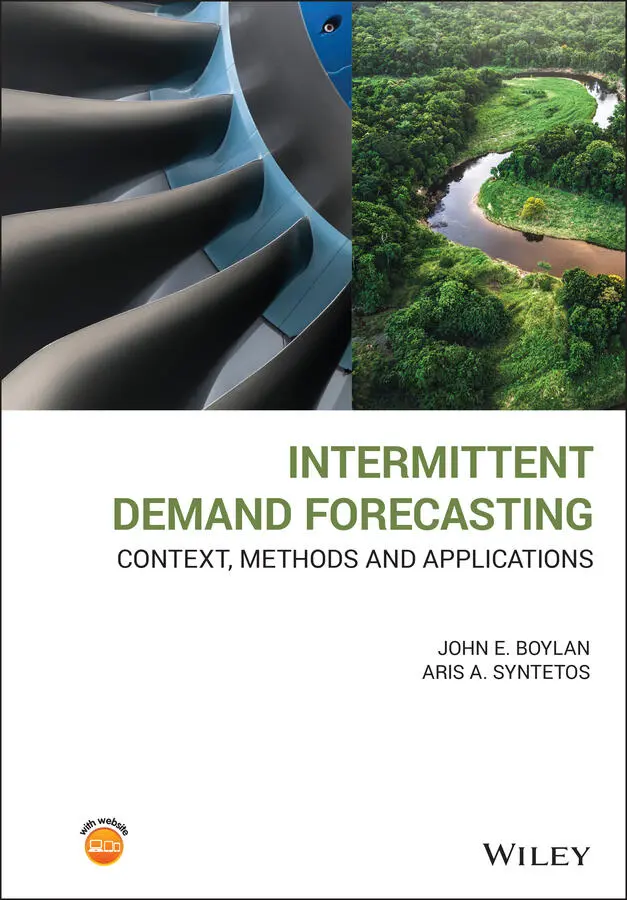
The first text to focus on the methods and approaches of intermittent, rather than fast, demand forecasting
Intermittent Demand Forecasting No prior knowledge of intermittent demand forecasting or inventory management is assumed in this book. The key formulae are accompanied by worked examples to show how they can be implemented in practice. For those wishing to understand the theory in more depth, technical notes are provided at the end of each chapter, as well as an extensive and up-to-date collection of references for further study. Software developments are reviewed, to give an appreciation of the current state of the art in commercial and open source software.
“Intermittent demand forecasting may seem like a specialized area but actually is at the center of sustainability efforts to consume less and to waste less. Boylan and Syntetos have done a superb job in showing how improvements in inventory management are pivotal in achieving this. Their book covers both the theory and practice of intermittent demand forecasting and my prediction is that it will fast become the bible of the field.” —
, Professor, University of Nicosia, and Director, Institute for the Future and the Makridakis Open Forecasting Center (MOFC).
“We have been able to support our clients by adopting many of the ideas discussed in this excellent book, and implementing them in our software. I am sure that these ideas will be equally helpful for other supply chain software vendors and for companies wanting to update and upgrade their capabilities in forecasting and inventory management.”—
, VP, Research and Development, Blue Yonder.
“As product variants proliferate and the pace of business quickens, more and more items have intermittent demand. Boylan and Syntetos have long been leaders in extending forecasting and inventory methods to accommodate this new reality. Their book gathers and clarifies decades of research in this area, and explains how practitioners can exploit this knowledge to make their operations more efficient and effective.”—
, Professor Emeritus, Rensselaer Polytechnic Institute.
Intermittent Demand Forecasting — читать онлайн ознакомительный отрывок
Ниже представлен текст книги, разбитый по страницам. Система сохранения места последней прочитанной страницы, позволяет с удобством читать онлайн бесплатно книгу «Intermittent Demand Forecasting», без необходимости каждый раз заново искать на чём Вы остановились. Поставьте закладку, и сможете в любой момент перейти на страницу, на которой закончили чтение.
Интервал:
Закладка:
In this book, we consider the case of stochastic demand in make to stock environments. (For an interesting discussion on how intermittent demand may be treated in MTO environments, please refer to the work of Bartezzaghi and Verganti 1995, briefly summarised in Technical Note 2.1.) But given the fact that demand is inherently slow moving, is it always worthwhile keeping an item in stock? This issue is discussed in Section 2.3. In practice, it should be addressed before determining ordering policies and their forecasting requirements.
2.2.4 Summary
There is great scope for advancing the inventory control practices for intermittent demand items. We treat intermittent demand as independent and do not expand further on MRP because the principal forecasting task relates to independent demand items. Dependent demand items present challenges relating to the planning of manufacturing but do not require a forecasting system if orders are known in advance and the items can be obtained within the requisite time frame.
In Section 2.3, we address a fundamental problem in this area, which is whether to stock an item or not. Given a positive stocking decision, follow‐up decisions relate to determining how much to stock and when to replenish. These decisions depend on the stock rules that are in use, and we continue with an overview of appropriate inventory control rules for intermittent demand items. We conclude that, in general, the periodic order‐up‐to (OUT) level policy is appropriate for managing intermittent demand inventories. In the next chapter, we distinguish between systems that are driven by service and cost considerations. In Chapters 4and 5, we determine what needs to be forecasted to allow inventory decisions to be made.
2.3 Should an Item Be Stocked at All?
A considerable amount of effort is expended by organisations to optimise inventory levels. This is expected, if we consider the huge inventory investments made in industry. Consider, for example, a car manufacturer investing £10 million in inventories of service parts to sustain their after‐sales operations in Europe. A mere 5% reduction of their stock levels translates automatically to £500 000 savings that may be invested in other business areas, or account towards an increase in their profit margin. There are two ways of achieving such savings: (i) ceasing to replenish stock for some items; (ii) continuing to replenish stock for other items but reducing the quantities held. Sometimes, an organisation may become preoccupied with the second option, drawing their attention away from the equally important problem, for SKUs with intermittent demand, of whether the item should be kept in stock at all. The decision to stop replenishing an item does not necessarily coincide with the decision to write off stock from the accounts ( Technical Note 2.2).
Of course, management of spare parts is often subject to very specific contractual agreements, such as the obligation to service a piece of equipment by carrying items in stock for an agreed length of time. In these cases, ceasing to replenish an item is obviously not an option. Similarly, the life cycle phase of a product or a service part often dictates inventory decisions beyond cost optimisation. For example, even if it is potentially cost‐optimal not to stock an item in the introductory phase of its life cycle, high service requirements may result in always keeping some stock to satisfy demand.
Moreover, it is important to note that service levels are often targeted and measured on an ‘order’ rather than individual SKU basis. An order consists of a number of units requested for a number of items, and some organisations target the percentage of orders (rather than items) completely satisfied directly from stock on hand. (This is the ‘order fill rate’, which is further discussed in Chapter 3.) In this case, a non‐stock decision, taken on the basis of individual SKU requirements only, may be reversed based on collective considerations.
2.3.1 Stock/Non‐Stock Decision Rules
Having taken contractual and other constraints into account, a careful evaluation of whether an item should be stocked at all is needed. Such decisions typically rely upon an evaluation of the cost of keeping an item in stock, and the cost of not having an item in stock (see, for example, Croston 1974; Tavares and Almeida 1983). These are the two pillars upon which much inventory theory has been built, and so a detailed discussion of them is warranted.
The cost of keeping an item in stock is typically estimated based on the inventory holding charge (  ), which is used to calculate the cost of keeping one unit of a particular item in stock over a specified time interval (unit time). The inventory holding charge is invariably expressed as a fraction applied to the unit cost of an item (
  ). Suppose for example that we operate with monthly time units and the inventory holding charge for a particular item is
  for each item unit per unit of time (one month in this case). Further assume that the cost of this item is
  . Then it costs £10 (
  multiplied by
  ) to keep one unit of this item in stock for a month. The inventory holding charge is typically determined in an approximate manner to reflect such costs as the opportunity cost (i.e. the cost of not being able to invest the money, tied up in stock, elsewhere), warehousing space costs, potential pilferage and spoilage, and cost of obsolescence.
Usually, the inventory holding charge is set to be the same across an entire stock base. (At the time of writing, inventory holding charges in the range 10%–25% over a year reflect a good proportion of real‐world cases.) However, this ignores the fact that intermittent demand items have a higher risk of obsolescence. This should be reflected by inventory holding charges that are higher than those imposed on faster‐moving SKUs. Better informed inventory systems do distinguish between non‐intermittent and intermittent SKUs, fixing the inventory holding charge for the former category and appropriately inflating it for the latter. The necessary degree of inflation depends on the industry and the nature of the products, which determines both the cost and environmental implications of disposing of an obsolete item. In our experience, it would vary between 3% and 5% over and above the inventory holding charge assumed for the faster‐moving SKUs (see, for example, Trimp et al. 2004). The inventory holding charge does not take into account ordering costs, which are often omitted from stock/non‐stock rules. Ordering costs do tend to feature in determining inventory replenishment policies, to be discussed later in this chapter.
The cost of not having an item in stock is typically estimated based on a charge that specifies the penalty cost of running out of stock. Such a charge will be different for cases where sales are lost and those where unsatisfied demand may be backordered (i.e. satisfied as soon as some stock becomes available again). Let us focus on the backorder case here; we return to the differences between lost sales and backordered demand later in the chapter. The backordering charge (  ) may take different forms: (i) a specified fractional charge (of the unit cost) per unit short (regardless of the duration of the stockout) or (ii) a specified fractional charge per unit short per unit time.
Интервал:
Закладка:
Похожие книги на «Intermittent Demand Forecasting»
Представляем Вашему вниманию похожие книги на «Intermittent Demand Forecasting» списком для выбора. Мы отобрали схожую по названию и смыслу литературу в надежде предоставить читателям больше вариантов отыскать новые, интересные, ещё непрочитанные произведения.










Обсуждение, отзывы о книге «Intermittent Demand Forecasting» и просто собственные мнения читателей. Оставьте ваши комментарии, напишите, что Вы думаете о произведении, его смысле или главных героях. Укажите что конкретно понравилось, а что нет, и почему Вы так считаете.