John E. Boylan - Intermittent Demand Forecasting
Здесь есть возможность читать онлайн «John E. Boylan - Intermittent Demand Forecasting» — ознакомительный отрывок электронной книги совершенно бесплатно, а после прочтения отрывка купить полную версию. В некоторых случаях можно слушать аудио, скачать через торрент в формате fb2 и присутствует краткое содержание. Жанр: unrecognised, на английском языке. Описание произведения, (предисловие) а так же отзывы посетителей доступны на портале библиотеки ЛибКат.
- Название:Intermittent Demand Forecasting
- Автор:
- Жанр:
- Год:неизвестен
- ISBN:нет данных
- Рейтинг книги:5 / 5. Голосов: 1
-
Избранное:Добавить в избранное
- Отзывы:
-
Ваша оценка:
Intermittent Demand Forecasting: краткое содержание, описание и аннотация
Предлагаем к чтению аннотацию, описание, краткое содержание или предисловие (зависит от того, что написал сам автор книги «Intermittent Demand Forecasting»). Если вы не нашли необходимую информацию о книге — напишите в комментариях, мы постараемся отыскать её.
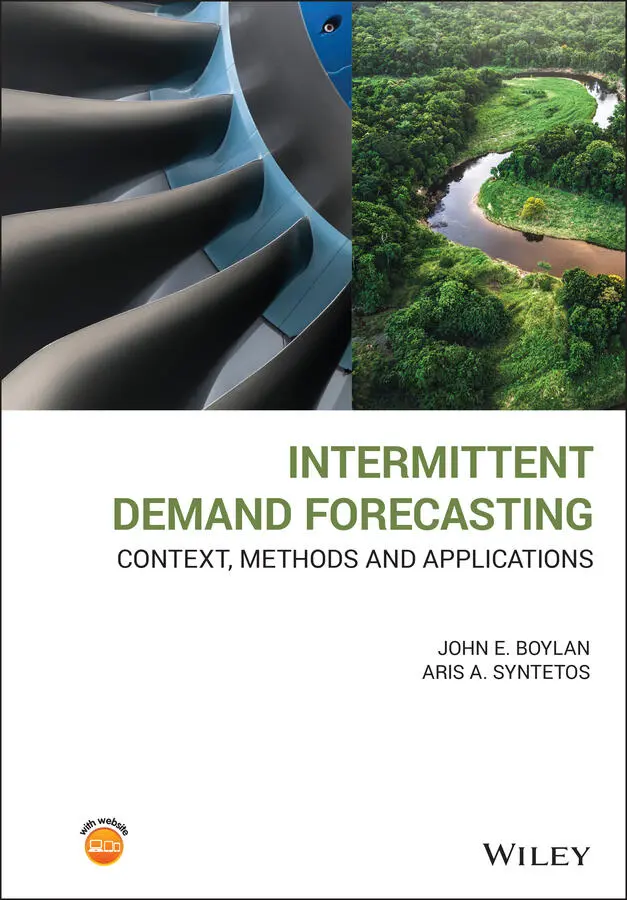
The first text to focus on the methods and approaches of intermittent, rather than fast, demand forecasting
Intermittent Demand Forecasting No prior knowledge of intermittent demand forecasting or inventory management is assumed in this book. The key formulae are accompanied by worked examples to show how they can be implemented in practice. For those wishing to understand the theory in more depth, technical notes are provided at the end of each chapter, as well as an extensive and up-to-date collection of references for further study. Software developments are reviewed, to give an appreciation of the current state of the art in commercial and open source software.
“Intermittent demand forecasting may seem like a specialized area but actually is at the center of sustainability efforts to consume less and to waste less. Boylan and Syntetos have done a superb job in showing how improvements in inventory management are pivotal in achieving this. Their book covers both the theory and practice of intermittent demand forecasting and my prediction is that it will fast become the bible of the field.” —
, Professor, University of Nicosia, and Director, Institute for the Future and the Makridakis Open Forecasting Center (MOFC).
“We have been able to support our clients by adopting many of the ideas discussed in this excellent book, and implementing them in our software. I am sure that these ideas will be equally helpful for other supply chain software vendors and for companies wanting to update and upgrade their capabilities in forecasting and inventory management.”—
, VP, Research and Development, Blue Yonder.
“As product variants proliferate and the pace of business quickens, more and more items have intermittent demand. Boylan and Syntetos have long been leaders in extending forecasting and inventory methods to accommodate this new reality. Their book gathers and clarifies decades of research in this area, and explains how practitioners can exploit this knowledge to make their operations more efficient and effective.”—
, Professor Emeritus, Rensselaer Polytechnic Institute.
Intermittent Demand Forecasting — читать онлайн ознакомительный отрывок
Ниже представлен текст книги, разбитый по страницам. Система сохранения места последней прочитанной страницы, позволяет с удобством читать онлайн бесплатно книгу «Intermittent Demand Forecasting», без необходимости каждый раз заново искать на чём Вы остановились. Поставьте закладку, и сможете в любой момент перейти на страницу, на которой закончили чтение.
Интервал:
Закладка:
In the first case, the backordering charge is typically set subjectively to reflect costs arising from expediting orders, loss of customers' goodwill, and negative word of mouth publicity. Expediting charges arise by ordering emergency replenishments from suppliers, which come at a (considerably) higher cost than normal replenishments.
The second case is more relevant in a maintenance spare parts context, as each unit short could result, for example, in a machine being idled, with the idle time being equal to the duration of the shortage. So, for the example considered above (with monthly time units and  ), if
), if  /unit short/unit time, it costs
  per unit short per month.
In both cases, the backordering charge is typically in the range of 5 up to 30 (or even more) times higher than the inventory holding charge, and this reflects the asymmetric costs of under‐stocking and over‐stocking. All else being equal, it always costs more to run out of stock by one unit than to keep in stock one unit that remains unused over a unit time period.
Then, why do we consider the possibility of not stocking an item at all? This is because, over time, it may indeed be more beneficial to allow for a potential (forthcoming) shortage, rather than having to carry an item in stock for a very long time. For example, if  is five times
  , and (for monthly time buckets) unit sized demands occur on average every six months or more, then it is cost beneficial not to stock that particular item.
Early work in this area by Tavares and Almeida (1983) proposed a rule, along the lines discussed above, for the stock control of very slow moving spare parts in large production systems, such as ship repair yards and light steel mills. The decision rule was developed in order to decide whether it is economic to have one item in stock or none. In particular, a threshold level of the mean demand was proposed, equal to  , the ratio of the holding charge (
  ) to the backordering charge (
  ), with the latter covering additional delivery and penalty costs. The mean demand per unit time (
  ) is then compared to that threshold value in order to make a decision. If the mean demand is less than the threshold, then the recommended stock (
  ) is zero; if the mean demand is greater than (or equal to) the threshold, then the recommended stock is one, as shown in Eq. (2.1).
(2.1) 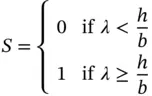
For the example offered above,  . So if the mean demand is
  (one unit is requested for that item every six months, on average), then we should not stock that item. (The symbol
  [lambda] is often used to denote the mean demand per unit time, and it is the standard symbol for the mean of the Poisson distribution, to be discussed in Chapter 4.)
Johnston et al. (2011) examined the inventory system at Euro Car Parts and demonstrated that, for practical purposes, stock/non‐stock decisions may rely upon the number of movements over a particular time interval. ‘Movements’ are demand incidences that lead to an issue of stock. For unit sized demands, the number of demand incidences is equal to the demand over the same time interval.
The rule offered by Johnston et al. (2011) was derived empirically, following a comprehensive analysis of the stock base of the company. The researchers evaluated the stockout and inventory implications associated with alternative stock/non‐stock cut‐off points and found that a boundary of three movements (over a year) offered the best results: if there are three or more movements per year, then stock this item; else, do not keep it in stock. The implementation of the new rule at Euro Car Parts resulted in a 29% improvement in stock turn, at a time when no other major changes were made to the distribution system. (Stock turn, also known as inventory turnover, measures how many times an organisation has sold and replaced inventory during a given period and is discussed further in Chapter 3.)
2.3.2 Historical or Forecasted Demand?
In both of the papers discussed above, historical demand was employed. However, it has been argued that forecasted demand is more relevant for the stocking decision (Boylan 2018). It is the demand that is anticipated over the future that should determine an item's viability. The decision rules do not change their form as a consequence of this different perspective. All that changes is that forecasted mean demand (or number of movements) is used instead of the historical mean demand (or number of movements). The focus on the mean value is natural as the rules are based on the expected (mean) costs associated with stocking or not stocking an item.
The problem of whether to stock becomes particularly important when either products or spare parts reach the end of their life cycle, become obsolete, and are not being requested often or, eventually, at all. In Chapter 12, we return to this issue and discuss, in more detail, forecasting methods that have been proposed to estimate mean demand whilst allowing for explicit linkages to be made between the forecasting task and inventory obsolescence. More common methods for intermittent demand forecasting will be discussed in Chapter 6.
2.3.3 Summary
Before setting stock levels for intermittent demand items, a decision should be taken as to whether an item should be stocked at all. In some situations, keeping zero stock is not an option. Otherwise, an evaluation of demand is required to determine whether the item should be stocked. Such decisions are typically based on a forecast of the mean demand (discussed in Chapter 6), requiring no estimates of the variability of demand (discussed in Chapter 7), which may be required when deciding on replenishment quantities.
2.4 Inventory Control Requirements
Assuming that it is cost beneficial to keep replenishing a particular item in stock, the next important decision relates to how much to keep in stock for that item. Stock levels depend on the size of replenishment orders and how often these orders are placed on the supplier(s). Raising an order is not cost free. Therefore, in addition to the costs previously discussed, of holding inventories and the cost of running out of inventories, another cost factor comes into the equation, that of ordering inventories, as shown in Eq. (2.2).
Читать дальшеИнтервал:
Закладка:
Похожие книги на «Intermittent Demand Forecasting»
Представляем Вашему вниманию похожие книги на «Intermittent Demand Forecasting» списком для выбора. Мы отобрали схожую по названию и смыслу литературу в надежде предоставить читателям больше вариантов отыскать новые, интересные, ещё непрочитанные произведения.










Обсуждение, отзывы о книге «Intermittent Demand Forecasting» и просто собственные мнения читателей. Оставьте ваши комментарии, напишите, что Вы думаете о произведении, его смысле или главных героях. Укажите что конкретно понравилось, а что нет, и почему Вы так считаете.