Lee G. Bolman - Reframing Organizations
Здесь есть возможность читать онлайн «Lee G. Bolman - Reframing Organizations» — ознакомительный отрывок электронной книги совершенно бесплатно, а после прочтения отрывка купить полную версию. В некоторых случаях можно слушать аудио, скачать через торрент в формате fb2 и присутствует краткое содержание. Жанр: unrecognised, на английском языке. Описание произведения, (предисловие) а так же отзывы посетителей доступны на портале библиотеки ЛибКат.
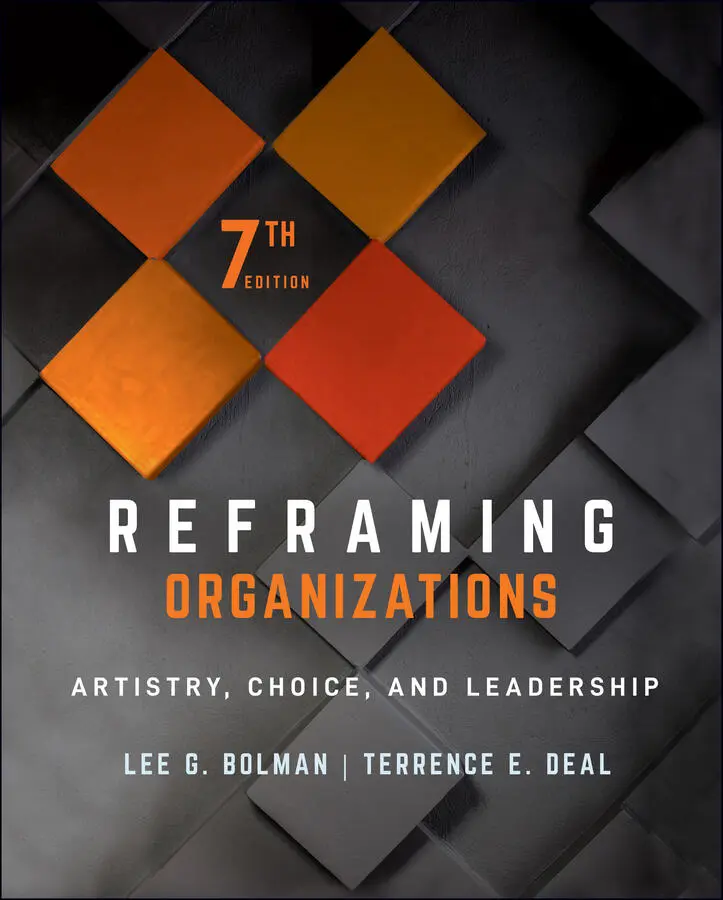
- Название:Reframing Organizations
- Автор:
- Жанр:
- Год:неизвестен
- ISBN:нет данных
- Рейтинг книги:4 / 5. Голосов: 1
-
Избранное:Добавить в избранное
- Отзывы:
-
Ваша оценка:
Reframing Organizations: краткое содержание, описание и аннотация
Предлагаем к чтению аннотацию, описание, краткое содержание или предисловие (зависит от того, что написал сам автор книги «Reframing Organizations»). Если вы не нашли необходимую информацию о книге — напишите в комментариях, мы постараемся отыскать её.
The Structural Frame The Human Resource Frame The Political Frame The Symbolic Frame The
has been updated with new information on cross-sector collaboration, generational differences, virtual environments, globalization, cross-cultural communication, and more, with an expanded Instructor’s Guide that includes summaries, mini-assessments, videos, and extra resources.
Reframing Organizations — читать онлайн ознакомительный отрывок
Ниже представлен текст книги, разбитый по страницам. Система сохранения места последней прочитанной страницы, позволяет с удобством читать онлайн бесплатно книгу «Reframing Organizations», без необходимости каждый раз заново искать на чём Вы остановились. Поставьте закладку, и сможете в любой момент перейти на страницу, на которой закончили чтение.
Интервал:
Закладка:
Akira Kurosawa's classic film Rashomon recounts the same event through the eyes of several witnesses. Each tells a different story. Similarly, organizations are filled with people who have divergent interpretations of what is and should be happening. Each version contains glimmers of truth, but each is a product of the prejudices and blind spots of its maker. Each frame tells a different story (Gottschall, 2012), but no single story is comprehensive enough to make an organization fully understandable or manageable. Effective managers need frames to generate multiple stories, the skill to sort through the alternatives, and the wisdom to match the right story to the situation. 6
Lack of imagination—Langer (1989) calls it “mindlessness”—is a major cause of the shortfall between the reach and the grasp of so many organizations—the empty chasm between noble aspirations and disappointing results. The gap is painfully acute in a world where organizations dominate so much of our lives. Taleb (2007) depicts events like the Covid‐19 pandemic or the 9/11 attacks as “black swans”—novel events that are unexpected because we have never seen them before. If every swan we've observed is white, we expect the same in the future. But fateful, make‐or‐break events are more likely to fall outside previous experience and catch us flat‐footed, as was true of the 2020 pandemic. Imagination and mindfulness offer our best chance for being ready when a black swan sails into view, and multi‐frame thinking is a powerful stimulus to the broad, creative mind‐set imagination requires.
Engineering and Art
Exhibit 1.3presents two contrasting approaches to management and leadership. One is a rational‐technical mind‐set emphasizing certainty and control. The other is an expressive, artistic conception encouraging flexibility, creativity, and interpretation. The first portrays managers as technicians; the second sees them as artists.
Exhibit 1.3. Expanding Managerial Thinking.
| How Managers Often Think | How Managers Might Think |
|---|---|
| Oversimplify reality (for example, blame problems on individuals' flaws and errors) | Think holistically about a full range of significant issues: people, power, structure, and symbols |
| Regardless of the problems at hand, rely on facts, logic, restructuring | Use feeling and intuition as well as logic, bargaining as well as training, celebration as well as reorganization |
| Cling to certainty, rationality, and control while fearing ambiguity, paradox, and “going with the flow” | Develop creativity, risk taking, and playfulness in response to life's dilemmas and paradoxes, and focus as much on finding the right question as the right answer, on finding meaning and faith amid clutter and confusion |
| Rely on the “one right answer” and the “one best way” | Show passionate, unwavering commitment to principle, combined with flexibility in understanding and responding to events |
Artists interpret experience and express it in forms that can be felt, understood, and appreciated by others. Art embraces emotion, subtlety, ambiguity. An artist reframes the world so others can see new possibilities. Modern organizations often rely too much on engineering and too little on art in searching for quality, commitment, and creativity. Art is not a replacement for engineering but an enhancement and a powerful partner. Artistic leaders and managers help us look and probe beyond today's reality to new forms that release untapped individual energies and improve collective performance. The leader as artist relies on abstract images as well as memos, poetry as well as policy, reflection as well as command, and reframing as well as refitting.
CONCLUSION
As organizations have become pervasive and dominant, they have also become harder to understand and manage. The result is that managers are often nearly as clueless as their subordinates (the Dilberts of the world) think they are. The consequences of myopic management and leadership show up every day, sometimes in small and subtle ways, sometimes in large and blatant catastrophes. Think of the enormous differences in levels of suffering and death between the relatively few countries that contained the Covid‐19 pandemic effectively, and the many that did not. Our basic premise is that a primary cause of managerial failure is faulty thinking rooted in inadequate ideas and truncated possibilities. Managers and those who try to help them too often rely on narrow models that capture only part of organizational life.
Learning multiple perspectives, or frames, is a defense against thrashing around without a clue about what you are doing or why. Frames serve multiple functions. They are sources of new questions, filters for sorting essence from trivia, maps that aid navigation, and tools for solving problems and getting things done. This book is organized around four frames rooted in both managerial wisdom and social science knowledge. The structural approach focuses on the architecture of organization—the design of units and subunits, rules and roles, goals and policies. The human resource lens emphasizes understanding people—their strengths and foibles, reason and emotion, desires and fears. The political view sees organizations as competitive arenas of scarce resources, competing interests, and struggles for power and advantage. Finally, the symbolic frame focuses on issues of meaning and faith. It puts ritual, ceremony, story, play, and culture at the heart of organizational life.
Each of the frames is powerful and coherent. Collectively, they make it possible to reframe, looking at the same thing from multiple lenses or points of view. When the world seems hopelessly confusing and nothing is working, reframing is a powerful tool for gaining clarity, regaining balance, generating new questions, and finding options that actually make a difference.
Notes
1 1.Among the possible ways of talking about frames are schemata or schema theory (Fiedler, 1982; Fiske and Dyer, 1985; Lord and Foti, 1986), representations (Frensch and Sternberg, 1991; Lesgold and Lajoie, 1991; Voss, Wolfe, Lawrence, and Engle, 1991), cognitive maps (Weick and Bougon, 1986), paradigms (Gregory, 1983; Kuhn, 1970), social categorizations (Cronshaw, 1987), implicit theories (Brief and Downey, 1983), mental models (Senge, 1990), definitions of the situation, and root metaphors.
2 2.J. R. Latham, [Re]Create the Organization You Really Want!: Leadership and Organization Design for Sustainable Excellence (Colorado Springs, CO: Organization Design Studio, Ltd., 2016).
3 3.Ken Blanchard and Colleen Barrett, Lead with LUV: A Different Way to Create Real Success (Upper Saddle River, NJ: FT Press, 2010), p. 7.
4 4.Jeffrey Pfeffer, Power: Why Some People Have It—and Others Don't (New York: Harper Business, 2010), p. 5.
5 5.Dave Logan, John King, and Halee Fischer‐Wright, Tribal Leadership: Leveraging Natural Groups to Build a Thriving Organization (New York: Harper, 2011), p. 4.
6 6.A number of scholars (including Allison, 1971; Bergquist, 1992; Birnbaum, 1988; Elmore, 1978; Morgan, 1986; Perrow, 1986; Quinn, 1988; Quinn, Faerman, Thompson, and McGrath, 1996; and Scott, 1981) have made similar arguments for multi‐frame approaches to groups and social collectives.
Chapter 2 Simple Ideas, Complex Organizations
The alarm system was ready. Scarred by the SARS epidemic that erupted in 2002, China had created an infectious disease reporting system that officials said was world‐class: fast, thorough and, just as important, immune from meddling. Hospitals could input patients' details into a computer and instantly notify government health authorities in Beijing, where officers are trained to spot and smother contagious outbreaks before they spread.It didn't work.
Читать дальшеИнтервал:
Закладка:
Похожие книги на «Reframing Organizations»
Представляем Вашему вниманию похожие книги на «Reframing Organizations» списком для выбора. Мы отобрали схожую по названию и смыслу литературу в надежде предоставить читателям больше вариантов отыскать новые, интересные, ещё непрочитанные произведения.
![Lee Jungmin - Хвала Орку 1-128 [некоммерческий перевод с корейского]](/books/33159/lee-jungmin-hvala-orku-1-thumb.webp)









Обсуждение, отзывы о книге «Reframing Organizations» и просто собственные мнения читателей. Оставьте ваши комментарии, напишите, что Вы думаете о произведении, его смысле или главных героях. Укажите что конкретно понравилось, а что нет, и почему Вы так считаете.