Lee G. Bolman - Reframing Organizations
Здесь есть возможность читать онлайн «Lee G. Bolman - Reframing Organizations» — ознакомительный отрывок электронной книги совершенно бесплатно, а после прочтения отрывка купить полную версию. В некоторых случаях можно слушать аудио, скачать через торрент в формате fb2 и присутствует краткое содержание. Жанр: unrecognised, на английском языке. Описание произведения, (предисловие) а так же отзывы посетителей доступны на портале библиотеки ЛибКат.
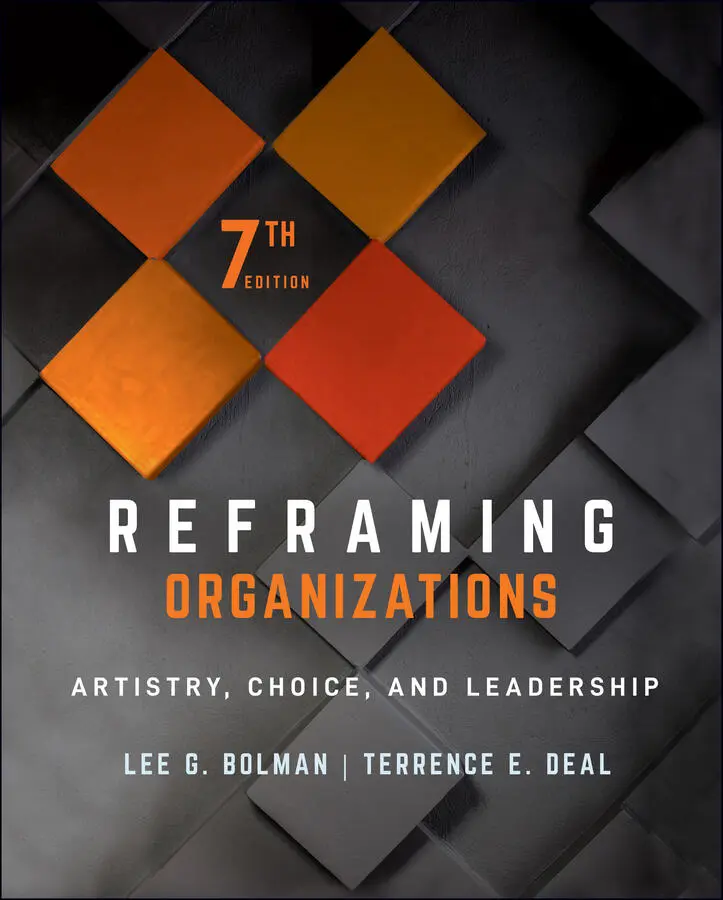
- Название:Reframing Organizations
- Автор:
- Жанр:
- Год:неизвестен
- ISBN:нет данных
- Рейтинг книги:4 / 5. Голосов: 1
-
Избранное:Добавить в избранное
- Отзывы:
-
Ваша оценка:
Reframing Organizations: краткое содержание, описание и аннотация
Предлагаем к чтению аннотацию, описание, краткое содержание или предисловие (зависит от того, что написал сам автор книги «Reframing Organizations»). Если вы не нашли необходимую информацию о книге — напишите в комментариях, мы постараемся отыскать её.
The Structural Frame The Human Resource Frame The Political Frame The Symbolic Frame The
has been updated with new information on cross-sector collaboration, generational differences, virtual environments, globalization, cross-cultural communication, and more, with an expanded Instructor’s Guide that includes summaries, mini-assessments, videos, and extra resources.
Reframing Organizations — читать онлайн ознакомительный отрывок
Ниже представлен текст книги, разбитый по страницам. Система сохранения места последней прочитанной страницы, позволяет с удобством читать онлайн бесплатно книгу «Reframing Organizations», без необходимости каждый раз заново искать на чём Вы остановились. Поставьте закладку, и сможете в любой момент перейти на страницу, на которой закончили чтение.
Интервал:
Закладка:
Caldicott (2014) sees reframing as vital for leadership:
One distinguishing difference between leaders that succeed at driving collaboration and innovation versus those that fail is their ability to grasp complexity. This skill set involves framing difficult concepts quickly, synthesizing data in a way that drives new insight, and building teams that can generate future scenarios different from the world they see today.
A growing body of psychological research shows that reframing can improve performance across a range of tasks. Autin and Croizet (2012) gave students a difficult task on which they all struggled. Some students were taught to reframe the struggle as a normal sign of learning. That intervention increased confidence, working memory, and reading comprehension on subsequent tasks. Jamieson and others (2010) found that they could improve scores on the Graduate Record Exam by reframing anxiety as an aid to performance. The old song lyric, “accentuate the positive and eliminate the negative,” is powerful advice.
Like maps, frames are both windows on a terrain and tools for navigating its contours. Every tool has distinctive strengths and limitations. The right tool makes a job easier; the wrong one gets in the way. Tools thus become useful only when a situation is sized up accurately. Furthermore, one or two tools may suffice for simple jobs but not for more complex undertakings. Managers who master the hammer and expect all problems to behave like nails find life at work confusing and frustrating. The wise manager, like a skilled carpenter, wants a diverse collection of high‐quality implements at hand. Experienced managers also understand the difference between possessing a tool and knowing when and how to use it. Only experience and practice foster the skill and wisdom to take stock of a situation and use suitable tools with confidence and skill.
The Four Frames
Only in the past 100 years or so have social scientists devoted much time or attention to developing ideas about how organizations work, how they should work, or why they often fail. In the social sciences, several major schools of thought have evolved. Each has its own concepts, assumptions, and evidence espousing a particular view of how to bring social collectives under control. Each tradition claims a scientific foundation. But a theory can easily become a theology that preaches a single, parochial scripture. Modern managers must sort through a cacophony of voices and visions for help.
Sifting through competing voices is one of our goals in this book. We are not seeking or advocating the one best way. Rather, we consolidate major schools of organizational thought and research into a comprehensive framework encompassing four perspectives. Our goal is usable knowledge. We have sought ideas powerful enough to capture the subtlety and complexity of life in organizations yet simple enough to be useful. Our distillation has drawn much from the social sciences—particularly sociology, psychology, political science, and anthropology. Thousands of managers and scores of organizations have helped us sift through social science research to identify ideas that work in practice. We have sorted insights from both research and practice into four major frames—structural, human resource, political, and symbolic (Bolman and Deal, 1984). Each is used by academics and practitioners alike and can be found, usually independently, on the shelves of libraries and bookstores.
Four Frames: As Near as Your Local Bookstore
Imagine a harried executive browsing online or at her local bookseller on a brisk winter day in 2021. She worries about her company's flagging performance and wonders if her own job might soon disappear. She spots the gray cover of [Re]Creating the Organization You Really Want: Leadership and Organization Design for Sustainable Excellence . 2 Flipping through the table of contents, she notes topics like “Compelling Directive,” “Focused Strategy,” and “Comprehensive Scorecard.” She is drawn to phrases such as “Leaders today face many challenges that require the design or redesign of organizational structures, systems, and processes to achieve and sustain high performance.” (p. 35). “This stuff may be good,” the executive tells herself, “but it seems a little dry.”
Next, she finds Lead with LUV: A Different Way to Create Real Success . 3 Glancing inside, she reads,
Many of our officers handwrite several thousand notes each year. Besides being loving, we know this is meaningful to our People because we hear from them if we miss something significant in their lives like the high school graduation of one of their kids. We just believe in accentuating the positive and celebrating People's successes. (p. 7)
“Sounds nice,” she mumbles, “but a little too touchy‐feely. Let's look for something more down to earth.”
Continuing her search, she looks at Power: Why Some People Have It and Others Don't . 4 She reads, “You can compete and triumph in organizations of all types … if you understand the principles of power and are willing to use them. Your task is to know how to prevail in the political battles you will face” (p. 5). She wonders, “Does it really all come down to politics? It seems so cynical and scheming. How about something more uplifting?”
She spots Tribal Leadership: Leveraging Natural Groups to Build a Thriving Organization . 5 She ponders its message: “Tribal leaders focus their efforts on building the tribe, or, more precisely, upgrading the tribal culture. If they are successful, the tribe recognizes them as leaders, giving them top effort, cult‐like loyalty, and a track record of success” (p. 4). “Fascinating,” she concludes, “but maybe a little too primitive and nebulous for modern organizations.”
In her book excursion, our worried executive has rediscovered the four perspectives at the heart of this book. Four distinct metaphors capture the essence of each of the books she examined: organizations as factories, families, jungles, and temples or carnivals. But she leaves more confused than ever. Some titles seemed to register with her way of thinking. Others fell outside her zone of comfort. Where should she go next? How can she put it all together?
Factories
The first book she stumbled across, [Re]Create the Organization You Really Want , provides counsel on finding the right structure for your situation. It extends a long tradition that treats an organization as a factory. Drawing from sociology, economics, and management science, the structural frame depicts a rational world and emphasizes organizational architecture, including planning, strategy, goals, structure, technology, specialized roles, coordination, formal relationships, metrics, and rubrics. Structures—commonly depicted by organization charts—are designed to fit an organization's environment and technology. Organizations allocate responsibilities (“division of labor”). They then create rules, policies, procedures, systems, and hierarchies to coordinate diverse activities into a unified effort. Objective indicators measure progress. Problems arise when structure doesn't line up well with current circumstances or when performance sags. At that point, some form of reorganization or redesign is needed to remedy the mismatch.
Families
Our executive next encountered Lead with LUV: A Different Way to Create Real Success , with its focus on people and relationships. The human resource perspective, rooted in psychology, sees an organization as an extended family, made up of individuals with needs, feelings, prejudices, skills, and limitations. From a human resource view, the key challenge is to tailor organizations to individuals—finding ways for people to get the job done while feeling good about themselves and their work. When basic needs for security and trust are unfulfilled, people withdraw from an organization, join unions, go on strike, sabotage, or quit. Psychologically healthy organizations provide adequate wages and benefits and make sure employees have the skills, support, and resources to do their jobs.
Читать дальшеИнтервал:
Закладка:
Похожие книги на «Reframing Organizations»
Представляем Вашему вниманию похожие книги на «Reframing Organizations» списком для выбора. Мы отобрали схожую по названию и смыслу литературу в надежде предоставить читателям больше вариантов отыскать новые, интересные, ещё непрочитанные произведения.
![Lee Jungmin - Хвала Орку 1-128 [некоммерческий перевод с корейского]](/books/33159/lee-jungmin-hvala-orku-1-thumb.webp)








Обсуждение, отзывы о книге «Reframing Organizations» и просто собственные мнения читателей. Оставьте ваши комментарии, напишите, что Вы думаете о произведении, его смысле или главных героях. Укажите что конкретно понравилось, а что нет, и почему Вы так считаете.