Reservoir Characterization
Здесь есть возможность читать онлайн «Reservoir Characterization» — ознакомительный отрывок электронной книги совершенно бесплатно, а после прочтения отрывка купить полную версию. В некоторых случаях можно слушать аудио, скачать через торрент в формате fb2 и присутствует краткое содержание. Жанр: unrecognised, на английском языке. Описание произведения, (предисловие) а так же отзывы посетителей доступны на портале библиотеки ЛибКат.

- Название:Reservoir Characterization
- Автор:
- Жанр:
- Год:неизвестен
- ISBN:нет данных
- Рейтинг книги:3 / 5. Голосов: 1
-
Избранное:Добавить в избранное
- Отзывы:
-
Ваша оценка:
Reservoir Characterization: краткое содержание, описание и аннотация
Предлагаем к чтению аннотацию, описание, краткое содержание или предисловие (зависит от того, что написал сам автор книги «Reservoir Characterization»). Если вы не нашли необходимую информацию о книге — напишите в комментариях, мы постараемся отыскать её.
This collection of papers covers the strategic and economic implications of methods used to characterize petroleum reservoirs. Born out of the journal by the same name, formerly published by Scrivener Publishing, most of the articles in this volume have been updated, and there are some new additions, as well, to keep the engineer abreast of any updates and new methods in the industry.
Truly a snapshot of the state-of-the-art, this groundbreaking volume is a must-have for any petroleum engineer working in the field, environmental engineers, petroleum engineering students, and any other engineer or scientist working with reservoirs.
Reservoir Characterization — читать онлайн ознакомительный отрывок
Ниже представлен текст книги, разбитый по страницам. Система сохранения места последней прочитанной страницы, позволяет с удобством читать онлайн бесплатно книгу «Reservoir Characterization», без необходимости каждый раз заново искать на чём Вы остановились. Поставьте закладку, и сможете в любой момент перейти на страницу, на которой закончили чтение.
Интервал:
Закладка:
Static reservoir model provides a representation of the structure, thickness, lithology, porosity, initial fluids in the reservoir. As discussed in Section 1.5on DRC, a dynamic reservoir model is a representation of the changes in fluid flow in the reservoir model that needs to be validated with reservoir performance data-pressure changes, production and injection rates. Rock properties defined in the reservoir rocks from 3D seismic interpretation include: Lithology, Porosity, Net pay thickness (or porosity volume), Fluid type and the respective fluid saturation, as well as the reservoir pressure. The heterogeneity within a petroleum reservoir has a profound influence on its production performance. Structural deformations, fractures, lithological variations, and diagenetic alternations all contribute to the creation or destruction of conduits and barriers to fluid flow through the reservoir matrix. Rock physics is a key component of analyzing the reservoir properties. It is important to monitor changes in the fluid flow or its composition during the producing life of the field. Figure 1.9illustrates different components of reservoir modeling.
These integrated reservoir models are critical for forecasting, monitoring, and optimizing reservoir performance over the life cycle of the reservoir, from exploration, development, primary production and secondary/tertiary production. They will enable reservoir engineers to more accurately perform flow simulation studies, identify permeability flow-paths and barriers, map bypassed oil, and monitor pressure and saturation fronts in the reservoir. All of these are essential for effective reservoir management. Figure 1.10shows how the original (static) geological or reservoir model based on the integration of geophysical data could be used to for reservoir simulation which in turn it can be used for reservoir monitoring and reservoir model updating.
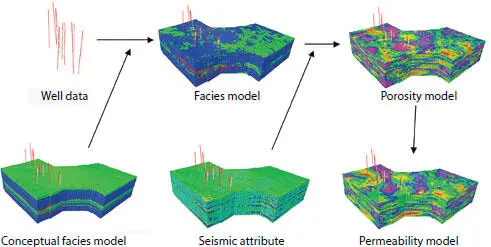
Figure 1.9 Reservoir modeling process workflow. The process takes control of the data within its modeling framework and integrates the various types of data attributes. Courtesy: Roxar-Emerson.
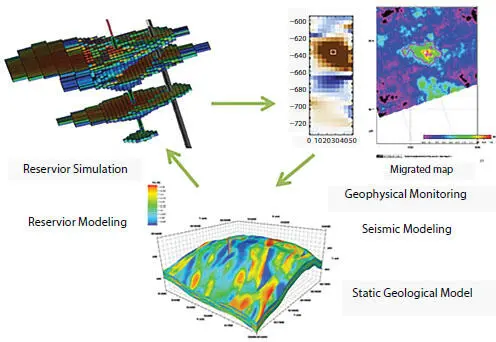
Figure 1.10 Integrated reservoir modeling, fluid simulation update and reiteration by incorporating geophysical monitoring data. http://www.co2care.org/Sections.aspx?section=538.5.
In Part 7of this volume, we will discuss Artificial Intelligence (AI) and Data Analytic (DA) can help address some of the remaining complexities associated with reservoir characterization results. For example, Nikravesh and Aminzadeh [12] reported on the past, present and future of AI in reservoir characterization. Twenty years later Aminzadeh [3], discussed how human and machine intelligence can be combined to improve characterization results. It is firmly believed that AI- and DA offer hope solve the issues related to the SURE Challenge discussed earlier.
1.7 Conclusion
Reservoir Characterization Is an important step in the entire life cycle of the reservoir. Reservoir Characterization is aimed at assessing reservoir properties and its condition, using the available data from different sources such as core samples, log data, seismic surveys (3D and 4D) and production data. This is done in different stages of the E&P process from high grading reservoirs in exploration to their delineation, for their development, as well as their description for optimum production to assessing their evolution in their stimulation for enhance oil/gas recovery to extend their economic life. An integrated approach for reservoir characterization bridges the traditional disciplinary divides, leading to better handling of uncertainties and improvement of the reservoir model for field development. Among the main difficulties in reservoir characterization is what I call “SURE” Challenge. The display here demonstrates the complications involved in integrating different data types with different Scale, Uncertainty, Resolution and Environment.
References
1. Aminzadeh, F., 2005, Meta-Attributes: A new concept detecting geologic features and predicting reservoir properties, Second International Congress on Geosciences Merida, Mexico September 2005
2. Aminzadeh, F. and Dasgupta, S., 2013 Geophysics for Petroleum Engineers, Elsevier.
3. Aminzadeh, F., 2021, Reservoir Characterization: Combining Machine Intelligence with Human Intelligence, E&P Plus, April 2021, Vol. 96 Issue 4, E&P Plus, Hart Energy.
4. Castagna, J., Han, D., Batzle, M.L., 1995, Issues in rock physics and implications for DHI interpretation , The Leading Edge, August 1995.
5. Dvorkin, J., & Nur,A., 1993, Dynamic poroelasticity: A unified model with the squirt and the Biot mechanisms , Geophysics 58, 524-533.
6. Fornel, A. and Estublier, A. 2013. To A Dynamic Update of The Sleipner CO2 Storage Geological Model Using 4D Seismic Data. Energy Procedia. 37. 4902-4909. 10.1016/j.egypro.2013.06.401.
7. Kosco, K. & Schiøtt, C.R. & Vejbaek, Ole & Herwanger, Jorg & Wold, Rune & Koutsabeloulis, N., 2010, Integrating time-lapse seismic, Reservoir Simulation and Geomechanics. 231. 61-66.
8. Ma, Y. Z., Phillips, D. Gomez, E., 2020 Synergistic Integration of Seismic and Geologic Data for Modeling Petrophysical Properties, The Leading Edge, March 2020.
9. Maity, D., Aminzadeh, F., 2015. Novel Fracture Zone Identifier Attribute Using Geophysical and Well Log Data for Unconventional Reservoirs, Interpretation Journal, Vol.3, No. 3, P.T155-T167.
10. Maleki, M., 2018, Integration of 3D and 4D seismic impedance into the simulation model to improve reservoir characterization. PhD Dissertation, University of Compinas.
11. Meadows, M., 2012, Time-lapse seismic data for reservoir monitoring and characterization Course notes on Advanced Oil Field Operations with Remote Visualization, Guest Lecturer for F. Aminzadeh’s course, USC PTE 587.
12. Nikravesh, N. and Aminzadeh, F., 2001, “Past, present and future intelligent reservoir characterization trends,” Journal of Petroleum Science and Engineering , vol. 31, no. 2, pp. 67–79, 2001.
1 Email: fred.aminzadeh@fact-corp.com
2
A Comparison Between Estimated Shear Wave Velocity and Elastic Modulus by Empirical Equations and that of Laboratory Measurements at Reservoir Pressure Condition
Haleh Azizia1*, Hamid Reza Siahkoohi2, Brian Evans3, Nasser Keshavarz Farajkhah4 and Ezatollah KazemZadeh4
1Department of Geophysics, Science and Research Branch, Islamic Azad University, Tehran, Iran
2Institute of Geophysics, University of Tehran, Tehran, Iran
3Department of Petroleum Engineering, Curtin University, Perth, Australia
4Research Institute of Petroleum Industry, Tehran, Iran
Abstract
The objective of this study is to assess the accuracy of the empiricalequations in estimating the shear wave velocity and elastic modulus of rock sample at reservoir pressure condition. The evaluated relations are Gassman, Greenberg and Castagna which have been in use by researchers for a long time and have shown acceptable results. The plug sample investigated in this study is taken from Berea sandstone reservoir southwest of Australia, which is a known reference sandstone for this type of study. This plug in the laboratory was flooded with supercritical carbon dioxide fluid, saturated and pressured under axial, radial and pore pressure comparable to oil reservoirs pressures, after which elastic wave velocity and elasticity modules were determined. Then, using empirical relationships such as Gassman, Greenberg and Castagna and measured values of P-wave velocity, shear wave velocity, and elasticity coefficients were estimated. Comparison of theoretical values versus experimental values shows they compare very well, only in some cases a difference between estimated and experimental values for the coefficients of elasticity has been observed. We believe that the difference is due to the assumptions that were made in those theories. The shear wave modulus didn’t remain constant during fluid saturation. Also, the measured bulk modulus and the calculated values based on Gassman formula did not compare very well. This difference was observed to be larger at higher pressures.
Читать дальшеИнтервал:
Закладка:
Похожие книги на «Reservoir Characterization»
Представляем Вашему вниманию похожие книги на «Reservoir Characterization» списком для выбора. Мы отобрали схожую по названию и смыслу литературу в надежде предоставить читателям больше вариантов отыскать новые, интересные, ещё непрочитанные произведения.







Обсуждение, отзывы о книге «Reservoir Characterization» и просто собственные мнения читателей. Оставьте ваши комментарии, напишите, что Вы думаете о произведении, его смысле или главных героях. Укажите что конкретно понравилось, а что нет, и почему Вы так считаете.