Reservoir Characterization
Здесь есть возможность читать онлайн «Reservoir Characterization» — ознакомительный отрывок электронной книги совершенно бесплатно, а после прочтения отрывка купить полную версию. В некоторых случаях можно слушать аудио, скачать через торрент в формате fb2 и присутствует краткое содержание. Жанр: unrecognised, на английском языке. Описание произведения, (предисловие) а так же отзывы посетителей доступны на портале библиотеки ЛибКат.

- Название:Reservoir Characterization
- Автор:
- Жанр:
- Год:неизвестен
- ISBN:нет данных
- Рейтинг книги:3 / 5. Голосов: 1
-
Избранное:Добавить в избранное
- Отзывы:
-
Ваша оценка:
Reservoir Characterization: краткое содержание, описание и аннотация
Предлагаем к чтению аннотацию, описание, краткое содержание или предисловие (зависит от того, что написал сам автор книги «Reservoir Characterization»). Если вы не нашли необходимую информацию о книге — напишите в комментариях, мы постараемся отыскать её.
This collection of papers covers the strategic and economic implications of methods used to characterize petroleum reservoirs. Born out of the journal by the same name, formerly published by Scrivener Publishing, most of the articles in this volume have been updated, and there are some new additions, as well, to keep the engineer abreast of any updates and new methods in the industry.
Truly a snapshot of the state-of-the-art, this groundbreaking volume is a must-have for any petroleum engineer working in the field, environmental engineers, petroleum engineering students, and any other engineer or scientist working with reservoirs.
Reservoir Characterization — читать онлайн ознакомительный отрывок
Ниже представлен текст книги, разбитый по страницам. Система сохранения места последней прочитанной страницы, позволяет с удобством читать онлайн бесплатно книгу «Reservoir Characterization», без необходимости каждый раз заново искать на чём Вы остановились. Поставьте закладку, и сможете в любой момент перейти на страницу, на которой закончили чтение.
Интервал:
Закладка:
The results of seismic monitoring (4D or MEQ or combination of the two) along with the well log and production data can be used to constrain the flow simulation model in the reservoir history matching and fluid flow prediction process, as well as characterizing the fracture regime. As an example, see Maity and Aminzadeh [8]. Figure 1.7shows how integration of conventional seismic, well log data and MEQ data have been able to create a 3-D fracture distribution, using a neural network approach through integrating “Fracture Zone Identifier” or FZI attributes.
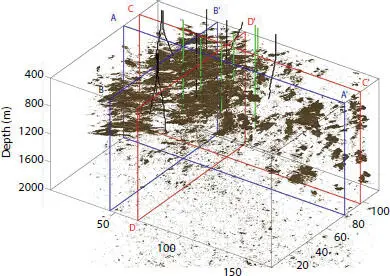
Figure 1.7 Use of conventional seismic, well log data and MEQ data to create a 3-D fracture distribution volume, using a neural network by integrating “Fracture Zone Identifier” or FZI attributes, Maity and Aminzadeh [9].
1.6 More on Reservoir Characterization and Reservoir Modeling for Reservoir Simulation
No discussion on reservoir characterization is complete without understanding rock properties and the corresponding rock physics. Furthermore, reservoir modeling could be considered as the last step for reservoir characterization during different stages of the life of the reservoir. Indeed, ideally, any reservoir simulation and could use reservoir models based on static and dynamic reservoir characterization to improve the process. 4D seismic data can help with the reservoir model updating process, thus enabling creation of a dynamic reservoir model.
Figure 1.8shows how a static reservoir model with the associated structural earth model and corresponding geologic and reservoir properties such as facies, porosities, and vshale among other parameters can be a starting point (top left). Through reservoir simulation a flow model can be created at different time points, with the respective information about pressure, saturation and temperature. Output of the reservoir simulation model and the earth model could be used to generate (invert for) the reservoir rock physics properties such as density, compressional and shear wave velocities at different time periods. Such information can then be used to generate the synthetic 4D seismic data. Comparison of the synthetic and field 4D seismic data will then lead to an updated Earth model. The process continuous until we establish a good match between real and simulated seismic and reservoir flow models leading to an acceptable dynamic reservoir characterization results from the accurately derived rock physics properties as well as other reservoir properties such as porosity, permeability, oil and gas saturation, and pressure among other properties.
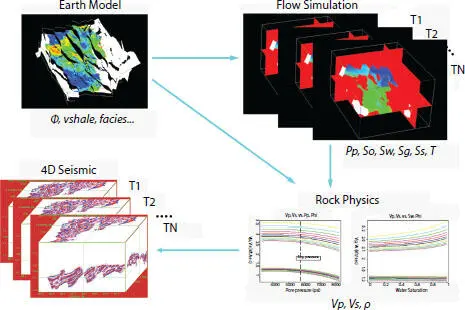
Figure 1.8 The entire process of reservoir model updating through 4D seismic modeling and reservoir simulation, (from Meadows, [11]).
In what follows we describe rock physics and reservoir modeling briefly.
1.6.1 Rock Physics
Rock physics investigates reservoir rocks properties that affect transmission of seismic waves through the rocks. These physical properties are rigidity, compressibility, and porosity. This provides a connection between elastic properties measured at the surface of the earth, within the borehole environment or in the laboratory with the intrinsic properties of rocks, such as mineralogy, porosity, pore shapes, pore fluids, pore pressures, permeability, viscosity, stresses and overall architecture such as laminations and fractures.
Description of rock and fluid properties between the well control points requires understanding of the linkage of bulk and seismic properties to each other and their changes with geologic age, burial depth, and location. This connection allows us to understand and model the petrophysical and geometrical properties which give rise to the seismic signal. Rock physics requires a knowledge and understanding of geophysics, petrophysics, geomechanics and the causes of distribution of fluids in the subsurface reservoir between wells. From seismic fluid monitoring we can obtain valuable information about reservoir fluid movements and geologic reservoir heterogeneities. The results can also resolve seal integrity issues and guide the optimum placement of wells in complex reservoirs.
Rock physics uses sonic, density and dipole sonic logs to establish a relationship between the geophysical data and the petrophysical properties. In ‘80s and ‘90s many oil companies had their own rock physics laboratories. Because of the longer-range objectives and the need to assemble large databases, today such laboratories are found primarily within five or six universities and a few service companies. The focus of rock physics analysis started with estimating porosity and permeability of sandstones and carbonates. Today, much of the research is focused on unconventional reservoirs and on estimating rock strength or “fracability” and the presence of total organic carbon. For some detailed discussion on the value of rock physics analysis in various aspects of reservoir characterization and reservoir property estimation see Dvorkin and Nur [5] and Castagna et al . [4].
Integration of 3D seismic interpretation with well measurements provides a powerful tool for characterization a reservoir for the 3D distribution of rock properties and the geometric framework of the reservoir. While the cores, wireline logs and outcrops provide the vertical resolution it is only geophysical data like 3D seismic data that can provide detailed spatial information between the wells for the geological model. Since 3D seismic is a measurement made at the surface of the earth, the subsurface interpretation using seismic data can be done only after proper calibration with available well information. Seismic reflection data provide the gross acoustic properties within a volume of rock and do not have the vertical resolution of wireline logs.
1.6.2 Reservoir Modeling
Quantification of rock properties and the fluids in three dimensions is the process of reservoir modeling. The goal of reservoir modeling and fluid simulation is increased hydrocarbon fluid production with an increased rate of return. The 3D quantification is performed in a geo-cellular model that consists or reservoir geometry, lithology, porosity, permeability and initial fluid saturation. Integration of information from seismic data, cores, wireline logs and outcrops provide the quantification of the static reservoir model of the reservoir. A geological reservoir characterization is performed using a cellular facies model. Rock properties are assigned to model cells according to the defined facies. The geological models describe the flow layers that account for fluid and displacement phenomenon in the reservoir. It models the inter-well connectivity and continuity of flow units in the rock facies present within the reservoir architecture.
Reservoir fluid simulation is the quantification of fluid flow over time in the 3D reservoir model. The numerical model simulation and forecasts of reservoir performance is based on the geo-cellular static model. Reservoir simulation is performed to infer fluid flow behavior from a mathematical model. The forecast of reservoir performance is improved with increased accuracy in the geological model. Major decisions regarding the development and production plans for the reservoirs e.g., location and spacing of production and injector wells, depletion strategy, maximum production rates are based on the reservoir simulation. As hydrocarbons remaining in place become more difficult to recover, fluid movement in the reservoir needs to be more closely monitored. The location of remaining hydrocarbons must be known to plan injection schemes. Also, the manner in which injected fluids move and make contact with the target oil must be known in order to evaluate and, if necessary, correct the recovery project.
Читать дальшеИнтервал:
Закладка:
Похожие книги на «Reservoir Characterization»
Представляем Вашему вниманию похожие книги на «Reservoir Characterization» списком для выбора. Мы отобрали схожую по названию и смыслу литературу в надежде предоставить читателям больше вариантов отыскать новые, интересные, ещё непрочитанные произведения.







Обсуждение, отзывы о книге «Reservoir Characterization» и просто собственные мнения читателей. Оставьте ваши комментарии, напишите, что Вы думаете о произведении, его смысле или главных героях. Укажите что конкретно понравилось, а что нет, и почему Вы так считаете.