John O'Brien - Earth Materials
Здесь есть возможность читать онлайн «John O'Brien - Earth Materials» — ознакомительный отрывок электронной книги совершенно бесплатно, а после прочтения отрывка купить полную версию. В некоторых случаях можно слушать аудио, скачать через торрент в формате fb2 и присутствует краткое содержание. Жанр: unrecognised, на английском языке. Описание произведения, (предисловие) а так же отзывы посетителей доступны на портале библиотеки ЛибКат.
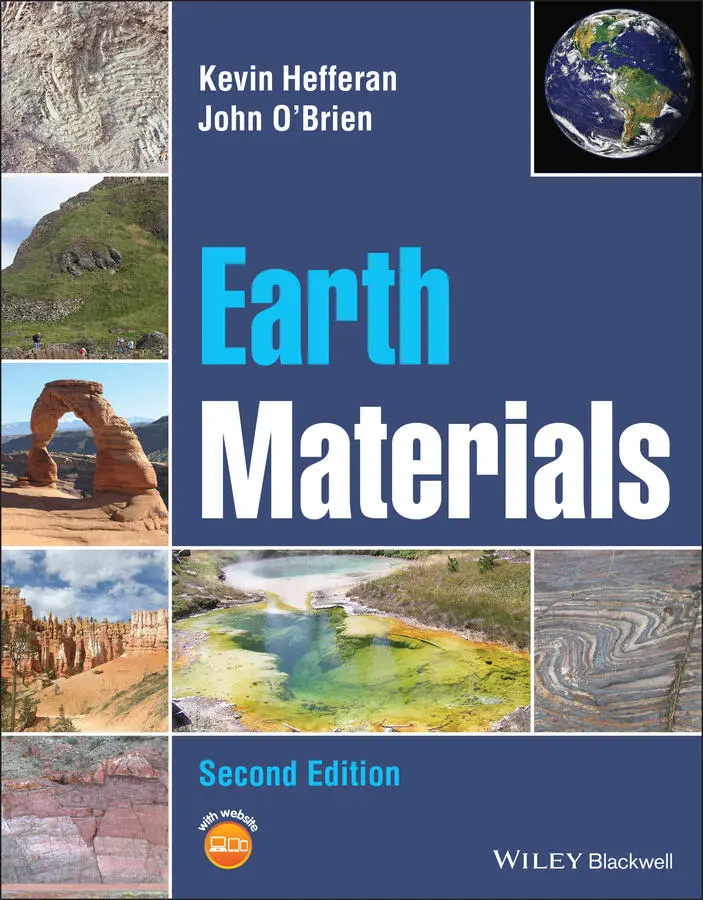
- Название:Earth Materials
- Автор:
- Жанр:
- Год:неизвестен
- ISBN:нет данных
- Рейтинг книги:5 / 5. Голосов: 1
-
Избранное:Добавить в избранное
- Отзывы:
-
Ваша оценка:
Earth Materials: краткое содержание, описание и аннотация
Предлагаем к чтению аннотацию, описание, краткое содержание или предисловие (зависит от того, что написал сам автор книги «Earth Materials»). Если вы не нашли необходимую информацию о книге — напишите в комментариях, мы постараемся отыскать её.
Earth Materials,
Earth Materials,
Earth Materials — читать онлайн ознакомительный отрывок
Ниже представлен текст книги, разбитый по страницам. Система сохранения места последней прочитанной страницы, позволяет с удобством читать онлайн бесплатно книгу «Earth Materials», без необходимости каждый раз заново искать на чём Вы остановились. Поставьте закладку, и сможете в любой момент перейти на страницу, на которой закончили чтение.
Интервал:
Закладка:
3 In addition to the β‐quartz—cristobalite—liquid triple point show by the letter X in Figure 3.6, identify the two other triple points shown in the figure in terms of the three phases that exist in equilibrium and the unique temperature and pressure at which the three phases are equilibrium. Which of these sets of coexisting minerals might be expected to exist deep below the surface and which might be more likely to occur much nearer the surface? How might you recognize a rock that formed under triple point conditions?
4 Starting with a melt of composition An30, trace the crystallization history as the melt cools, crystallizes and solidifies by answering the following questions.At what temperature does the melt begin to crystallize?What is the composition of the first crystals?In general, what happens as the system continues to cool?At a temperature of 1250o, what is the composition and percentage of crystals?What is the composition and percentage of the remaining melt?How has the composition and percentage of each changed as the system cooled from the temperature of initial crystallization?Explain in terms of continuous reactions how this happened?At what temperature does the system become solid rock and what is its final composition?
5 Starting with a solid of composition An70 at 1200o, trace the melting history as the system is heated progressively.At what temperature does it begin to melt?What is the composition of the first melt?In general, what happens to the system as the temperature continues to increase.At a temperature of 1400o, what is the composition and percentage of the remaining melt?What is the composition of the remaining crystals?How has the percentage of each changed and how can this be explained in terms of continuous reactions?At what temperature would the melting become complete and what would be its composition?
6 For feldspar of composition Or55, please answer the following questions using Figure 3.4.At what temperature did this mineral crystallize?As it cools, at what temperature would it reach the solvus and begin to undergo exsolution (unmixing)?What is the composition of the first exsolved component?At 400oC, what is the composition and percentage of the exsolved component? What is the composition and percentage of the host phase?What is the best name for the texture of this feldspar after exsolution has occurred?
7 Explain what is meant by silica undersaturation, silica oversaturation and silica saturation. What modal mineral group is indicative of silica oversaturation? What two modal mineral groups are generally suggestive of silica undersaturation? Using the phase diagram for nepheline‐silica ( Figure 3.10), describe in terms of %SiO2 component the compositions that are undersaturated, oversaturated and precisely saturated with respect to SiO2 and the minerals that would form from each during equilibrium crystallization of a melt. Do the same for the system forsterite‐silica in terms of weight %SiO2, noting the mineral that forms from a system that is precisely saturated.
8 Summarize the differences between16O and18O? Then explain the effects of temperature and global ice volumes on the ratio of these two isotopes (18O/16O) in ocean water and how they can be used to estimate fluctuations in temperatures and glacial ice volumes through time.
9 What is a radioactive element? What are the three major types of radioactive decay and how does each type account for the specific changes that occur when a parent isotope is converted into a daughter isotope?
10 Explain the meaning of the term half‐life of a radioactive decay process. What percentage of parent isotopes has been converted into the daughter isotope after one half‐life? After 2 half‐lives? After 3, 4, 5 and 6 half‐lives?
REFERENCES
1 Best, M.G. (2000). Igneous Petrology. New York: Wiley‐Blackwell 455 pp.
2 Dyer, M.D., Gunter, M.E., and Tasa, D. (2008). Mineralogy and Optical Mineralogy. Chantilly, VA: Mineralogical Society of America 708 pp.
3 Epstein, S. and Mayeda, T. (1953). Variation of O18 content of waters from natural sources. Geochimica et Cosmochimica Acta 4: 213–224.
4 Frost, B.R. and Frost, C.D. (2019). Essentials of Igneous and Metamorphic Petrology, 2e. Cambridge University Press 321 pp.
5 Gehler, A., Gingerich, P.D., and Pack, A. (2016). Temperature and atmospheric CO2 concentration estimates through PETM using triple oxygen isotope analysis of mammalian bioapatite. Proceedings of the National Academy of Science. 113 (28): 7739–7744.
6 Gibbs, J.W. (1928). The Collected Works of J. Willard Gibbs, Vol. I. Thermodynamics. New Haven, CT: Yale University Press 438 pp.
7 Ivany, L., Pietsch, C., Handley, J.C. et al. (2018). Little lasting impact of the Paleocene–Eocene thermal maximum on shallow water molluscan faunas. Science Advances 4 (9): 1–9.
8 James, N.P. and Jones, B. (2016). Origin of Carbonate Sedimentary Rocks. Chichester, UK: Wiley 446 pp.
9 Kennet, J.P. and Stott, L.D. (1991). Abrupt deep‐sea warming, paleooceanographic changes and benthic extinctions at the end of the Palaeocene. Nature 353: 225–229.
10 Klein, C. and Dutrow, B. (2007). Manual of Mineral Science (Manual of Mineralogy), 23e. New York: Wiley 704 pp.
11 Nesse, W.D. (2016). Introduction to Mineralogy, 3e. New York: Oxford University Press 512 pp.
12 Philpotts, A. and Ague, J. (2009). Principles of Igneous and Metamorphic Petrology. Cambridge University Press 684 pp.
13 Pinkster, L.M. (2002). Sudden warming in the past. Geotimes 30: 77.
14 Rohl, V., Bralower, T.J., and Norris, R.D. (2000). New chronology for the late Paleocene thermal maximum and its environmental implications. Geology 28: 927–930.
15 Wenk, H.‐R. and Bulakh, A. (2004). Minerals: Their Constitution and Origin. Cambridge, UK: Cambridge University Press 646 pp.
16 Wenk, H.‐R. and Bulakh, A. (2016). Minerals: Their Constitution and Origin, 3e. Cambridge, UK: University Press 621 pp.
17 Winter, J.D. (2009). Principles of Igneous and Metamorphic Petrology, 2e. New York: Pearson 720 pp.
18 Zachos, J.C., Lohmann, K.C., Walker, J.C.G., and Wise, S.W. (1993). Abrupt climate change and transient climates during the Paleogene – a marine perspective. Journal of Geology 101: 191–213.
Chapter 4 Crystallography
1 4.1 Crystalline substances
2 4.2 Symmetry operations
3 4.3 Two‐dimensional motifs and lattices (meshes)
4 4.4 Three‐dimensional motifs and lattices
5 4.5 Crystal systems
6 4.6 Indexing planes in crystals
7 4.7 Twinned crystals
8 4.8 Crystal defects
9 4.9 Polymorphs and pseudomorphs
4.1 CRYSTALLINE SUBSTANCES
Crystallography emphasizes the long‐range order or crystal structure of crystalline substances. It focuses on the symmetry of crystalline materials and on the ways in which their long‐range order is related to the three‐dimensional repetition of fundamental units of pattern during crystal growth. In minerals, the fundamental units of pattern are molecular clusters of coordination polyhedra or stacking sequences ( Chapter 2). The ways in which these basic units can be repeated to produce crystal structures with long‐range order are called symmetry operations. Crystallography is also focused on the description and significance of planar features in crystals including planes of atoms, cleavage planes, crystal faces, and the forms of crystals. In addition, it is concerned with crystal defects which are local imperfections in the long‐range order of crystals.
4.1.1 Crystals and crystal faces
Mineral crystals are one of nature's most beautiful creations. Many crystals are enclosed by flat surfaces called crystal faces. Crystal facesare formed when mineral crystals grow, and enclose crystalline solids when they stop growing. Perfectly formed crystals are notable for their remarkable symmetry ( Figure 4.1). The external symmetry expressed by crystal faces allowed us to infer the geometric patterns of atoms in mineral crystal structures. These patterns inferred from external symmetry have been confirmed by advanced analytical techniques such as X‐ray diffraction (XRD) and atomic force microscopy (AFM).
Читать дальшеИнтервал:
Закладка:
Похожие книги на «Earth Materials»
Представляем Вашему вниманию похожие книги на «Earth Materials» списком для выбора. Мы отобрали схожую по названию и смыслу литературу в надежде предоставить читателям больше вариантов отыскать новые, интересные, ещё непрочитанные произведения.









Обсуждение, отзывы о книге «Earth Materials» и просто собственные мнения читателей. Оставьте ваши комментарии, напишите, что Вы думаете о произведении, его смысле или главных героях. Укажите что конкретно понравилось, а что нет, и почему Вы так считаете.