Alan Gunn - Parasitology
Здесь есть возможность читать онлайн «Alan Gunn - Parasitology» — ознакомительный отрывок электронной книги совершенно бесплатно, а после прочтения отрывка купить полную версию. В некоторых случаях можно слушать аудио, скачать через торрент в формате fb2 и присутствует краткое содержание. Жанр: unrecognised, на английском языке. Описание произведения, (предисловие) а так же отзывы посетителей доступны на портале библиотеки ЛибКат.
- Название:Parasitology
- Автор:
- Жанр:
- Год:неизвестен
- ISBN:нет данных
- Рейтинг книги:3 / 5. Голосов: 1
-
Избранное:Добавить в избранное
- Отзывы:
-
Ваша оценка:
Parasitology: краткое содержание, описание и аннотация
Предлагаем к чтению аннотацию, описание, краткое содержание или предисловие (зависит от того, что написал сам автор книги «Parasitology»). Если вы не нашли необходимую информацию о книге — напишите в комментариях, мы постараемся отыскать её.
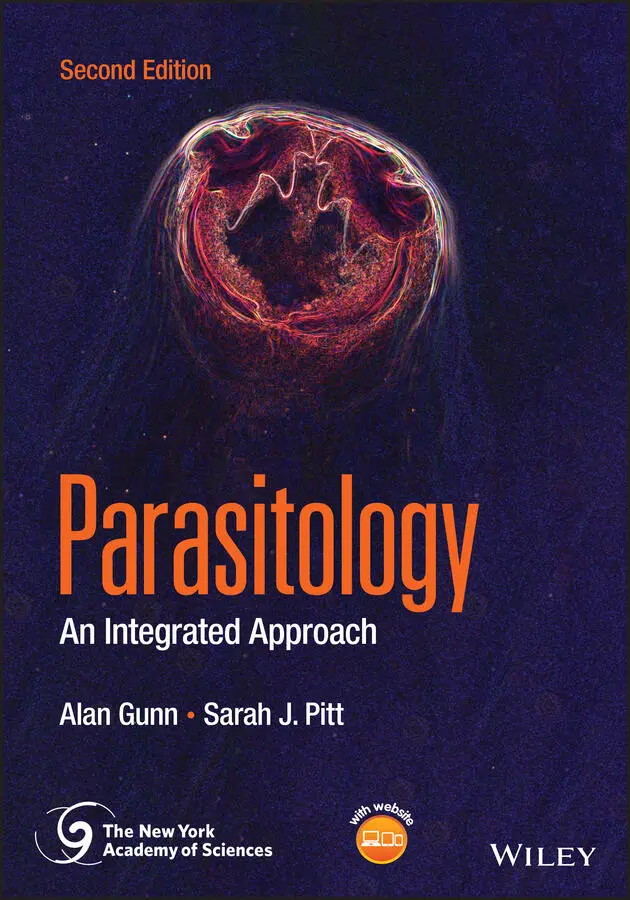
Highly detailed textbook on parasites and parasite relationships Parasitology: An Integrated Approach
Parasitology: An Integrated Approach, 2nd edition
Parasitology — читать онлайн ознакомительный отрывок
Ниже представлен текст книги, разбитый по страницам. Система сохранения места последней прочитанной страницы, позволяет с удобством читать онлайн бесплатно книгу «Parasitology», без необходимости каждый раз заново искать на чём Вы остановились. Поставьте закладку, и сможете в любой момент перейти на страницу, на которой закончили чтение.
Интервал:
Закладка:

Figure 4.5 Lutzomyia longipalpis adult male; male sandflies have prominent claspers at the end of their abdomen. Sandflies are small (<4 mm in length), and their wings and body are covered in hairs. Their palps are very long and fold backwards. In common with many other nematoceran flies (e.g., mosquitoes), they have long legs, and their long antennae consist of many joints. Only female sandflies consume blood.
How Harming the Vector Facilitates Transmission
On reaching the stomodeal valve, the Leishmania promastigotes secrete a gel‐like substance called promastigote secretory gel, the main component of which is filamentous proteophosphoglycan, and some of them transform into the infective metacyclic promastigote stage (this has a long flagellum and is very active). The gel physically blocks the gut, and this together with the vast numbers of parasites severely compromises the fly’s ability to feed. Further compounding this, the parasites also produce chitinase enzymes that physically damage the peritrophic membrane and stomodeal valve. Because the insect’s ability to ingest food is impaired, it becomes hungry thereby increasing its probing and number of visits to hosts all of which increases the chance of transmission. Physical probing probably does not transfer many parasites but to ingest food the infected fly must first expel some of the promastigote secretory gel. This gel contains numerous infective metacyclic stage parasites, as well as other non‐infective stage(s). The secretory gel also facilitates the establishment of the infection in the vertebrate host, so it has a dual role in both the invertebrate and vertebrate host (Giraud et al. 2019).
The transmission mechanism(s) employed by the Sauroleishmania remain uncertain. Within the sandfly vector, these species tend to remain in the posterior regions of the gut, and therefore, it is unlikely that transmission occurs when the sandfly feeds. Furthermore, sandflies do not usually defaecate whilst feeding, so it is unlikely that transmission resembles that of T. cruzi by triatomid bugs. A third possibility is that the transmission occurs through the lizards consuming infected sandflies.
Much of the work on how Leishmania establishes and develops within its mammalian hosts involves mice as model organisms and those few Leishmania species capable of being cultured in the laboratory. One should therefore be careful of extrapolating from these studies to the likely behaviour of other Leishmania species and infections in other hosts. Mice and humans are both mammals, but one cannot assume that their immune systems react identically to the same infectious agent. Furthermore, leishmaniasis manifests itself in numerous ways. Therefore, different Leishmania species and strains probably exhibit variations in the way they establish themselves and interact with the host immune system. Nevertheless, all species follow a basic pattern of development following their entry into the blood stream that involves morphological and physiological transformations and establishment in the mononuclear phagocytes and in particular the macrophages.
How Leishmania Establishes Within Mammalian Phagocytes
After an infected sandfly feeds, mononuclear phagocytes quickly detect and ingest the promastigotes that enter the blood circulation. Initial attachment of a parasite to a phagocyte begins at the tip of the parasite’s flagellum via a ligand‐receptor process. The principal ligands are phosphoglycans and the zinc metalloprotease enzyme GP63 (glycoprotein 63) on the surface of the promastigote whilst on the phagocyte, a variety of complement receptors are involved in the attachment process. After phagocytosing the Leishmania parasite, a phagocyte holds it within a membrane‐bound vesicle called a phagosome. Lysomes then fuse with the phagosome and discharge hydrolytic enzymes and microbicidal peptides into it. They also acidify the contents. The structure then becomes to known as a parasitophorous vacuole or phagolysosome. Different species of Leishmania cause the formation of different types of phagolysosomes: those produced by L. mexicana tend to be large and contain many parasites whilst those formed by L. donovani tend to be much smaller.
The combination of a rise in temperature associated with moving to a mammalian host and the drop in pH caused by enclosure within a phagolysosome induce the promastigote to change into the amastigote form. This transformation takes about 1–4 hours following ingestion and is essential if the parasite is to survive the acidic pH and hydrolytic enzymes within the phagolysosome. Transformation includes changes the composition of the cell surface phosphoglycans. Some of these, the glycoinositol phospholipids (GIPLs) directly inhibit the production of nitric oxide (NO) by the phagocyte. The expression of GP63 is downregulated in the amastigote but they continue to express it, and it is important for both the survival of the parasite and as a virulence factor (Olivier et al. 2012). The membrane changes associated with transformation to the amastigote stage means amastigotes invade phagocytes using a different set of ligands and receptors to the promastigote stage. Despite these changes, phagocytes remain capable of destroying amastigotes. Therefore, the reasons why some people develop serious or even fatal infections, whilst in others the infection is resolved, possibly without displaying any symptoms is uncertain.
4.2.1.2 Visceral Leishmaniasis
Classical visceral leishmaniasis is commonly known as kala‐azar and causes fevers like those of malaria. Both malaria and kala‐azar occur in the same areas, so it is important for doctors to distinguish between them. The name kala‐azar (black head) derives from the symptomatic darkening of the forehead and mouth of patients suffering from visceral leishmaniasis. In India, great plagues of visceral leishmaniasis occurred in Assam in the late nineteenth and early twentieth centuries that depopulated whole villages. Serious outbreaks still occur today, and visceral leishmaniasis remains an important cause of morbidity and mortality in over 70 countries around the world. Most cases of visceral leishmaniasis occur in South Asia (~67%), but it is also a big problem in parts of East Africa (e.g., Sudan in the region bordering with Ethiopia). There is also a focus of infection in South America, especially in Brazil.
The clinical picture of visceral leishmaniasis differs geographically. There is, nonetheless, a basic pattern to the course of the disease. The first stage begins when a papule develops at the site of the sandfly bite, but this eventually regresses. Low‐grade recurrent fevers then develop anything from 10 days to 2 years or more afterwards, and these persist throughout the course of the disease. Within the spleen, immune‐related responses destroy red blood cells, and this causes anaemia. In addition, the liver becomes enlarged (hepatomegaly) as does the spleen (splenomegaly). Enlargement of the spleen results from a combination of hyperplasia induced by the need to produce new mononuclear phagocytes and from infected mononuclear phagocytes filling with parasites. The patient often suffers from diarrhoea and this, together with the fever, leads to anorexia, malnutrition, and dehydration. If the disease is not treated, 90% of those suffering visceral leishmaniasis will die. Recovery can be rapid and complete with or without treatment. However, in many cases the parasite persists and may appear on the skin in raised macules causing the disfiguring condition post kala‐azar dermal leishmaniasis.
Читать дальшеИнтервал:
Закладка:
Похожие книги на «Parasitology»
Представляем Вашему вниманию похожие книги на «Parasitology» списком для выбора. Мы отобрали схожую по названию и смыслу литературу в надежде предоставить читателям больше вариантов отыскать новые, интересные, ещё непрочитанные произведения.











Обсуждение, отзывы о книге «Parasitology» и просто собственные мнения читателей. Оставьте ваши комментарии, напишите, что Вы думаете о произведении, его смысле или главных героях. Укажите что конкретно понравилось, а что нет, и почему Вы так считаете.