Alan Gunn - Parasitology
Здесь есть возможность читать онлайн «Alan Gunn - Parasitology» — ознакомительный отрывок электронной книги совершенно бесплатно, а после прочтения отрывка купить полную версию. В некоторых случаях можно слушать аудио, скачать через торрент в формате fb2 и присутствует краткое содержание. Жанр: unrecognised, на английском языке. Описание произведения, (предисловие) а так же отзывы посетителей доступны на портале библиотеки ЛибКат.
- Название:Parasitology
- Автор:
- Жанр:
- Год:неизвестен
- ISBN:нет данных
- Рейтинг книги:3 / 5. Голосов: 1
-
Избранное:Добавить в избранное
- Отзывы:
-
Ваша оценка:
Parasitology: краткое содержание, описание и аннотация
Предлагаем к чтению аннотацию, описание, краткое содержание или предисловие (зависит от того, что написал сам автор книги «Parasitology»). Если вы не нашли необходимую информацию о книге — напишите в комментариях, мы постараемся отыскать её.
Highly detailed textbook on parasites and parasite relationships Parasitology: An Integrated Approach
Parasitology: An Integrated Approach, 2nd edition
Parasitology — читать онлайн ознакомительный отрывок
Ниже представлен текст книги, разбитый по страницам. Система сохранения места последней прочитанной страницы, позволяет с удобством читать онлайн бесплатно книгу «Parasitology», без необходимости каждый раз заново искать на чём Вы остановились. Поставьте закладку, и сможете в любой момент перейти на страницу, на которой закончили чтение.
Интервал:
Закладка:
Table 4.3 Taxonomic divisions within the genus Leishmania .
| Genus | Subgenus | Disease | Example |
|---|---|---|---|
| Leishmania | Leishmania | Visceral | Leishmania donovani phenetic complex Leishmania infantum phenetic complex |
| Old World cutaneous | Leishmania major phenetic complex Leishmania tropica phenetic complex | ||
| New World cutaneous | Leishmania mexicana phenetic complex | ||
| Viannia | New World | Leishmania braziliensis phenetic complex | |
| Sauroleishmania | Lizard leishmaniasis | Leishmania tarentolae |
The taxonomy of the genus Leishmania is complex, and it is extremely difficult or impossible to distinguish many of them from their morphology using a light microscope. Lainson and Shaw (1987) comprehensively reviewed the genus and molecular and phylogenetic studies have largely supported their proposals for how it should be divided ( Table 4.3). However, agreement concerning the status of several species is far from complete, and there remain uncertainties about many aspects of the evolution of the Leishmania – see Schönian et al. (2018) for further details. Lainson and Shaw (1987) identified two subgenera: Leishmania and Viannia . In the subgenus Leishmania, the parasites begin their development in the sandfly vector’s midgut and then move forward to the pharynx. The sandfly then injects the parasites into the vertebrate host when she feeds. By contrast, in the subgenus Viannia the parasites begin development in the vector’s hindgut and then move forward to the pharynx.
Those species within the subgenus Viannia (e.g., Leishmania braziliensis, Leishmania peruviana, Leishmania guyanensis , Leishmania panamensis ) are restricted to South America and are primarily responsible for cutaneous disease. Species belonging to the subgenus Leishmania (e.g., Leishmania donovani, Leishmania major, Leishmania infantum, Leishmania tropica, Leishmania mexicana ) have representatives in both the New World and the Old World and include agents of both visceral and cutaneous disease. Because of the difficulties associated with identifying the parasites and the diversity of the pathologies they cause, there is a tendency to refer to Leishmania phenetic complexes. That is, a species exhibits various phenotypes that may or may not relate to underlying genotypic differences. In addition, some species hybridize, and this can affect their subsequent transmission and pathology. For example, hybrids between L. infantum and L. major have greater transmission potential (Volf et al. 2007).
Present day members of the genus Leishmania are responsible for a great deal of morbidity and mortality in us and some cause serious disease in domestic and wild animals. There is even a suggestion that ancestral versions of Leishmania (with help from some other parasites) killed off the dinosaurs (Poinar and Poinar 2008). However, this theory has not gained a lot of support and most scientists continue to blame a meteorite. In humans, leishmaniasis exists as a complex of diseases caused by various species of Leishmania . While it is convenient to group those species of Leishmania, which invade organs as ‘visceral’ and those which affect the outer body surface as ‘cutaneous’, the distinctions are far from clear. For example, L. donovani is normally associated with the development of visceral leishmaniasis, but it can become cutaneous – as in the development of post kala‐azar dermal leishmaniasis (see later). Similarly, L. tropica usually causes cutaneous leishmaniasis but can infect the viscera. Some 12 million people are infected with cutaneous leishmaniasis, which leaves long‐lasting sores, and a further 500,000 with the potentially fatal visceral leishmaniasis of whom up to 80,000 die every year. The incidence of HIV/ Leishmania co‐infections is also increasing and a serious cause for concern.
4.2.1.1 Leishmania Life Cycle
In the vertebrate host, Leishmania exists in the amastigote form (2.5–5 μm) within mononuclear phagocytes and in particular the macrophages ( Figure 4.3). These are a sub‐group of the leukocytes (white blood cells) that have an essential role in the immune response in which they phagocytose and destroy foreign organisms. The parasites multiply by binary fission within a phagocyte until the host cell is destroyed after which they are released to be ingested by, and subsequently invade, new phagocytes ( Figure 4.4). Transmission is normally by female sandfly vectors: only the female sandfly feeds on blood – the males ( Figure 4.5) are harmless nectar feeders. Parenteral transmission, for example via contaminated needles or blood transfusion is also possible. Venereal and transplacental transmission of L. infantum sometimes occurs in dogs (Magro et al. 2017), but at the time of writing, there was little information on whether it also occurs in other species of Leishmania or in hosts other than dogs.

Figure 4.3 Spleen smear showing Leishmania donovani amastigotes infecting macrophages. Many of the infected cells have burst and released the parasites. Owing to the small size of the amastigotes, it is extremely difficult to distinguish between Leishmania species using a light microscope.
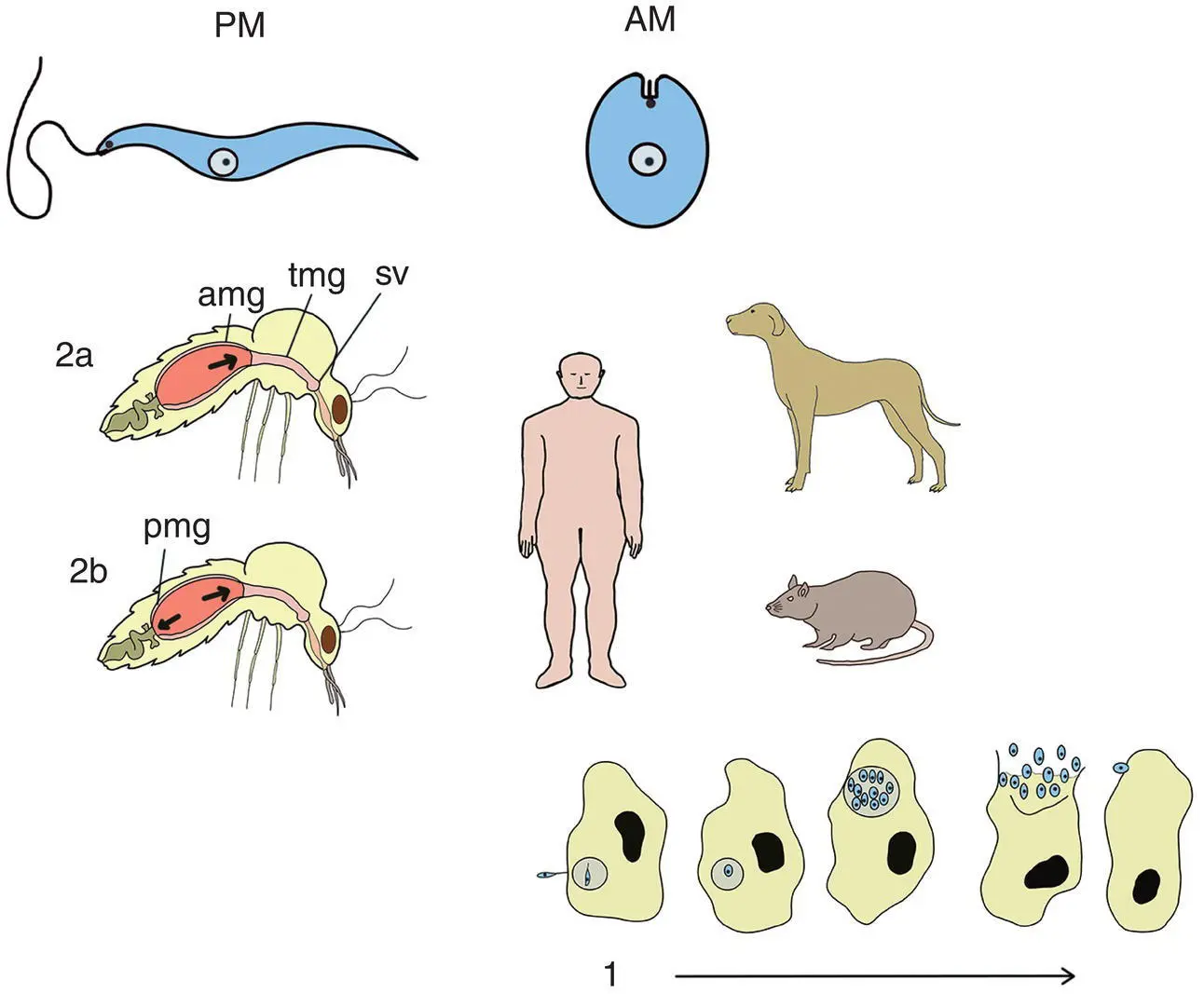
Figure 4.4 Generalized life cycle of Leishmania spp. The parasite exists in the promastigote form (PM) in the sandfly vector and the amastigote form (AM) in the mammalian host. Some Leishmania species infecting humans are zoonotic and infect other mammals such as dogs and rodents. 1: An infected sandfly injects promastigotes when it feeds, and these are taken up by macrophages and other mononuclear phagocytes. Within these cells, the parasite is enclosed within a phagosome. Here, it transforms into the amastigote form and reproduces asexually. Eventually, the host cell is destroyed, and this releases amastigotes that infect other cells. A sandfly becomes infected when it ingests blood containing infected phagocytes. After reaching the sandfly midgut, the parasites transform to the promastigote stage, reproduce asexually and undergo several morphological changes and migrations within the gut. 2a: In species belonging to the subgenus Leishmania , the promastigotes move to the anterior midgut (amg) and then to the stomadeal valve (sv). 2b: In species belonging to the subgenus Viannia , the parasites first move the posterior midgut (pmg) and then forward to the stomadeal valve. In both subgenera, the parasites are ejected when the fly attempts to feed. For further details, see text. Drawings not to scale.
The sequence of development within the sandfly vector varies slightly between species, but in all cases involves transformation, replication, and subsequent movement to the anterior region of the gut. A sandfly acquires an infection when it ingests infected mononuclear phagocytes during feeding. Like mosquitoes, sandflies are ‘batch processors’ that take in a large blood meal that is then enclosed within a peritrophic membrane when it enters the midgut. They hold the blood meal within the midgut and digest it after which the products are absorbed. There is therefore usually a gap of several days between blood meals. When the blood meal first reaches the insect’s midgut, the amastigotes transform to the procyclic promastigote stage. This occurs in response to the decrease in temperature and increase in pH. The procyclic stage has a relatively short flagellum, is not very motile, and multiplies by binary fission within the blood meal. The promastigotes undergo a series of morphological transformations and multiplications as they move up from the midgut to the region of the stomodeal valve that marks the boundary between the foregut and the midgut. Along the way, some of the parasites attach to the lining of the gut and stomodeal valve using their flagellae, and this attachment is an important part of the life cycle. In those species belonging to the sub‐genus Viannia, most parasites make their way to the pylorus region (hind triangle) at the posterior of the midgut before moving forward. Unlike Plasmodium (in which the infective stages invade the salivary glands of the vector mosquito), the metacyclic stages of Leishmania do not, as a rule, infect the salivary glands of the sandflies. However, sandfly saliva does play an important role in the transmission process.
Читать дальшеИнтервал:
Закладка:
Похожие книги на «Parasitology»
Представляем Вашему вниманию похожие книги на «Parasitology» списком для выбора. Мы отобрали схожую по названию и смыслу литературу в надежде предоставить читателям больше вариантов отыскать новые, интересные, ещё непрочитанные произведения.











Обсуждение, отзывы о книге «Parasitology» и просто собственные мнения читателей. Оставьте ваши комментарии, напишите, что Вы думаете о произведении, его смысле или главных героях. Укажите что конкретно понравилось, а что нет, и почему Вы так считаете.