Alan Gunn - Parasitology
Здесь есть возможность читать онлайн «Alan Gunn - Parasitology» — ознакомительный отрывок электронной книги совершенно бесплатно, а после прочтения отрывка купить полную версию. В некоторых случаях можно слушать аудио, скачать через торрент в формате fb2 и присутствует краткое содержание. Жанр: unrecognised, на английском языке. Описание произведения, (предисловие) а так же отзывы посетителей доступны на портале библиотеки ЛибКат.
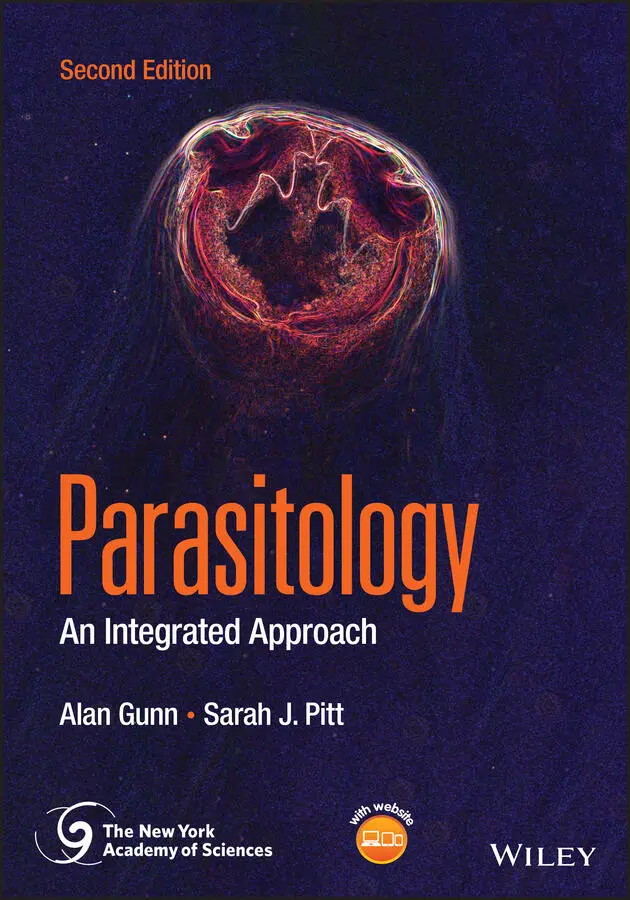
- Название:Parasitology
- Автор:
- Жанр:
- Год:неизвестен
- ISBN:нет данных
- Рейтинг книги:3 / 5. Голосов: 1
-
Избранное:Добавить в избранное
- Отзывы:
-
Ваша оценка:
Parasitology: краткое содержание, описание и аннотация
Предлагаем к чтению аннотацию, описание, краткое содержание или предисловие (зависит от того, что написал сам автор книги «Parasitology»). Если вы не нашли необходимую информацию о книге — напишите в комментариях, мы постараемся отыскать её.
Highly detailed textbook on parasites and parasite relationships Parasitology: An Integrated Approach
Parasitology: An Integrated Approach, 2nd edition
Parasitology — читать онлайн ознакомительный отрывок
Ниже представлен текст книги, разбитый по страницам. Система сохранения места последней прочитанной страницы, позволяет с удобством читать онлайн бесплатно книгу «Parasitology», без необходимости каждый раз заново искать на чём Вы остановились. Поставьте закладку, и сможете в любой момент перейти на страницу, на которой закончили чтение.
Интервал:
Закладка:
Within dogs, tissue tachyzoite stages also form and neurological symptoms occur if nervous tissues are infected. In addition, in pregnant bitches, the tachyzoites can invade across the placenta and infect the developing pups. The consequences of congenital infection in dogs can result in the pups being born with serious damage to nervous and skeletal muscle tissue that results in paralysis.
3.5.8 Genus Cryptosporidium
The taxonomy of the genus Cryptosporidium has undergone several re‐arrangements, so one must take care when reading the literature. Although traditionally considered coccidian parasites, albeit somewhat aberrant ones (e.g., they lack an apicoplast), molecular and ultrastructural studies indicate that cryptosporidians have much closer affinities to the gregarines. Consequently, the genus no longer resides amongst the Coccidia and currently lives in a new subclass, the Cryptogregaria (Ryan and Hijawa 2015; Ryan et al. 2016). The gregarines are a group of intracellular parasites that infect a wide range of invertebrates but not vertebrates. For more details on gregarines, see Desportes and Schrével (2013).
There are numerous Cryptosporidium species, and they include parasites of amphibia, reptiles, birds, and mammals Cryptosporidium (Fayer et al. 2018). Several species are zoonotic ( Table 3.4) but humans are predominantly infected by just two species: Cryptosporidium parvum and Cryptosporidium hominis . Both species express different subtypes that vary in their distribution and host preferences (Nader et al. 2019). In immunocompetent adults, cryptosporidiosis causes watery diarrhoea, abdominal cramps, and a slight fever, but it is usually self‐limiting. However, in children under 5 years of age, it can be highly pathogenic, and it is the second most common cause of death from diarrhoea after rotavirus infections. It is also potentially fatal in those who suffer from AIDS or are immunocompromised.
Table 3.4 Selected species of Cryptosporidium to indicate their usual host and zoonotic potential.
| Species name | Usual host | Zoonotic potential |
|---|---|---|
| Cryptosporidium muris | Mouse | Yes |
| Cryptosporidium parvum | Mouse | Yes |
| Cryptosporidium meleagridis | Turkey | Yes |
| Cryptosporidium wrairi | Guinea pig | No |
| Cryptosporidium felis | Cats | Yes |
| Cryptosporidium serpentis | Snakes | No |
| Cryptosporidium baileyi | Chicken | No |
| Cryptosporidium saurophilum | Skink | No |
| Cryptosporidium andersoni | Cattle | Yes |
| Cryptosporidium canis | Dog | Yes |
| Cryptosporidium hominis | Humans | Yes |
The life cycle of C. parvum is typical for the genus. When an oocyst reaches the small intestine or the respiratory system, it releases four sporozoites and these adhere to the surface mucus lying above the host epithelial cell’s apical membrane. They then release enzymes that break down the mucus, thereby enabling the sporozoites to contact and bind to the host cell membrane through receptor‐ligand interactions. The sporozoites then discharge the contents of their apical organelles. These include chemicals that induce the host cell membrane to form protrusions that surround the parasite and encapsulates it within a parasitophorous vacuole. Although the host cell initially encapsulates Cryptosporidium , the membrane that ultimately surrounds the parasitophorous vacuole contains both parasite and host cell components. This parasitophorous vacuole sits just inside the host cell apical membrane and is separate from the host cytoplasm. This location is unusual as it means that the vacuole is effectively extracytosolic. There is a spot, known as the annular ring, where the host apical membrane and the parasitophorous vacuole membrane fuse. In addition, the parasite develops a unique organelle called a ‘feeder organelle’ through which it derives nutrients from the host cell. Bones et al. (2019) provide more details of the invasion process. Within the parasitophorous vacuole, the sporozoite transforms into a trophozoite and then into a meront that divides asexually by merogony to produce type 1 meronts that contain 8 merozoites and then type 2 meronts that contain four merozoites. Further cycles of merogony can take place or the type 2 meronts may undergo gametogony to produce microgamonts (male) and macrogamonts (female). The microgamonts produce microgametocytes that leave their host cell and search for macrogamonts with which they fuse to form a zygote. About 20% of zygotes form thin‐walled oocysts that re‐infect the host. The other 80% of zygotes develop into thick‐walled oocysts that are shed into the environment where they are immediately infectious although they can survive for prolonged periods. Unlike Cyclospora , Isospora , and Sarcocystis , parasites of the genus Cryptosporidium do not form sporocysts.
Most people acquire their Cryptosporidium infection through ingesting oocysts transmitted by the faecal–oral contamination. However, infections also occur through inhaling the oocysts and autoinfection. On rare occasions, pulmonary infections occur, and these patients sometimes shed oocysts in their sputum. Cryptosporidiosis outbreaks are often associated with contamination of drinking water and infections of wild and domestic animals probably also occur through this route. The oocysts can survive in seawater and are resistant to chlorination. Consequently, infection can result from ingesting oocysts whilst swimming in recreational pools, lakes, or the sea. Flies and other invertebrates may also pick up and transmit the oocysts to food. Clams, oysters, and other shellfish concentrate Cryptosporidium oocysts from the surrounding water, but it is uncertain whether they pose a significant source of human infections. Detection of oocysts in patients’ samples or water sources using a light microscope is difficult because they are only ~5 μm long and often present in low numbers.
4 Parasitic Protozoa Part B: Phylum Kinetoplastida; Parasitic Algae and Fungi
CONTENTS
4.1 Introduction
4.2 Phylum Kinetoplastida
4.2.1 Genus Leishmania
4.2.2 Genus Trypanosoma
4.3 Phylum Chlorophyta
4.3.1 Genus Prototheca
4.4 Kingdom Fungi
4.4.1 Phylum Microspora
4.1 Introduction
In this chapter, we will introduce just a few of the kinetoplastid parasites that are important in human and veterinary medicine. This is a remarkable group of protozoa that includes parasites of plants, invertebrates, and vertebrates. Their transmission strategies range from contamination to vector assisted and sexually transmitted. We do not usually think of algae as parasitic organisms but there are a few that have adopted this lifestyle and some even parasitise us. This should not come as a surprise as several notorious protozoan parasites, such as Plasmodium , probably evolved from algal ancestors. The fungi have a Kingdom of their own and are normally considered the preserve of mycologists. However, the microsporidia are something of a special case. Originally classed as protozoa, they fell within the remit of parasitologists. Now, their subsequent reclassification as fungi presents parasitologists with a bit of dilemma. Namely, do they still belong within parasitology textbooks when yeast infections etc. are firmly excluded? At the time of writing, the classification of the Microsporidia is being called into question again, and therefore, we feel justified in including them here.
Читать дальшеИнтервал:
Закладка:
Похожие книги на «Parasitology»
Представляем Вашему вниманию похожие книги на «Parasitology» списком для выбора. Мы отобрали схожую по названию и смыслу литературу в надежде предоставить читателям больше вариантов отыскать новые, интересные, ещё непрочитанные произведения.










Обсуждение, отзывы о книге «Parasitology» и просто собственные мнения читателей. Оставьте ваши комментарии, напишите, что Вы думаете о произведении, его смысле или главных героях. Укажите что конкретно понравилось, а что нет, и почему Вы так считаете.