Тимоти Колтон - Everyone Loses - The Ukraine Crisis and the Ruinous Contest for Post-Soviet Eurasia
Здесь есть возможность читать онлайн «Тимоти Колтон - Everyone Loses - The Ukraine Crisis and the Ruinous Contest for Post-Soviet Eurasia» весь текст электронной книги совершенно бесплатно (целиком полную версию без сокращений). В некоторых случаях можно слушать аудио, скачать через торрент в формате fb2 и присутствует краткое содержание. Город: London, Год выпуска: 2017, ISBN: 2017, Издательство: The International Institute for Strategic Studies, Жанр: Политика, Публицистика, sci_economy, на английском языке. Описание произведения, (предисловие) а так же отзывы посетителей доступны на портале библиотеки ЛибКат.
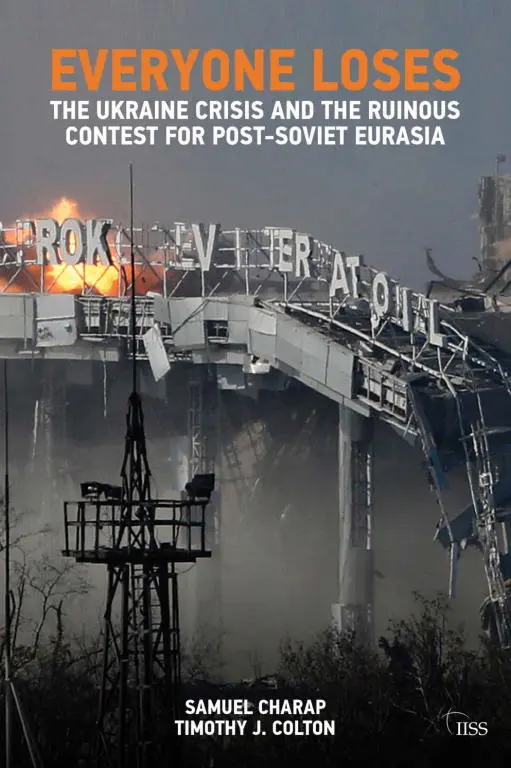
- Название:Everyone Loses: The Ukraine Crisis and the Ruinous Contest for Post-Soviet Eurasia
- Автор:
- Издательство:The International Institute for Strategic Studies
- Жанр:
- Год:2017
- Город:London
- ISBN:978-1-138-63308-7
- Рейтинг книги:4 / 5. Голосов: 1
-
Избранное:Добавить в избранное
- Отзывы:
-
Ваша оценка:
Everyone Loses: The Ukraine Crisis and the Ruinous Contest for Post-Soviet Eurasia: краткое содержание, описание и аннотация
Предлагаем к чтению аннотацию, описание, краткое содержание или предисловие (зависит от того, что написал сам автор книги «Everyone Loses: The Ukraine Crisis and the Ruinous Contest for Post-Soviet Eurasia»). Если вы не нашли необходимую информацию о книге — напишите в комментариях, мы постараемся отыскать её.
This Adelphi book argues that the crisis has yielded a ruinous outcome, in which all the parties are worse off and international security has deteriorated. This negative-sum scenario resulted from years of zero-sum behaviour on the part of Russia and the West in post-Soviet Eurasia, which the authors rigorously analyse. The rivalry was manageable in the early period after the Cold War, only to become entrenched and bitter a decade later. The upshot has been systematic losses for Russia, the West and the countries caught in between.
All the governments involved must recognise that long-standing policies aimed at achieving one-sided advantage have reached a dead end, Samuel Charap and Timothy J. Colton argue, and commit to finding mutually acceptable alternatives through patient negotiation.
Samuel Charap is Senior Fellow for Russia and Eurasia at the International Institute for Strategic Studies.
Timothy J. Colton is Morris and Anna Feldberg Professor of Government and Russian Studies, Harvard University.
Everyone Loses: The Ukraine Crisis and the Ruinous Contest for Post-Soviet Eurasia — читать онлайн бесплатно полную книгу (весь текст) целиком
Ниже представлен текст книги, разбитый по страницам. Система сохранения места последней прочитанной страницы, позволяет с удобством читать онлайн бесплатно книгу «Everyone Loses: The Ukraine Crisis and the Ruinous Contest for Post-Soviet Eurasia», без необходимости каждый раз заново искать на чём Вы остановились. Поставьте закладку, и сможете в любой момент перейти на страницу, на которой закончили чтение.
Интервал:
Закладка:
1
Besides the two small island nations of Malta and Cyprus, all the new EU members were either former Soviet republics (Estonia, Latvia and Lithuania), former communist states in East Central Europe (the Czech Republic, Hungary, Poland and Slovakia) or the Balkans (Slovenia, once a constituent republic of Yugoslavia). NATO took in Bulgaria, Estonia, Latvia, Lithuania, Romania, Slovakia and Slovenia in 2004. Bulgaria and Romania were to accede to the EU in 2007 and Croatia in the Balkans to NATO in 2009 and the EU in 2013.
2
See presentations by Minister of Defence Sergei Shoigu, Foreign Minister Sergei Lavrov and Chief of the General Staff Valerii Gerasimov at the 3rd annual Moscow Conference on International Security, available at http://mil.ru/mcis/2014.htm. For an English-language summary, see http://eng.mil.ru/files/MCIS_report_catalogue_final_ENG_21_10_preview.pdf.
3
Valerii Gerasimov, ‘Tsennost’ nauki v prognozirovanii’, Voenno-promyshlennyi kur’er , 5 March 2013.
4
As Michael McFaul notes, the foreign democracy-promotion wings of both of the United States’ national political parties were deeply involved in Ukrainian events in 2004: ‘That there were purposive efforts by both IRI [the International Republican Institute] and NDI [the National Democratic Institute] to strengthen Our Ukraine’s [Yushchenko’s party] campaign abilities is without question.’ Michael McFaul, ‘Ukraine Imports Democracy: External Influences on the Orange Revolution’, International Security , vol. 32, no. 2, Fall 2007, p. 74.
5
Lincoln A. Mitchell, The Color Revolutions (Philadelphia, PA: University of Pennsylvania Press, 2012), p. 86.
6
See Henry E. Hale, Patronal Politics: Eurasian Regime Dynamics in Comparative Perspective (Cambridge: Cambridge University Press, 2014).
7
It is conceivable that in Georgia the cosy relationship with the Bush administration actually encouraged nondemocratic behaviour, by leading Saakashvili to think he could mistreat local opponents without objection from external patrons.
8
See, for example, Nicolas Bouchet, ‘Russia and the Democracy Rollback in Europe’, The German Marshall Fund of the United States, 26 May 2016, http://www.gmfus.org/publications/russia-and-democracy-rollback-europe.
9
Timothy Colton, ‘Sources and Limits of Russia’s Influence in Post-Soviet Eurasia’, paper presented at the Annual Meeting of the American Political Science Association, Seattle, WA, 3 September 2011, p. 11.
10
Nelli Babayan, ‘The Return of the Empire? Russia’s Counteraction to Transatlantic Democracy Promotion in Its Near Abroad’, Democratization , vol. 22, no. 3, March 2015, pp. 438–58.
11
Andrei Kolesnikov, ‘Obnimai, no proveryai’, Kommersant , 21 March 2005.
12
‘Nachalo vstrechi s prem’er-ministrom Ukrainy Yuliei Timoshenko’, 19 March 2005, http://kremlin.ru/events/president/transcripts/22867.
13
‘Commission Staff Working Paper – European Neighbourhood Policy – Country Report Ukraine {COM(2004)373 Final}’, 12 May 2004, http://www.enpi-info.eu/library/content/ukraine-enp-country-report.
14
‘Russia – Final Version of the Road Map on the Common Economic Space Agreed at the EU–Russia Summit on 10 May’, 24 May 2005, http://www.enpi-info.eu/library/content/eu-russia-roadmap-common-economic-space.
15
Jonathan Stern, ‘The Russian–Ukrainian Gas Crisis of January 2006’, Oxford Institute for Energy Studies, 16 January 2006, p. 6.
16
Rilka Dragneva and Kataryna Wolczuk, Ukraine Between the EU and Russia (London: Palgrave Macmillan, 2015), p. 74.
17
James Sherr, Hard Diplomacy and Soft Coercion: Russia’s Influence Abroad (London: Chatham House, 2013).
18
Marlene Laruelle, ‘The “Russian World”: Russia’s Soft Power and Geopolitical Imagination’, Center on Global Interests, May 2015; Sinikukka Saari, ‘Russia’s Post-Orange Revolution Strategies to Increase Its Influence in Former Soviet Republics: Public Diplomacy Po Russkii ’, Europe – Asia Studies , vol. 66, no. 1, January 2014, pp. 50–66.
19
Dick Cheney, In My Time: A Personal and Political Memoir (New York: Threshold Editions, 2012), p. 428.
20
Ronald Asmus, ‘Redrawing (Again) the Map of Europe: A Strategy for Integrating Ukraine into the West’, in Joerg Forbrig and Robin Shepherd (eds), Ukraine after the Orange Revolution: Strengthening European and Transatlantic Commitments (Washington DC: The German Marshall Fund of the United States, 2005), p. 90.
21
George W. Bush, Decision Points (New York: Broadway Books, 2011), p. 430.
22
‘Cheney’s Speech in Lithuania’, 4 May 2006, http://www.nytimes.com/2006/05/04/world/europe/04cnd-cheney-text.html.
23
In 2006, NATO membership was broadly unpopular among Ukrainians, including in the traditionally pro-Western central and western regions, where 23% supported and 29% opposed, to say nothing of the south and east, traditionally more pro-Russian (7% support for NATO, 77% opposed). Kyiv International Institute of Sociology data cited in Valeriy Khmel’ko, ‘Cherez shcho politykam vdayet’sya rozkolyuvaty Ukrayinu’, Dzerkalo tyzhnya , 23 June 2006, http://gazeta.dt.ua/ARCHIVE/cherez_scho_politikam_vdaetsya_rozkolyuvati_ukrayinu.html.
24
‘Ukraine on the Road to NATO: A Status Report’, 14 February 2006, released by WikiLeaks as Cable 06KIEV604_a, https://wikileaks.org/plusd/cables/06KIEV604_a.html.
25
According to the US Department of State, at least US$2.5 million was spent on GUAM-related projects between the fiscal years 2004 and 2008. See US Government Assistance to and Cooperative Activities with Eurasia, http://www.state.gov/p/eur/rls/rpt/c10250.htm.
26
The Russian peacekeepers in Abkhazia and South Ossetia, stationed there under the terms of the ceasefire agreements that ended the conflicts of the early 1990s, were thus not covered by the Istanbul Commitments and remained.
27
Some details may be found in ‘A/S Fried-Poldir Araud on Iran, Kosovo, Georgia, Moldova/CFE, NATO Ministerial’, 31 January 2007, released by WikiLeaks as Cable 07PARIS363_a, https://search.wikileaks.org/plusd/cables/07PARIS363_a.html; ‘CFE: Germany Pushes for Being Forward-Leaning on A/CFE Ratification at Upcoming Extraordinary Conference’, 4 June 2007, released by WikiLeaks as Cable 07BERLIN1107_a, https://search.wikileaks.org/plusd/cables/07BERLIN1107_a.html; ‘November 7 HLTF and NRC-ACE Meetings at NATO’, 28 November 2006, released by WikiLeaks as Cable 06USNATO687_a, https://search.wikileaks.org/plusd/cables/06USNATO687_a.html.
28
‘Poslanie Federal’nomu Sobraniyu Rossiiskoi Federatsii’, 26 April 2007, http://kremlin.ru/events/president/transcripts/24203.
29
It should be noted that the CFE treaty contains no suspension clause so the Russian move was of dubious legality.
30
Интервал:
Закладка:
Похожие книги на «Everyone Loses: The Ukraine Crisis and the Ruinous Contest for Post-Soviet Eurasia»
Представляем Вашему вниманию похожие книги на «Everyone Loses: The Ukraine Crisis and the Ruinous Contest for Post-Soviet Eurasia» списком для выбора. Мы отобрали схожую по названию и смыслу литературу в надежде предоставить читателям больше вариантов отыскать новые, интересные, ещё непрочитанные произведения.






Обсуждение, отзывы о книге «Everyone Loses: The Ukraine Crisis and the Ruinous Contest for Post-Soviet Eurasia» и просто собственные мнения читателей. Оставьте ваши комментарии, напишите, что Вы думаете о произведении, его смысле или главных героях. Укажите что конкретно понравилось, а что нет, и почему Вы так считаете.