Ben Aaronovitch - Broken Homes
Здесь есть возможность читать онлайн «Ben Aaronovitch - Broken Homes» весь текст электронной книги совершенно бесплатно (целиком полную версию без сокращений). В некоторых случаях можно слушать аудио, скачать через торрент в формате fb2 и присутствует краткое содержание. Год выпуска: 2013, ISBN: 2013, Издательство: Orion, Жанр: sf_fantasy_city, на английском языке. Описание произведения, (предисловие) а так же отзывы посетителей доступны на портале библиотеки ЛибКат.
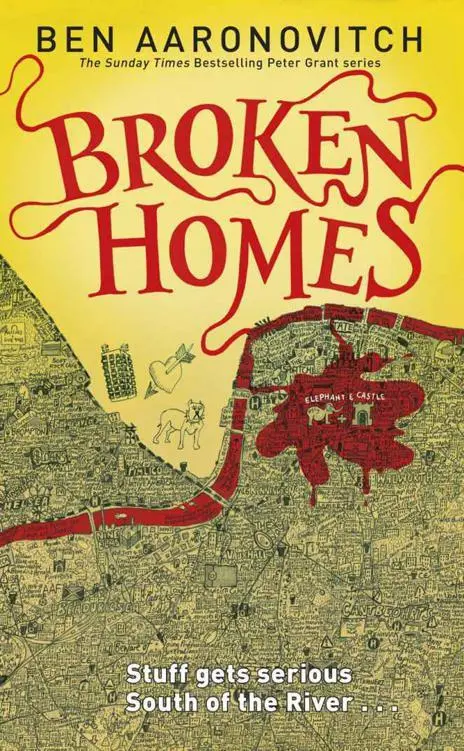
- Название:Broken Homes
- Автор:
- Издательство:Orion
- Жанр:
- Год:2013
- ISBN:9780575132498
- Рейтинг книги:4 / 5. Голосов: 1
-
Избранное:Добавить в избранное
- Отзывы:
-
Ваша оценка:
Broken Homes: краткое содержание, описание и аннотация
Предлагаем к чтению аннотацию, описание, краткое содержание или предисловие (зависит от того, что написал сам автор книги «Broken Homes»). Если вы не нашли необходимую информацию о книге — напишите в комментариях, мы постараемся отыскать её.
Broken Homes — читать онлайн бесплатно полную книгу (весь текст) целиком
Ниже представлен текст книги, разбитый по страницам. Система сохранения места последней прочитанной страницы, позволяет с удобством читать онлайн бесплатно книгу «Broken Homes», без необходимости каждый раз заново искать на чём Вы остановились. Поставьте закладку, и сможете в любой момент перейти на страницу, на которой закончили чтение.
Интервал:
Закладка:
‘Servants’ rooms,’ said Shapiro. ‘And what was supposed to be the main kitchen.’
But post World War Two full employment had put an end to the service culture, and the Stromberg family then had to make do with a woman who came in and ‘did’ for them three times a week. The servants’ quarters were turned into flats and Mrs Stromberg was forced to cook for herself.
Access to the main house was by a beautiful iron spiral staircase with mahogany steps.
‘It is a bit narrow, isn’t it?’ said Shapiro who’d obviously led a tour or two in her time. ‘Stromberg found that in order to get much of his wife’s furniture into the house he had to devise an ingenious pulley system on the first floor to hoist it up.’
I certainly wouldn’t want to manoeuvre a wardrobe up those stairs — not even flat packed.
Upstairs it was remarkably like stepping into a council flat, only bigger and more expensively furnished. The same low ceilings and rooms that were strangely proportioned — a dining room that was long and well lit but so narrow that there was barely enough room to put the uncomfortable looking Marcel Breuer chairs around the dining table, the tiny afterthought of a kitchen and the narrow beige coloured hallways. Stromberg’s office, I noticed, was a much better proportioned room. It had been preserved, Ms Shapiro told me, just as Stromberg had left it the morning in 1981 when he went into hospital for a routine operation and never came back.
‘Bowel cancer,’ she said. ‘Then complications, then pneumonia.’
The wall behind the large teak desk was lined with plain metal bracket and pine bookshelves. On it were racked box files labelled RIBA, photograph albums bound in leatherette, stacked copies of The Architectural Review and a surprising number of what looked like textbooks on material science. Big fat A4 sized books with blue and purple covers and academic logos on their cracked spines. I pointed them out to Ms Shapiro.
‘He was known for his innovative use of materials,’ she said.
His enamelled steel and oak drawing table had sleek 1950s lines and was positioned to catch the light from the south-facing window. A picture on the wall above it caught my eye, a water colour and pencil sketch of a nude black woman. The woman was depicted bent over, hands on knees, her heavy breasts hanging pendulously between her arms. The face was rough, outsized eyes and blubbery lips, and turned so she looked out of the picture. I thought it was a bit crude and sketchy to have pride of place opposite the desk.
‘That’s an original by Le Corbusier,’ said Mrs Shapiro. ‘Of Josephine Baker — the famous dancer.’
It didn’t look much like Josephine Baker to me, not with those outsized cartoon lips, flat nose and elongated head. Well, it was a quick sketch and perhaps old Corbusier had been too busy staring at her breasts. The feet were nicely done though — properly proportioned and detailed — maybe he just hadn’t been very good at faces.
‘Is it valuable?’ I asked.
‘Worth about three thousand pounds,’ she said.
Next to the Josephine Baker was a picture I recognised, a framed architectural sketch of Bruno Taut’s glass pavilion. Like all the other architects of his generation, Taut believed that you could morally uplift the masses through architecture. But unlike most of his contemporaries he didn’t want to do that by sticking them in concrete blocks. Taut’s big thing was glass, which he believed had spiritual qualities. He wanted to build Stadtkrones , literally ‘city crowns’, secular cathedrals that would draw the spiritual energy of the city upwards. His glass pavilion at the Cologne Exhibition in 1914 was an elongated dome constructed from glass panels with a step fountain inside — the Gherkin at St Mary Axe is a scaled-up version, but stuffed with lots of offices. As a piece of architecture, it was as pretty and non-functional as an art nouveau bicycle and an odd picture for a committed brutalist like Stromberg to have on his wall.
‘That’s by Bruno Taut,’ said Ms Shapiro. ‘A contemporary of Stromberg, bit of a rebel by all accounts. Can you tell which famous London building it influenced?’
‘Is it valuable as well?’ I asked.
‘Definitely,’ she said, obviously disappointed that I didn’t want to play. ‘Most of the works in here are original if minor pieces by some pretty famous names. The insurance estimate for the art alone is upwards of two million pounds. Hence the expensive security system.’
Even more expensive after the break-in, I thought. And yet none of the art was stolen. ‘If nothing was stolen,’ I asked, ‘how did you know there was a break-in?’
‘Because we found a hole,’ she said with a note of triumph.
I actually knew all about the hole from the report, but it’s always good to get a potential witness warmed up on something you can verify. That way you can tell how bad a liar they are. It’s nothing personal, you understand — just good police work.
Ms Shapiro gracefully dipped down and pulled back an ugly black and white striped rug to reveal where a neat rectangular section of the parquet floor had been recently replaced with a plain hardwood sheet. She hooked a finger through a ring handle at one end and lifted the board away to reveal the safe.
Custom built, possibly by Chubb in the 1950s, although the National Trust hadn’t been able to verify the manufacturer yet.
‘Which makes it an interesting item in its own right,’ said Ms Shapiro. ‘We’re thinking we may leave it uncovered so the public can see it.’
Mulkern had left no tool marks on the casing so it either hadn’t been locked — a possibility — or he’d cracked it the old-fashioned way.
‘Do you reckon it was part of the original build?’ I asked. The safe was shallow enough to fit into the concrete floor without protruding through the ceiling below but was definitely deep enough to hold the Die Praxis Der Magie plus a number of other books — maybe three or four more.
Ms Shapiro shook her head. ‘That’s an excellent question to which I wish I knew the answer.’
I lowered myself onto the floor and stuck my face in the safe. It smelt of clean metal and what might have been old paper — there were no vestigia that I could detect. Nightingale had advised that the grimoire wouldn’t have left a trace — ‘Books of magic,’ he’d said, ‘are not necessarily magical books.’ Still, I’d been hoping for a touch of the razor that I’d started associating with the Faceless Man.
But there was nothing. Mulkern, assuming it was him who broke into the villa, had either been working alone, or with hypothetical persons unknown who hadn’t used magic. Apart from the barbecue down in Bromley we didn’t have anything to link the Faceless Man to the Die Praxis Der Magie or the burglary. That’s the trouble with evidence — either you’ve got it or you ain’t.
In the report it mentioned the insurance company had found evidence that the door on the roof had been forced at some point in the recent past. I asked Ms Shapiro about the lock and if she’d show me up to have a look.
‘We don’t know when that happened for sure,’ she said as she led me back to the spiral stairs. ‘Frankly, the insurance company were just trying to impress us with how keen they were.’
‘Did they put your premiums up?’
‘What do you think?’ she asked.
There was a poster-sized photograph of the Skygarden Tower hanging on the second floor landing. It had been taken at night with the base lit by coloured floodlights and the windows ablaze. I asked whether Stromberg had hung it there himself.
‘No,’ said Ms Shapiro. ‘But he regarded Skygarden as his best work, so we thought it would be appropriate to mark that. It was taken in 1969 just before the first tenants moved in.’
Читать дальшеИнтервал:
Закладка:
Похожие книги на «Broken Homes»
Представляем Вашему вниманию похожие книги на «Broken Homes» списком для выбора. Мы отобрали схожую по названию и смыслу литературу в надежде предоставить читателям больше вариантов отыскать новые, интересные, ещё непрочитанные произведения.






Обсуждение, отзывы о книге «Broken Homes» и просто собственные мнения читателей. Оставьте ваши комментарии, напишите, что Вы думаете о произведении, его смысле или главных героях. Укажите что конкретно понравилось, а что нет, и почему Вы так считаете.