Ben Aaronovitch - Broken Homes
Здесь есть возможность читать онлайн «Ben Aaronovitch - Broken Homes» весь текст электронной книги совершенно бесплатно (целиком полную версию без сокращений). В некоторых случаях можно слушать аудио, скачать через торрент в формате fb2 и присутствует краткое содержание. Год выпуска: 2013, ISBN: 2013, Издательство: Orion, Жанр: sf_fantasy_city, на английском языке. Описание произведения, (предисловие) а так же отзывы посетителей доступны на портале библиотеки ЛибКат.
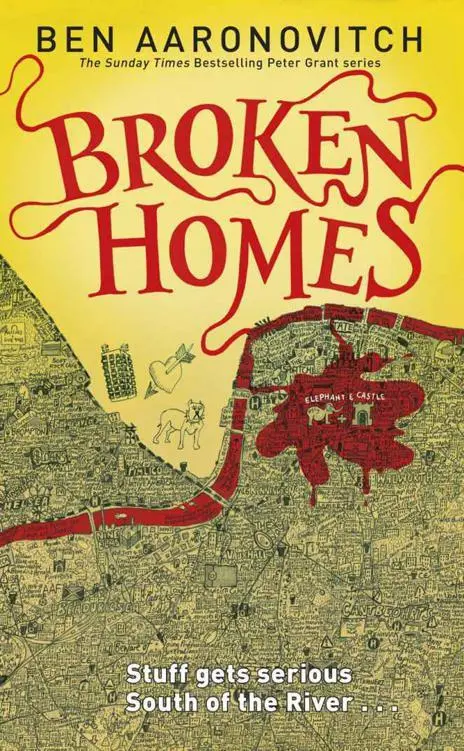
- Название:Broken Homes
- Автор:
- Издательство:Orion
- Жанр:
- Год:2013
- ISBN:9780575132498
- Рейтинг книги:4 / 5. Голосов: 1
-
Избранное:Добавить в избранное
- Отзывы:
-
Ваша оценка:
Broken Homes: краткое содержание, описание и аннотация
Предлагаем к чтению аннотацию, описание, краткое содержание или предисловие (зависит от того, что написал сам автор книги «Broken Homes»). Если вы не нашли необходимую информацию о книге — напишите в комментариях, мы постараемся отыскать её.
Broken Homes — читать онлайн бесплатно полную книгу (весь текст) целиком
Ниже представлен текст книги, разбитый по страницам. Система сохранения места последней прочитанной страницы, позволяет с удобством читать онлайн бесплатно книгу «Broken Homes», без необходимости каждый раз заново искать на чём Вы остановились. Поставьте закладку, и сможете в любой момент перейти на страницу, на которой закончили чтение.
Интервал:
Закладка:
‘Sorry,’ I said and told him about the break in at West Hill House in Highgate.
‘A somewhat slender thread,’ said Nightingale.
‘Yes,’ I said. ‘But what if I was to tell you that West Hill House was the home of Erik Stromberg the famous architect and German expatriate.’
Nightingale’s eyes narrowed. ‘You think the book might have belonged to Stromberg?’
‘He got out before Hitler came to power,’ I said. ‘What if he brought some secrets with him? What if he was a member of the Weimar Academy?’
‘London was full of expatriates in the run up to the war,’ said Nightingale. ‘German or otherwise. You’d be surprised how few of them turned out to be practitioners.’
‘That book had to come from somewhere,’ I said.
‘True,’ said Nightingale. ‘But Whitehall had a bee in its bonnet about German infiltration and hence much of our manpower was devoted to spotting them and rounding them up.’
‘They were interned?’
‘They were given a choice,’ said Nightingale with a shrug. ‘They could join the war effort or be shipped over to Canada for the duration. A surprising number of them stayed. Most of the Jews and the Gypsies, of course.’
‘But you might have missed some?’
‘It’s possible — if they kept quiet.’
‘Perhaps that’s where Mr Nolfi’s mother learnt her party tricks,’ I said. ‘She might have been an expatriate. I didn’t think of asking in the hospital.’ Tracking down the exploding granddad’s antecedents was yet another thing that was still sitting in the low priority things-to-be-done pile. It might have to be moved up.
‘Indeed,’ said Nightingale. ‘I’d like you to have a look at the house.’
‘Today?’
‘If possible,’ said Nightingale which meant, yes absolutely today. ‘I’ll liaise with the Detective Chief Inspector and Dr Walid, when he arrives. Once you’ve done that you and Lesley can join us for the post-mortem — which I suspect will be instructive.’
‘Oh joy,’ I said.
6
I felt a bit weird on my way north and had to pull over on the Old Kent Road and take a breather.
I sat in the car for a while listening to the rain dinging off the roof of the Asbo and glaring at the red metal doors of the fire station.
When you’re a young copper, the old sweats like to scare you with the horrors of the Job. Eviscerated motorists, bloated floaters and little old ladies who had ended their days as a protein supplement for their house cats were common themes — and so was the smell of burnt human flesh.
‘You never get the stink out of your nostrils,’ the old sweats would say and then, without fail, go on to tell you that it was worse when you hadn’t had your dinner. ‘Because then your mouth starts watering and then you remember what it is exactly that you’re smelling.’
As it happens I was feeling a bit hungry and the memory of the smell was definitely taking the edge off my appetite. Still, I don’t work well on an empty stomach so I bailed at the Bricklayers Arms and found a place that sold industrial strength vegetable samosas — the kind that are spicy enough to anaesthetise your sinuses — and had a couple of those. While I ate, I looked up the National Trust on my phone and spent a fun ten minutes bouncing around their switchboard — they wanted to be helpful but nobody was sure what do with a call from a random police officer. I told them I’d be up at West Hill House within the hour and left them to sort it out. When in doubt, make it somebody else’s problem.
Mouth full of the last of my samosa, I pulled out into the wet traffic. As I stopped and started my way through the Elephant and Castle I realised that I was actually right next to one of Erik Stromberg’s masterpieces — the Skygarden estate. A concrete spike which had dominated the area until they’d built the Strata building next door. They’d been going to tear Skygarden down in the 1980s, but it had been inexplicably listed. I’d read somewhere that Southwark Council were trying to get the decision reversed so they could finally blow the fucker up.
Skygarden had been famous for its resident pirate radio station, for being a no-go area where police only ever ventured mob-handed and qualifying as a top spot to commit suicide. It was the original sink estate back in the days before the media started slapping that label on any area with less than two artisanal cheese shops. There were all sorts of rumours about the architect — including one that he’d been driven mad by the guilt for what he’d created and thrown himself off the top. It was all bollocks, of course. Erik Stromberg had lived in luxury in a custom-built villa in the International Style at the top of Highgate Hill until the day he popped his clogs.
And at least, according to Google Earth, a kilometre from the nearest high-rise flats.
I went up the steep slope of Highgate West Hill with the houses peeking out from driveways and gated avenues and adding about a quarter of a million quid with every twenty metres of altitude. I turned right onto the summit of Highgate Hill, where most of the buildings dated back to the time when Highgate Village was a rural community that overlooked the stink and noise of London from a safe distance.
There was a terribly discreet National Trust logo marking the entrance to a drive and an open space beyond marked STRICTLY NO PARKING where I dumped the Asbo. I clambered out and got my first look at the house that Stromberg built.
It rose above the Georgian cottages like the flying bridge of the SS Corbusier and no doubt in bright Mediterranean sunlight the white stucco would have gleamed but in the cold rain it just looked dirty and grey. There were streaks of green discoloration fringing the top storey — which is what you get when you do away with such bourgeois affectations as gargoyles, decorative cornices and overhanging eves.
Like a good devotee of the International Style, Stromberg had probably wanted to raise the whole house on pillars, the better for us to appreciate its cubist simplicity. But land has never been that cheap in London, so he’d settled for lifting just the front third. The sheltered space was too shallow to make a useful garage and made me think of a bus shelter, but from the signs attached to the walls it was obvious the National Trust found it useful as a staging area for visiting parties.
Above the entrance was the compulsory Crittal-strip window so long and narrow that I almost expected a red light to start scanning from side to side while making a whumm, whumm noise.
I was met at the front door by a thin-faced white woman with short grey hair and half-moon glasses. She was dressed in shades of mauve in the tweedy hippy style adopted by many who sailed through the 1970s counterculture on the back of an expensive education and a family place in the country. She hesitated when she saw me.
‘PC Grant?’ she asked.
I identified myself and showed her my warrant card — I find it reassures some people.
She smiled with relief and shook my hand.
‘Margaret Shapiro,’ she said. ‘I’m the property manager for West Hill House. I understand that you’re interested in our break-in.’
I told her that I thought it might be connected to a related case.
‘We recovered a book we think may have been stolen from this property,’ I said. ‘I understand your records of what were stolen are incomplete.’
‘Incomplete?’ said Shapiro. ‘That’s one way of putting it. You’d better come up and have a look.’
She led me through the front door into a hallway with white plaster walls and a blond-wood floor. There were two doors to the left and right, both oddly smaller than standard — as if they’d shrunk in the wash.
Читать дальшеИнтервал:
Закладка:
Похожие книги на «Broken Homes»
Представляем Вашему вниманию похожие книги на «Broken Homes» списком для выбора. Мы отобрали схожую по названию и смыслу литературу в надежде предоставить читателям больше вариантов отыскать новые, интересные, ещё непрочитанные произведения.






Обсуждение, отзывы о книге «Broken Homes» и просто собственные мнения читателей. Оставьте ваши комментарии, напишите, что Вы думаете о произведении, его смысле или главных героях. Укажите что конкретно понравилось, а что нет, и почему Вы так считаете.