Дэн Симмонс - The Fall of Hyperion
Здесь есть возможность читать онлайн «Р”СЌРЅ РЎРёРјРјРѕРЅСЃ - The Fall of Hyperion» весь текст электронной книги совершенно бесплатно (целиком полную версию без сокращений). В некоторых случаях можно слушать аудио, скачать через торрент в формате fb2 и присутствует краткое содержание. Город: London, Год выпуска: 2006, ISBN: 2006, Издательство: Orion Publishing Group, Жанр: Эпическая фантастика, Космическая фантастика, на английском языке. Описание произведения, (предисловие) а так же отзывы посетителей доступны на портале библиотеки ЛибКат.
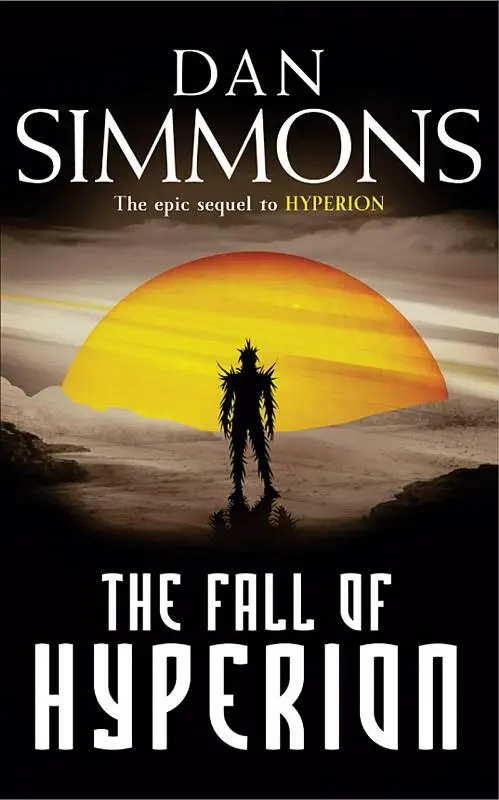
- Название:The Fall of Hyperion
- Автор:
- Издательство:Orion Publishing Group
- Жанр:
- Год:2006
- Город:London
- ISBN:9780575076389
- Рейтинг книги:5 / 5. Голосов: 1
-
Избранное:Добавить в избранное
- Отзывы:
-
Ваша оценка:
The Fall of Hyperion: краткое содержание, описание и аннотация
Предлагаем к чтению аннотацию, описание, краткое содержание или предисловие (зависит от того, что написал сам автор книги «The Fall of Hyperion»). Если вы не нашли необходимую информацию о книге — напишите в комментариях, мы постараемся отыскать её.
The Fall of Hyperion — читать онлайн бесплатно полную книгу (весь текст) целиком
Ниже представлен текст книги, разбитый по страницам. Система сохранения места последней прочитанной страницы, позволяет с удобством читать онлайн бесплатно книгу «The Fall of Hyperion», без необходимости каждый раз заново искать на чём Вы остановились. Поставьте закладку, и сможете в любой момент перейти на страницу, на которой закончили чтение.
Интервал:
Закладка:
Sol sat and held onto the stone stair as time tides pulled at him, tugged at him, and made him weep in the false shock of déjà vu. The entire Sphinx seemed to rock and pitch in the violent storm of expanding and contracting anti-entropic fields.
Rachel.
Sol would not leave while there was any chance his daughter might be alive. Lying on cold stone, listening to the wind scream die, Sol saw the cold stars appear, saw the meteor trail and laser-lance thrust and counterthrust of orbital war, knew in his heart that the war was lost, that the Web was in danger, that great empires were falling as he watched, the human race might be hanging in the balance this endless night… and he did not care.
Sol Weintraub cared about his daughter.
And even as he lay there, cold, buffeted by winds and time tides, bruised with fatigue and hollow from hunger, Sol felt a certain peace descend on him. He had given his daughter to a monster but not because God had commanded him to, not because fate or fear had willed it, but only because his daughter had appeared to him in a dream and told him that it was all right, that this was the thing to do, that their love—his and Sarai’s and Rachel’s—demanded it.
In the end, thought Sol, past logic and hope, it is dreams and the love of those dearest to us that form Abraham’s answer to God.
Sol’s comlog no longer worked. It might have been an hour or five hours since he had handed his dying infant to the Shrike. Sol lay back, still gripping stone as the time tides made the Sphinx bob like a small ship on a big sea, and stared at the stars and battle above.
Sparks drifted across the sky, glowed bright as supernovae as laser lances found them, and then fell in a shower of molten debris—white-hot to red to blue flame to darkness. Sol imagined dropships burning, imagined Ouster troops and Hegemony Marines dying in a scream of atmosphere and melting titanium… he tried to imagine this… and failed. Sol realized that space battles and the movements of fleets and the fall of empires were beyond his imagining, hidden from the reservoirs of his sympathy or understanding. Such things belonged to Thucydides and Tacitus and Catton and Wu. Sol had met his senator from Barnard’s World, had met with her several times in his and Sarai’s quest to save Rachel from Merlin’s sickness, but Sol could not imagine Feldstein’s participation on the scale of interstellar war—or in anything much larger than dedicating a new medical center in the capital of Bussard or pressing the flesh during a rally at the university in Crawford.
Sol had never met the current Hegemony CEO, but as a scholar, he had enjoyed her subtle replay of the speeches of such classical figures as Churchill and Lincoln and Alvarez-Temp. But now, lying between the paws of a great stone beast and weeping for his daughter, Sol could not imagine what was in that woman’s mind as she made decisions that would save or damn billions, preserve or betray the greatest empire in human history.
Sol didn’t give a damn. He wanted his daughter back. He wanted Rachel to be alive despite all logic to the contrary.
Lying between the Sphinx’s stone paws on a besieged world in a ravaged empire, Sol Weintraub wiped tears from his eyes the better to see the stars and thought of Yeats’s poem “A Prayer for My Daughter":
Once more the storm is howling, and half hid
Under this cradle-hood and coverlid
My child sleeps on. There is no obstacle
But Gregory’s wood and one bare hill
Whereby the haystack-and roof-levelling wind,
Bred on the Atlantic, can be stayed;
And for an hour I have walked and prayed
Because of the great gloom that is in my mind.
I have walked and prayed for this young child an hour
And heard the sea-wind scream upon the tower,
And under the arches of the bridge, and scream
In the elms above the Hooded stream;
Imagining in excited reverie
That the future years had come,
Dancing to a frenzied drum,
Out of the murderous innocence of the sea…
All Sol wanted, he realized now, was the same possibility once again to worry about those future years which every parent fears and dreads.
To not allow her childhood and teenage years and awkward young adulthood to be stolen and destroyed by the sickness.
Sol had spent his life willing the return of things unreturnable. He remembered the day he had come upon Sarai folding Rachel’s toddler clothes and setting them in a box in the attic, and he recalled her tears and his own sense of loss for the child they still had but who was lost to them through the simple arrow of time. Sol knew now that little could be returned except by memory—that Sarai was dead and beyond ability to return, that Rachel’s childhood friends and world were gone forever, that even the society he had left only a few weeks of his time ago was in the process of being lost beyond return.
And thinking of that, lying between the taloned paws of the Sphinx as the wind died and the false stars burned, Sol is reminded of part of a different and far more ominous poem by Yeats:
Surely some revelation is at hand;
Surely the Second Coming is at hand.
The Second Coming! Hardly are those words out
When a vast image out of Spiritus Mundi
Troubles my sight: somewhere in the sands of the desert
A shape with lion body and the head of a man,
A gaze blank and pitiless as the sun,
Is moving its slow thighs, while all about it
Reel shadows of the indignant desert birds.
The darkness drops again; but now I know
That twenty centuries of stony sleep
Were vexed to nightmare by a rocking cradle,
And what rough beast, its hour come round at last,
Slouches towards Bethlehem to be born?
Sol does not know. Sol discovers again that he does not care. Sol wants his daughter back.
The consensus in the War Council seemed to be to drop the bomb.
Meina Gladstone sat at the head of the long table and felt the peculiar and not-unpleasant sense of separateness which comes from far too little sleep over far too long a period. To close her eyes, even for a second, meant sliding on the black ice of fatigue, so she did not close her eyes, even when they burned and when the drone of briefings, conversation, and urgent debate faded and receded through thick curtains of exhaustion.
Together the Council had watched as the embers of Task Force 181.2—Commander Lee’s attack group—had winked out one by one until only a dozen of the original seventy-four were left still driving toward the center of the approaching Swarm. Lee’s cruiser was among the survivors.
During this silent attrition, this abstract and oddly attractive representation of violent and all-too-real death, Admiral Singh and General Morpurgo had completed their gloomy assessment of the war.
“…FORCE and the New Bushido were designed for limited conflicts, minor skirmishes, proscribed limits and modest aims,” summarized Morpurgo. “With less than half a million men and women under arms, FORCE would not be comparable to the armies of one of the Old Earth nation states a thousand years ago. The Swarm can swamp us with sheer numbers, outgun our fleets and win through arithmetic.”
Senator Kolchev glowered from his place at the opposite end of the table. The Lusian had been much more active in the briefing and debate than Gladstone—questions were turned his way more frequently than to her—almost as if everyone in the room were subliminally aware that power was shifting, the torch of leadership was being passed.
Nor yet, thought Gladstone, tapping her chin with steepled fingers and listening to Kolchev cross-examine the General.
“…of falling back and defending essential worlds on the second-wave list—Tau Ceti Center, of course, but also necessary industrial worlds such as Renaissance Minor, Fuji, Deneb Vier, and Lusus?”
Читать дальшеИнтервал:
Закладка:
Похожие книги на «The Fall of Hyperion»
Представляем Вашему вниманию похожие книги на «The Fall of Hyperion» списком для выбора. Мы отобрали схожую по названию и смыслу литературу в надежде предоставить читателям больше вариантов отыскать новые, интересные, ещё непрочитанные произведения.






Обсуждение, отзывы о книге «The Fall of Hyperion» и просто собственные мнения читателей. Оставьте ваши комментарии, напишите, что Вы думаете о произведении, его смысле или главных героях. Укажите что конкретно понравилось, а что нет, и почему Вы так считаете.