Дэн Симмонс - The Fall of Hyperion
Здесь есть возможность читать онлайн «Р”СЌРЅ РЎРёРјРјРѕРЅСЃ - The Fall of Hyperion» весь текст электронной книги совершенно бесплатно (целиком полную версию без сокращений). В некоторых случаях можно слушать аудио, скачать через торрент в формате fb2 и присутствует краткое содержание. Город: London, Год выпуска: 2006, ISBN: 2006, Издательство: Orion Publishing Group, Жанр: Эпическая фантастика, Космическая фантастика, на английском языке. Описание произведения, (предисловие) а так же отзывы посетителей доступны на портале библиотеки ЛибКат.
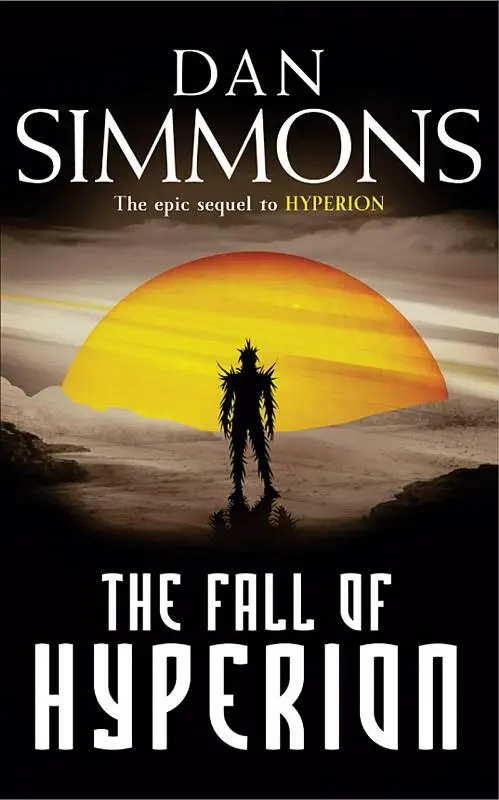
- Название:The Fall of Hyperion
- Автор:
- Издательство:Orion Publishing Group
- Жанр:
- Год:2006
- Город:London
- ISBN:9780575076389
- Рейтинг книги:5 / 5. Голосов: 1
-
Избранное:Добавить в избранное
- Отзывы:
-
Ваша оценка:
The Fall of Hyperion: краткое содержание, описание и аннотация
Предлагаем к чтению аннотацию, описание, краткое содержание или предисловие (зависит от того, что написал сам автор книги «The Fall of Hyperion»). Если вы не нашли необходимую информацию о книге — напишите в комментариях, мы постараемся отыскать её.
The Fall of Hyperion — читать онлайн бесплатно полную книгу (весь текст) целиком
Ниже представлен текст книги, разбитый по страницам. Система сохранения места последней прочитанной страницы, позволяет с удобством читать онлайн бесплатно книгу «The Fall of Hyperion», без необходимости каждый раз заново искать на чём Вы остановились. Поставьте закладку, и сможете в любой момент перейти на страницу, на которой закончили чтение.
Интервал:
Закладка:
“I don’t understand,” said Kassad, his voice tight, “but soldiers rarely understand the political situation.” He leaned forward, kissed the surprised Moneta, and removed her red scarf. “I love you,” he said as he tied the bit of cloth to the barrel of his assault rifle. Telltale’s showed that half his pulse charge and ammunition remained.
Fedmahn Kassad strode forward five paces, turned his back on the Shrike, raised his arms to the people, still silent on the hillside, and shouted, “For liberty!”
Three thousand voices cried back, “For liberty!” The roar did not end with the final word.
Kassad turned, keeping the rifle and pennant high. The Shrike moved forward half a step, opened its stance, and unfolded fingerblades.
Kassad shouted and attacked. Behind him, Moneta followed, weapon held high. Thousands followed.
Later, in the carnage of the valley, Moneta and a few others of the Chosen Warriors found Kassad’s body still wrapped in a death embrace with the battered Shrike. They removed Kassad with care, carried him to a waiting tent in the valley, washed and tended to his ravaged body, and bore him through the multitudes to the Crystal Monolith.
There the body of Colonel Fedmahn Kassad was laid on a bier of white marble, and weapons were set at his feet. In the valley, a great bonfire filled the air with light. All up and down the valley, men and women moved with torches while other people descended through the lapis lazuli sky, some in flying craft as insubstantial as molded bubbles, others on wings of energy or wrapped in circles of green and gold.
Later, when the stars were in place burning bright and cold above the light-filled valley, Moneta made her farewells and entered the Sphinx. The multitudes sang. In the fields beyond, small rodents poked among fallen pennants and the scattered remnants of carapace and armor, metal blade and melted steel.
Toward midnight, the crowd stopped singing, gasped, and moved back. The Time Tombs glowed. Fierce tides of anti-entropic force drove the crowds farther back—to the entrance of the valley, across the battlefield, back to the city glowing softly in the night.
In the valley, the great Tombs shimmered, faded from gold to bronze, and started their long voyage back.
Brawne Lamia passed the glowing Obelisk and struggled on against a wall of raging wind. Sand lacerated her skin and clawed at her eyes.
Static lightning crackled on the cliff tops and added to the eerie glow surrounding the Tombs. Brawne spread her hands over her face and stumbled on, squinting between her fingers to find the trail.
Brawne saw a golden light deeper than the general glow flowing through the shattered panes of the Crystal Monolith and seeping out over the twisting dunes that were covering the valley floor. Someone was inside the Monolith.
Brawne had vowed to go straight to the Shrike Palace, do whatever she could to free Silenus, and then return to Sol, not to be turned aside by diversions. But she had seen the silhouette of a human form inside the tomb. Kassad was still missing. Sol had told her of the Consul’s mission, but perhaps the diplomat had returned while the storm raged.
Father Duré was unaccounted for.
Brawne came closer to the glow and paused at the jagged entrance to the Monolith.
The space inside was expansive and impressive, rising almost a hundred meters to a half-sensed skylight roof. The walls, seen from within, were translucent, with what appeared to be sunlight turning them a rich gold and umber. The heavy light fell on the scene at the center of the wide area before her.
Fedmahn Kassad lay on some sort of stone funeral bier. He was clothed in FORCE dress black, and his large, pale hands were crossed on his chest. Weapons, unknown to Brawne except for Kassad’s assault rifle, lay at his feet. The Colonel’s face was gaunt in death, but no more gaunt than it had been in life. His expression was calm. There was no question that he was dead; the silence of death hung about the place like incense.
But it was the other person in the room who had shown the silhouette from afar and who now commanded Brawne’s attention.
A young woman in her mid-to late twenties knelt by the bier. She wore a black jumpsuit, had short hair, fair skin, and large eyes. Brawne remembered the soldier’s story, told during their long trip to the valley, remembered the details of Kassad’s phantom lover.
“Moneta,” whispered Brawne.
The young woman had been on one knee, her right hand extended to touch the stone next to the Colonel’s body. Violet containment fields flickered around the bier, and some other energy—a powerful vibration in the air—refracted light around Moneta as well so that the scene was cast in haze and halo.
The young woman raised her head, peered at Brawne, rose to her feet, and nodded.
Brawne started to step forward, a score of questions already forming in her mind, but the time tides within the tomb were too powerful and drove her back with waves of vertigo and déjà vu.
When Brawne looked up, the bier remained, Kassad lay in state under his forcefield, but Moneta was gone.
Brawne had the urge to run back to the Sphinx, find Sol, tell him everything, and wait there until the storm abated and the morning came. But above the rasp and whine of wind, Brawne thought that she could still hear the screams from the thorn tree, invisible behind its curtain of sand.
Pulling her collar high, Brawne walked back into the storm and turned up the trail toward the Shrike Palace.
The mass of rock floated in space like a cartoon of a mountain, all jagged spires, knife-edge ridges, absurdly vertical faces, narrow ledges, broad rock balconies, and a snow-capped summit wide enough for only one person to stand there—and he or she only if both feet were together.
The river twisted in from space, passed through the multilayered containment field half a klick out from the mountain, crossed a grassy swale on the widest of the rock balconies, and then plunged a hundred meters or more in a slow-motion waterfall to the next terrace, then rebounding in artfully directed rivulets of spray to half a dozen minor streams and waterfalls which found their way down the face of the mountain.
The Tribunal held session on the highest terrace. Seventeen Ousters—six males, six females, and five of indeterminate sex—sat within a stone circle set in the wider circle of rock-walled grass. Both circles held the Consul as their locus.
“You’re aware,” said Freeman Ghenga, the Spokesman of the Eligible Citizens of the Freeman Clan of the Transtaural Swarm, “that we are aware of your betrayal?”
“Yes,” said the Consul. He had worn his finest dark blue bolo suit, maroon cape, and diplomat’s tricorne cap.
“Aware of the fact that you murdered Freeman Andil, Freeman Iliam, Coredwell Betz, and Mizenspesh Torrence.”
“I knew Andil’s name,” said the Consul softly. “I wasn’t introduced to the technicians.”
“But you murdered them?”
“Yes.”
“Without provocation or warning.”
“Yes.”
“Murdered them to take possession of the device which they had delivered to Hyperion. The machine which we told you would collapse the so-called time tides, open the Time Tombs, and release the Shrike from bondage.”
“Yes.” The Consul’s gaze appeared to be focused on something above Freeman Ghenga’s shoulder but far, far away.
“We explained,” said Ghenga, “that this device was to be used after we had successfully driven off the Hegemony ships. When our invasion and occupation was imminent. When the Shrike could be… controlled.”
“Yes.”
“Yet you murdered our people, lied to us about it, and activated the device yourself, years ahead of time.”
Читать дальшеИнтервал:
Закладка:
Похожие книги на «The Fall of Hyperion»
Представляем Вашему вниманию похожие книги на «The Fall of Hyperion» списком для выбора. Мы отобрали схожую по названию и смыслу литературу в надежде предоставить читателям больше вариантов отыскать новые, интересные, ещё непрочитанные произведения.







Обсуждение, отзывы о книге «The Fall of Hyperion» и просто собственные мнения читателей. Оставьте ваши комментарии, напишите, что Вы думаете о произведении, его смысле или главных героях. Укажите что конкретно понравилось, а что нет, и почему Вы так считаете.