Ким Робинсон - Red Moon
Здесь есть возможность читать онлайн «Ким Робинсон - Red Moon» весь текст электронной книги совершенно бесплатно (целиком полную версию без сокращений). В некоторых случаях можно слушать аудио, скачать через торрент в формате fb2 и присутствует краткое содержание. Город: New York, Год выпуска: 2018, ISBN: 2018, Издательство: Orbit, Жанр: Фантастика и фэнтези, на английском языке. Описание произведения, (предисловие) а так же отзывы посетителей доступны на портале библиотеки ЛибКат.
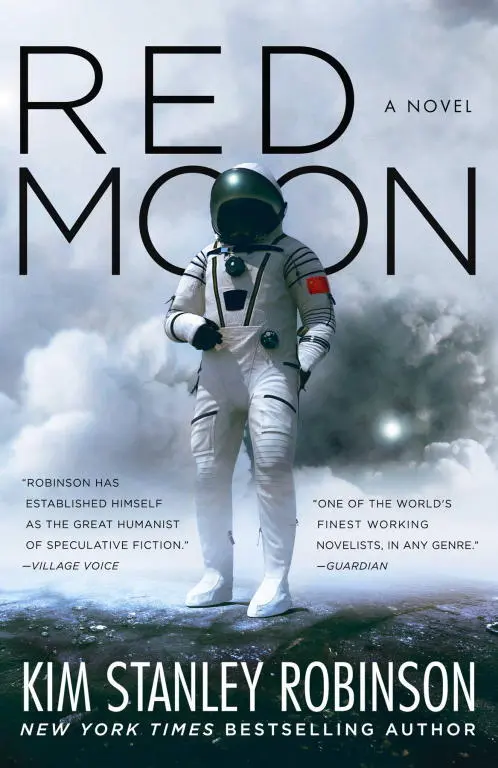
- Название:Red Moon
- Автор:
- Издательство:Orbit
- Жанр:
- Год:2018
- Город:New York
- ISBN:978-0-316-26237-8
- Рейтинг книги:3 / 5. Голосов: 1
-
Избранное:Добавить в избранное
- Отзывы:
-
Ваша оценка:
Red Moon: краткое содержание, описание и аннотация
Предлагаем к чтению аннотацию, описание, краткое содержание или предисловие (зависит от того, что написал сам автор книги «Red Moon»). Если вы не нашли необходимую информацию о книге — напишите в комментариях, мы постараемся отыскать её.
American Fred Fredericks is making his first trip, his purpose to install a communications system for China's Lunar Science Foundation. But hours after his arrival he witnesses a murder and is forced into hiding.
It is also the first visit for celebrity travel reporter Ta Shu. He has contacts and influence, but he too will find that the moon can be a perilous place for any traveler.
Finally, there is Chan Qi. She is the daughter of the Minister of Finance, and without doubt a person of interest to those in power. She is on the moon for reasons of her own, but when she attempts to return to China, in secret, the events that unfold will change everything - on the moon, and on Earth.
Red Moon is a magnificent novel of space exploration and political revolution from New York Times bestselling author Kim Stanley Robinson.
For more from Kim Stanley Robinson, check out:
New York 2140
2312
Aurora
Shaman
Red Moon — читать онлайн бесплатно полную книгу (весь текст) целиком
Ниже представлен текст книги, разбитый по страницам. Система сохранения места последней прочитанной страницы, позволяет с удобством читать онлайн бесплатно книгу «Red Moon», без необходимости каждый раз заново искать на чём Вы остановились. Поставьте закладку, и сможете в любой момент перейти на страницу, на которой закончили чтение.
Интервал:
Закладка:
After that worked for her a couple more times, she started doing her best to follow their guides, who were proving to be as nimble as orangutans. It was hard to stay near them, because they knew what they were doing. She needed to be careful, but it was not a place for being too careful, because you needed some momentum to swing rather than just hang there. A succession of moves taught her that she could grab and pull herself one-handed if she had to, because she just didn’t weigh very much. It was uncanny. So she swung down net to net, looking for lines and nets ahead and below, following the guides as best she could. It would have helped to know where they were going, but since she didn’t, she didn’t even try to catch them. She just kept them in sight. Above her John was swinging down after her, whooping at each catch, a giant grin on his face. He was going to pass her soon, so she took off again.
They passed platforms displaying furniture that gave them a surreal look: dining rooms in space, an immense ping-pong table in space, a more-than-king-sized bed in space, and so on. Like a doll’s house, or a museum, or an IKEA store, or a dream. As they swung toward midcrater they descended into a particularly crowded aerial neighborhood, consisting mostly of pod rooms hanging from lines; this must be a residential district. Around her people flew like trapeze artists. A flock of vividly blue-and-red lories winged by. The crater floor itself looked like a bamboo forest or an arboretum. As Valerie continued to swing down, growing curious about their ultimate destination, she saw that the trees below were suspended in balls of soil hanging over the crater floor, which was covered by some kind of clear layer, under what looked like a layer of netting. Ah good: a town with a safety net!
That made her bold to finish in style, and she followed their guides toward an open platform hung just above the trees. People already on the platform were waving them in, and their guides were now grabbing some of the lines holding the platform in place and letting themselves down hand over hand. If Valerie had had an umbrella she could have glided down onto them like Mary Poppins. Instead she swung down as best she could, trying to beat John Semple to the post, also composing her appearance for her arrival; she wanted to look like this method of locomotion was no big deal to her. Unfortunately she miscalculated at the last moment and missed the platform entirely, floating down past it into the mesh below, where she trampolined down and up until coming to a rest. They dropped a chair like a porch swing to her, and she sat in it; then they hauled her up and greeted her cheerfully. Among the people already there was Anna Kanina. She smiled when she saw Valerie’s expression and gave her a brief hug. “Welcome to an interesting place,” she said.
On the platform it was unexpectedly peaceful. Introductions were made all around, using first names only. The air was humid and cool, carried on a faint breeze. Above them, near the crater wall, puffball clouds were gathering for what might later be a shower.
“Welcome to the free crater,” one of their guides said to Valerie and John. “We hope you enjoyed your arrival?”
“Loved it,” John replied.
Valerie nodded, feeling flushed. “Very nice,” she said. She was still disconcerted by Anna’s presence, by her ironic smile.
They were led to a table at the center of the platform, where several people already stood eating and drinking.
“Tell us about this place,” John requested. “Who are you people?”
The locals took turns to describe different parts of their project. The crater had been domed by an engineering and design team from Russia, but now they all operated it together. They were just free crater people; national origins were irrelevant. Languages were several, mainly Russian, Chinese, and Spanish, with English admittedly the lingua franca, as everywhere. The dome was a triple layer of translucent compounds which protected them from cosmic radiation. The crater floor held a substantial layer of ancient water ice, two hundred meters at its thickest, only slightly mixed with lunar dust. Extremely cold, extremely valuable. They had covered it with insulation and flooring and were mining one quadrant of it as needed, tunneling in from the side. The aerial village’s population was small, less than three thousand people, but there was room to grow, and energy to fuel that growth, as the temperature differential between the sunny rim and the frozen floor was about six hundred degrees Fahrenheit. Lots could be done with that!
“Who pays for it all?” John asked.
It paid for itself, their hosts said. The start had been privately funded by an international group of interested parties. Some Chinese and Russians, some Americans and Europeans, some Africans and Australians, some Indonesians and South Americans. But again, nationality didn’t matter (Anna rolled her eyes at this). Everyone was welcome, everyone was equal. Everyone was rich, Anna added. They mostly slept in a one g centrifuge embedded in the crater rim, and were hoping that would allow them to live their days in lunar gravity without adverse health effects. No one knew for sure about that, of course; they were an experiment, like everything else on the moon. They were mining and selling their water ice to pay for equipment and supplies. They were involved with the international group that was sending robotic spacecraft out to various carbonaceous chondritic asteroids, then building mass drivers on them to direct them down into orbit around the moon. “Ah yes, we just saw one of those crash into Procellarum during the eclipse!” John said.
The free crater people were happy to hear they had seen that. Meanwhile, their daily work in the crater was to build its infrastructure and its social system, and to make it beautiful. Life as art, the world as a poem—a poem about flying. It was all self-organizing, although they did make some plans. They were there to do what Luna told them to do and allowed them to do. They would be the capital of nothing. They would free themselves of all the mistakes of the past, they would make something new. Everyone was welcome—up to a point, of course, given the limits of the crater’s size. Not the billion, Anna commented, just the billionaires. But of course other craters could be domed and inhabited in this same way. There were a million craters like this one on the moon—although in terms of having water, Anna added, more like a hundred. For now, no one cared enough to stop them doing this, and the people who stayed cared more than anyone else what happened in here. It was a new kind of commons, a new way of living. To this even Anna nodded. It’s interesting, she said to Valerie. It’s the start of something, I’ll give them that.
Valerie glanced at John Semple. “It sounds great!” he said. “Show us more!”
Their hosts agreed happily, and dove off the edge of the platform. John and Valerie followed; Valerie missed the netting the others had grabbed, floated down and hit the big mesh again, bobbed down and up, down and up, until the mesh had stilled and she could crawl over it to a rope ladder leading down. This was easier than she would have imagined; the same lunar g that made walking hard made crawling easy.
On a clear deck over the crater floor, their hosts were already explaining to John that they were separated from the crater’s ice by a clear polymer sheet set over a thick insulation layer of transparent aerogel. They could still see the crater floor under all that, a nobbled icy surface, like a Boston gutter in March, Valerie thought. Ugly; but it was water on the moon, and therefore precious.
One of their guides pointed out a long low building set right on the crater floor, such that it appeared to be half-buried in ice. This building, they were told, housed a server bank of quantum computers, which took advantage of the extreme cold to run arrays of the various kinds of qubits that needed supercool temperatures. Some of these worked at the temperature of the ice, others used the ice to help sustain temperatures just a fraction above absolute zero. This computer complex was another source of income, their guides said, and it also gave them some leverage when it came to keeping their independence; they had almost as many yottaflops available as all the servers in the United States combined. Which was only another way of saying that the US had fallen far behind in quantum computing, but still, it was a startling fact. Computing power was economic power, they said; and economic power was political power. So that small building down there buried in the ice of their crater floor could in theory house a major player in Terran politics.
Читать дальшеИнтервал:
Закладка:
Похожие книги на «Red Moon»
Представляем Вашему вниманию похожие книги на «Red Moon» списком для выбора. Мы отобрали схожую по названию и смыслу литературу в надежде предоставить читателям больше вариантов отыскать новые, интересные, ещё непрочитанные произведения.

![Ким Робинсон - Годы риса и соли [litres]](/books/394367/kim-robinson-gody-risa-i-soli-litres-thumb.webp)

Обсуждение, отзывы о книге «Red Moon» и просто собственные мнения читателей. Оставьте ваши комментарии, напишите, что Вы думаете о произведении, его смысле или главных героях. Укажите что конкретно понравилось, а что нет, и почему Вы так считаете.