Ким Робинсон - Red Moon
Здесь есть возможность читать онлайн «Ким Робинсон - Red Moon» весь текст электронной книги совершенно бесплатно (целиком полную версию без сокращений). В некоторых случаях можно слушать аудио, скачать через торрент в формате fb2 и присутствует краткое содержание. Город: New York, Год выпуска: 2018, ISBN: 2018, Издательство: Orbit, Жанр: Фантастика и фэнтези, на английском языке. Описание произведения, (предисловие) а так же отзывы посетителей доступны на портале библиотеки ЛибКат.
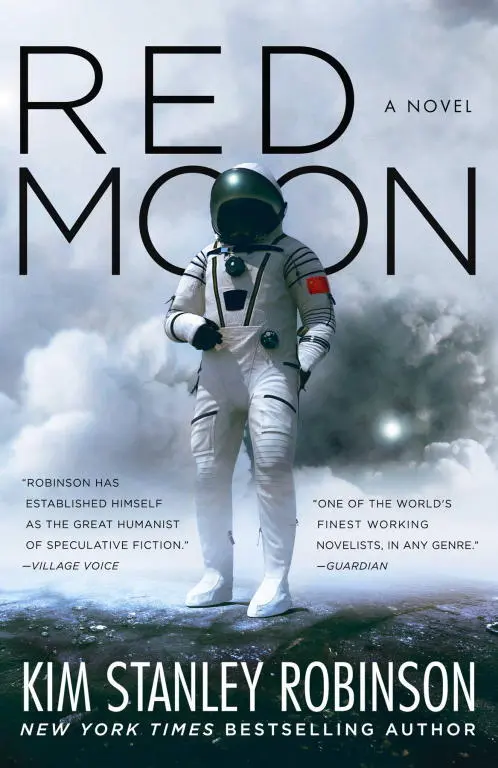
- Название:Red Moon
- Автор:
- Издательство:Orbit
- Жанр:
- Год:2018
- Город:New York
- ISBN:978-0-316-26237-8
- Рейтинг книги:3 / 5. Голосов: 1
-
Избранное:Добавить в избранное
- Отзывы:
-
Ваша оценка:
Red Moon: краткое содержание, описание и аннотация
Предлагаем к чтению аннотацию, описание, краткое содержание или предисловие (зависит от того, что написал сам автор книги «Red Moon»). Если вы не нашли необходимую информацию о книге — напишите в комментариях, мы постараемся отыскать её.
American Fred Fredericks is making his first trip, his purpose to install a communications system for China's Lunar Science Foundation. But hours after his arrival he witnesses a murder and is forced into hiding.
It is also the first visit for celebrity travel reporter Ta Shu. He has contacts and influence, but he too will find that the moon can be a perilous place for any traveler.
Finally, there is Chan Qi. She is the daughter of the Minister of Finance, and without doubt a person of interest to those in power. She is on the moon for reasons of her own, but when she attempts to return to China, in secret, the events that unfold will change everything - on the moon, and on Earth.
Red Moon is a magnificent novel of space exploration and political revolution from New York Times bestselling author Kim Stanley Robinson.
For more from Kim Stanley Robinson, check out:
New York 2140
2312
Aurora
Shaman
Red Moon — читать онлайн бесплатно полную книгу (весь текст) целиком
Ниже представлен текст книги, разбитый по страницам. Система сохранения места последней прочитанной страницы, позволяет с удобством читать онлайн бесплатно книгу «Red Moon», без необходимости каждый раз заново искать на чём Вы остановились. Поставьте закладку, и сможете в любой момент перейти на страницу, на которой закончили чтение.
Интервал:
Закладка:
“Interesting,” John said. “Well, it makes sense that Chang was well connected. The moon is a big prize for whoever is seen to be in charge here.”
“So it might be caught up in the struggle for who becomes the next president?”
“Yes.” John looked at her. “Is the Secret Service up on any of this?”
“I don’t know.”
“Is the president up on any of this?”
“I don’t know. You report to him too, right?”
“We try.”
On their flight north, their rocket made a stop in the Procellarum KREEP zone, to drop off a clutch of mining engineers. Valerie looked out a window at the moonscape expecting to see the same monochrome craterscape that seemed completely ubiquitous, but here it was surprisingly different: a broad white plane was marred only by a single mountain range, which was not arced like the crater rims always were, but instead ran straight across the flats surrounding it, thus resembling some big mountain range on Earth. The Harbinger Mountains, Valerie was told by one of the mining engineers.
Procellarum was the most mineral-rich area on the moon, this engineer told her as their craft descended. It was the right eye of the Man in the Moon, a basin so big that it had been named Oceanus rather than Mare by the early astronomers. It had been the last part of the lunar crust to cool down and harden after the moon had recoalesced from the fragments of the Gaia-Theia collision, and because it was the last pool of liquid lava, all the lightest elements available had floated up into it and then hardened into the crust. Thus KREEP, the K standing for potassium, REE for rare earth elements, and P for phosphorus.
“And now we’re mining that?” Valerie asked. “It’s an American operation?”
The engineer nodded. They were sending the potassium and phosphorus to the north pole base to aid the local agriculture, and they threw the rare earths home to Earth. Some heavy-duty high-capacity launch rails had been built at the north end of Procellarum, to be as near the north pole base as possible. These launch rails cast freighters full of refined rare earths down to low-Earth orbit, and later piecemeal down to Earth. It was the biggest American operation on the moon by far, and almost the only way the moon was actually proving of use to humanity, in this miner’s opinion.
“You’re not breaking the Outer Space Treaty?” Valerie asked.
The engineer didn’t think so. The mines were kept underground and the surface therefore was left mostly unmarked. No open pit mines or strip mines. And they were taking less than a hundredth of one percent of the available minerals, if even that. And none of it was going to the military, not directly anyway. Basically it was claimed to be a scientific experiment, testing various aspects of mining. Kind of like how Japan did scientific testing on whales. So it conformed pretty well to treaty regulations.
They came down on a landing pad cut into the lowlands next to the Harbinger Mountains, which as they got lower looked positively Himalayan in their stark vertical grandeur. The mining station looked like any small airport anywhere. Strangely, given Valerie’s preexisting conclusion that the moon was tediously the same everywhere, some patches of land flanking the mountain range were parti-colored. The colors were subtle but definite: tans, pinks, pale greens, even one patch of vivid lemon. KREEPy land, the engineer confirmed. Frozen lakes of rare earth elements, rising to the top when the moon had been a coalescing ball of liquid-hot elements.
Inside the station everyone was led up into a bubble dome that poked out of the ground. From here they had a magnificent view of the Harbingers, and after the sterile monochromatic grays of the rest of the moon, the pastel patchwork on the land struck Valerie’s eye as an intense relief: broad swathes of mauve, burgundy, olive, yellow. She hummed, she drank it in.
But this was not what the locals were now excited to see; they were all getting prepared to witness a solar eclipse, and not only that, but the landing of a chunk of carbonaceous chondritic asteroid during this eclipse as well. The latter had been timed to happen during the former, apparently just to see how it would look.
The sun overhead already had a big bite taken out of it, easy to see after they put eclipse glasses on. That black arc biting it was the Earth, getting between the sun and the moon. The colors on the land that Valerie was so enjoying were getting easier to see as the usual blaze of sunlight was reduced.
Through the course of the next couple of hours, the rest of the sun was eaten. As the process reached its apotheosis, the lunar landscape around them darkened. Then the moment came when they could look up without their eclipse glasses, and see overhead a thin red ring in the sky, a glowing red tracery of a band, pulsing and shimmering. This apparently was Earth’s atmosphere, lit up and glowing like a corona around the black circle that was the Earth. The black circle was duskier than the starry black of space, and through binoculars and other scopes one could see what seemed to be stars dotting it; these were cities on Earth’s night side.
Eclipses were fairly common on the moon, Valerie and John were told. The red annular band surrounding Earth was sunlight bending through the atmosphere; this phenomenon explained why people on Earth looking up at a lunar eclipse saw the moon turn a dusky red.
And indeed the land around them was now that same color. When they finally looked down from the mesmerizing sight of the red ring in the sky, they saw that the land around them had turned both dark and distinctly red. It was somewhat like the color of a red sunset on Earth, but darker and more intense, a subtly shifting array of dim blackish reds, all coated by a dusty copper sheen. The previously pastel patches of rare earths were now shifted to purples and forest greens and rusty browns. But these were highlights in what was for the most part a dark red land, strong in both color and mood. It reminded Valerie of the last scene in a Parsifal she had seen in New York the year before, in which the chorus had waded across a stage knee-deep in blood. The Harbinger Mountains now reared like a bloody dragon spine out of an ocean of blood. Harbingers indeed! War—chaos—bloodshed—
“Okay, here it comes,” someone said, and then a big gray blob shot over the horizon, a brilliant blaze of light pouring out of its forward end against the direction of its movement. Faster than Valerie could take in a breath it slammed into the moon, and a great gout of fire flew back up toward the stars, extra bright in the eclipse darkness, arcing down lazily like fireworks.
The locals cheered. “Carbon!” the miner explained to Valerie and John. “They cut off a chunk of the asteroid we put into lunar orbit, and drop it to the surface with a mass driver that works like a retro-rocket. It doesn’t completely work, but it doesn’t have to—all you need is a collision that doesn’t vaporize the impactor, and leaves it mostly at the crash site. So it augers in at about the same speed as a jet on Earth, and boom. Carbon.”
“KREEPy,” John Semple remarked. The miners laughed and popped champagne bottles, and wandered the room toasting the sight of the crimson metallic sheens out there around them. Valerie shuddered and kept her bloody thoughts to herself. She took a glass and drank with the rest, clinked her glass with John Semple’s when he offered.
“Red moon!” he said. “Awesome!”
“Yes,” Valerie agreed coolly.
He grinned at her. He knew she disliked his uncultured shtick, so he was tweaking her by playing it even harder; she saw that, she saw that he saw that she saw it, and so on to infinity; and still he did it. It was very irritating.
Читать дальшеИнтервал:
Закладка:
Похожие книги на «Red Moon»
Представляем Вашему вниманию похожие книги на «Red Moon» списком для выбора. Мы отобрали схожую по названию и смыслу литературу в надежде предоставить читателям больше вариантов отыскать новые, интересные, ещё непрочитанные произведения.

![Ким Робинсон - Годы риса и соли [litres]](/books/394367/kim-robinson-gody-risa-i-soli-litres-thumb.webp)

Обсуждение, отзывы о книге «Red Moon» и просто собственные мнения читателей. Оставьте ваши комментарии, напишите, что Вы думаете о произведении, его смысле или главных героях. Укажите что конкретно понравилось, а что нет, и почему Вы так считаете.