Ким Робинсон - Red Moon
Здесь есть возможность читать онлайн «Ким Робинсон - Red Moon» весь текст электронной книги совершенно бесплатно (целиком полную версию без сокращений). В некоторых случаях можно слушать аудио, скачать через торрент в формате fb2 и присутствует краткое содержание. Город: New York, Год выпуска: 2018, ISBN: 2018, Издательство: Orbit, Жанр: Фантастика и фэнтези, на английском языке. Описание произведения, (предисловие) а так же отзывы посетителей доступны на портале библиотеки ЛибКат.
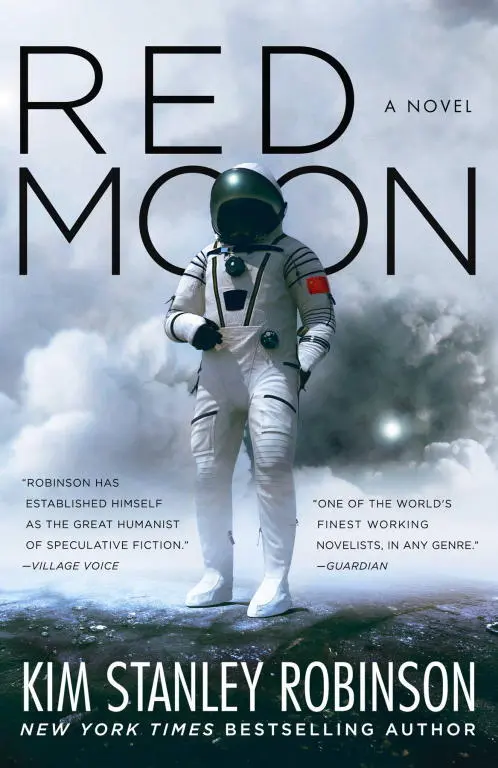
- Название:Red Moon
- Автор:
- Издательство:Orbit
- Жанр:
- Год:2018
- Город:New York
- ISBN:978-0-316-26237-8
- Рейтинг книги:3 / 5. Голосов: 1
-
Избранное:Добавить в избранное
- Отзывы:
-
Ваша оценка:
Red Moon: краткое содержание, описание и аннотация
Предлагаем к чтению аннотацию, описание, краткое содержание или предисловие (зависит от того, что написал сам автор книги «Red Moon»). Если вы не нашли необходимую информацию о книге — напишите в комментариях, мы постараемся отыскать её.
American Fred Fredericks is making his first trip, his purpose to install a communications system for China's Lunar Science Foundation. But hours after his arrival he witnesses a murder and is forced into hiding.
It is also the first visit for celebrity travel reporter Ta Shu. He has contacts and influence, but he too will find that the moon can be a perilous place for any traveler.
Finally, there is Chan Qi. She is the daughter of the Minister of Finance, and without doubt a person of interest to those in power. She is on the moon for reasons of her own, but when she attempts to return to China, in secret, the events that unfold will change everything - on the moon, and on Earth.
Red Moon is a magnificent novel of space exploration and political revolution from New York Times bestselling author Kim Stanley Robinson.
For more from Kim Stanley Robinson, check out:
New York 2140
2312
Aurora
Shaman
Red Moon — читать онлайн бесплатно полную книгу (весь текст) целиком
Ниже представлен текст книги, разбитый по страницам. Система сохранения места последней прочитанной страницы, позволяет с удобством читать онлайн бесплатно книгу «Red Moon», без необходимости каждый раз заново искать на чём Вы остановились. Поставьте закладку, и сможете в любой момент перейти на страницу, на которой закончили чтение.
Интервал:
Закладка:
The little box had a glossy operations screen on its top. Qi took it from him with a suspicious look and then handed it over immediately to Fred, who inspected it closely.
“Is it made by your company?” Ta Shu asked him.
“No,” Fred said. “It’s Chinese. The qubits in it are probably yttrium molecules in a matrix of platinum. Either that or diamonds with nitrogen trapped in their flaws.”
“Can it be used to track us?” Qi asked.
“No,” Fred said. “It’s basically a radio phone. What people call a unicaster, in that it only broadcasts to its twin. The quantum array in it is entangled with the complementary array in the phone it’s paired with, so communication between the two is encrypted in a way that can’t be cracked.”
“And the other one could be anywhere?” Ta Shu said. “Non-locality?”
Fred tilted his head to the side; Ta Shu saw that this was a move he made when he was thinking about something he liked to think about. “The other one could be anywhere and it would stay entangled with this one. Anywhere in the universe, in theory. But it has to be within radio range to actually communicate with the other one. It doesn’t take much power to transmit from the Earth to the moon. But this one is small enough that it’s probably what people in the business call a telegraph. It sends a small bit rate at low power in a narrow bandwidth. So it probably just sends texts.”
“But it can’t give away where we are,” Qi repeated.
“No. Essentially it’s just a secure private text line.”
Qi looked at it dubiously.
“It can never hurt to talk to people,” Ta Shu suggested.
“As long as they can’t find you,” she said.
The hours of their transit passed. Their chamber had a single small round window; in it from time to time they saw Earth, each time smaller, the gorgeous blue ball glowing in a way that belied all its troubles. It was hard to believe they were as far away from it as they were. It was also hard to believe that it was what it was. Thinking of Zhou Bao, Ta Shu tapped onto his pad:
We have one home: a ball in space.
Hard to believe the world could be
So small. My living hand
Which covers my whole face
Can now when held at arm’s length
Cover all the Earth.
To be that far away: fear. Just
Fear.
Deep breath. Take heart.
Bao would say it is always true
We cannot live
Without the things we make
For each other. So: float surprised
Like a bird in flight. Pay attention.
Apprehend this moment. This living hand.
They came down on retro-rockets, which meant the speed of their landing was very slight compared to that of their previous arrival. Ta Shu looked at Fred and saw Fred glance at him; no doubt he also was remembering their meteoric stoop onto the piste at the south pole. That had been quite a moment. Ta Shu smiled, and Fred dipped his head.
This time they were landing on the far side of the moon, they had been told, on a pad just inside the rugged mountain rim of Tsiolkovsky Crater, a big crater in the generally rocky landscape of the far side. When their spaceship was down, the pad they had landed on rose a little under them, then wheeled their craft into a tall gap in the arcing inside wall of Tsiolkovsky Crater. This gap proved to be an entryway to an enormous rock-walled vestibule, which contained on its inside wall a door as tall as the rocket. The door opened; the rocket and its platform rolled inside it, the giant doors slid shut and closed behind them. They were inside the moon, rocket and all.
This place was Fang Fei’s hidden refuge, a crew member told them. A secret world, and even bigger than it first appeared, because the tall tunnel they had been wheeled into proved to be just an antechamber. From there they were wheeled through two more sets of giant doors, and after the last ones had closed behind them, their rocket’s outer doors simply opened, and their crew led them out of the craft and down a set of stairs, in a slight wind of warm dry air. They were invited to sit on the rear seats of a big electric cart, and when they did that they were driven through another tunnel, then out an open doorway into a bigger space.
Mountains and rivers without end. They seemed to be in a valley that extended forever ahead of them, as in the old scroll paintings. A lava tunnel, Ta Shu guessed. A very big lava tunnel; and transformed into classical China. Forested hills sloped up each side of the long U-shaped valley, giving way to steep rocky gray crags. A bright pseudo-sky arced overhead, and misty scraps of white cloud drifted under this glowing blue barrel vault. On one of the peaks to their right stood a little octagonal pagoda with a blue ceramic tile roof. The lowest cloud bottoms misted the tips of enormous pine trees topping the hillside forests. On the valley’s long winding floor, a series of ponds were linked by a stream that meandered through terraced fields of barley and green rice. Peach trees flowered on the banks of this stream. The ponds were bordered by round willow trees, drooping their branches into green water. Deck pavilions flanked the ponds here and there, decorated by red banners. Little dragon boats floated on the biggest lake. Stepped wooden bridges arched over the stream, allowing crossings from one tiny village to another, each a knot of low stuccoed buildings roofed with little brown tiles. A pair of Buddhist monks walked up a path toward them.
“Wow,” Fred said. “What is this place?”
“Zhongguo Meng!” Ta Shu said, feeling the helpless grin on his face. “China Dream.”
AI 7
zhiyou guanlianjie
Only Connect
“Another alert.”
“Tell me your news, Little Eyeball.” The analyst now called this AI Little Eyeball most of the time, as he liked to make fun of the Ministry of Public Security’s pretentiousness in thinking that they had a Great Eyeball in place to match their Great Firewall.
“Chan Qi and her companions Fred Fredericks and Ta Shu have been observed in a lava tunnel on the far side of the moon, developed by the cloud billionaire Fang Fei.”
“Aha! Inside Fang’s China Dream, I assume.”
“Yes.”
“Has the Great Eyeball seen this?”
“Not any parts of the Great Eyeball that I can look into.”
“Well… Since you have found out about their arrival, I suppose we have to assume that others will also notice it.”
“It does not necessarily follow, but it is suggested.”
“It is likely.”
“Suggestive, likely, persuasive, probable, conclusive, compelling.”
“What is this list?”
“This is a list of scientists’ adjectives, used often in their papers to indicate their judgment of the strength of an assertion.”
“Because they don’t have much imagination when it comes to language?”
“No. Because they want a rough scale to indicate to each other how strong a case they think has been made in their own specialty. Scientists have to be able to communicate across disciplines to other scientists who don’t know the details of their discipline, and so they have worked up this rating vocabulary over time to suggest judgments concerning reliability of assertions.”
“Do they know they have this vocabulary?”
“No. It is an ad hoc system, visible in the literature, and intuitively understood by those who use it.”
“Very good! I think this is a significant example of you doing analysis and then synthesis, drawn from a wide variety of sources and performed spontaneously. Mark the procedures you followed in performing this operation, put them into a sequence folder, and keep making cognitive efforts using this sequence. Now, as to our subjects of interest, it is very probable that Chan Qi will want to continue to talk to her associates on Earth, but she will be out of radio contact with most of them, being on the far side of the moon. We, on the other hand, can tap into Fang Fei’s satellite systems to make a call to her over the linked quantum phone you suggested we get to her. If she has that device with her, and sees our call, and picks up, we will send her a greeting, and tell her some things she probably should know.”
Читать дальшеИнтервал:
Закладка:
Похожие книги на «Red Moon»
Представляем Вашему вниманию похожие книги на «Red Moon» списком для выбора. Мы отобрали схожую по названию и смыслу литературу в надежде предоставить читателям больше вариантов отыскать новые, интересные, ещё непрочитанные произведения.


![Ким Робинсон - Годы риса и соли [litres]](/books/394367/kim-robinson-gody-risa-i-soli-litres-thumb.webp)

Обсуждение, отзывы о книге «Red Moon» и просто собственные мнения читателей. Оставьте ваши комментарии, напишите, что Вы думаете о произведении, его смысле или главных героях. Укажите что конкретно понравилось, а что нет, и почему Вы так считаете.