Ким Робинсон - Red Moon
Здесь есть возможность читать онлайн «Ким Робинсон - Red Moon» весь текст электронной книги совершенно бесплатно (целиком полную версию без сокращений). В некоторых случаях можно слушать аудио, скачать через торрент в формате fb2 и присутствует краткое содержание. Город: New York, Год выпуска: 2018, ISBN: 2018, Издательство: Orbit, Жанр: Фантастика и фэнтези, на английском языке. Описание произведения, (предисловие) а так же отзывы посетителей доступны на портале библиотеки ЛибКат.
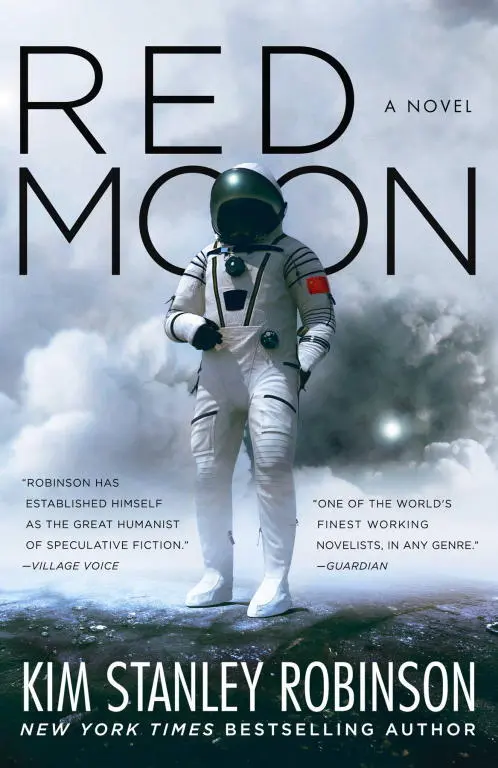
- Название:Red Moon
- Автор:
- Издательство:Orbit
- Жанр:
- Год:2018
- Город:New York
- ISBN:978-0-316-26237-8
- Рейтинг книги:3 / 5. Голосов: 1
-
Избранное:Добавить в избранное
- Отзывы:
-
Ваша оценка:
Red Moon: краткое содержание, описание и аннотация
Предлагаем к чтению аннотацию, описание, краткое содержание или предисловие (зависит от того, что написал сам автор книги «Red Moon»). Если вы не нашли необходимую информацию о книге — напишите в комментариях, мы постараемся отыскать её.
American Fred Fredericks is making his first trip, his purpose to install a communications system for China's Lunar Science Foundation. But hours after his arrival he witnesses a murder and is forced into hiding.
It is also the first visit for celebrity travel reporter Ta Shu. He has contacts and influence, but he too will find that the moon can be a perilous place for any traveler.
Finally, there is Chan Qi. She is the daughter of the Minister of Finance, and without doubt a person of interest to those in power. She is on the moon for reasons of her own, but when she attempts to return to China, in secret, the events that unfold will change everything - on the moon, and on Earth.
Red Moon is a magnificent novel of space exploration and political revolution from New York Times bestselling author Kim Stanley Robinson.
For more from Kim Stanley Robinson, check out:
New York 2140
2312
Aurora
Shaman
Red Moon — читать онлайн бесплатно полную книгу (весь текст) целиком
Ниже представлен текст книги, разбитый по страницам. Система сохранения места последней прочитанной страницы, позволяет с удобством читать онлайн бесплатно книгу «Red Moon», без необходимости каждый раз заново искать на чём Вы остановились. Поставьте закладку, и сможете в любой момент перейти на страницу, на которой закончили чтение.
Интервал:
Закладка:
“But a launchpad to where?”
“To anywhere. It’s cheaper to launch stuff from here than from Earth, which makes it easier to go farther out.”
“Are the Chinese already going farther out?”
“Sure. Everyone is. The Chinese are focused on Venus and the asteroids.”
“Isn’t Venus useless?”
“Yes, but they’re building a floating station in its atmosphere, like a city inside a blimp. And they’re sending big chunks of aluminum from here to Venus orbit. Looks like they’re thinking of building a sunshade at Venus’s L2 point to shade Venus completely, to cool it down. It’s a very Chinese project, some kind of thousand-year plan or whatever. It’s crazy, but if you don’t include Venus in your thinking, you can’t really understand the Chinese presence here.”
“So the Chinese are going to be the first ones to yet another place?”
“Yes. But the solar system is big. We don’t have to worry about every crazy idea the Chinese choose to pursue.”
“Don’t we?”
“I don’t think so. It’s not a zero-sum game.”
“But what if there are people in Washington who think it is—wouldn’t they come up here and try to do something about it?”
“Like what?”
“That’s what I’m asking you.”
“I don’t know. People may be doing that, trying to mess with them, but it would be stupid. I don’t think there’s anything we can or should do about other governments’ activities in space.”
“You’re very unconcerned!”
“It’s true. Maybe that’s because I grow such fine tomatoes.”
“Can I have one?”
“Let’s slice a couple and have a caprese salad. I grow the basil too.”
She sliced the tomatoes on a big cutting block right next to her potting station. Ingredients were indeed unwashed. Valerie ate a delicious forkful or two and said, “Wow, they are good. The basil too.”
“I grow ten kinds of basil, it’s wonderful.”
“Where do you get the mozzarella?”
“From Italy. Lots of food is shipped up, like you said. It’s like any other local food movement. If the local stuff reaches thirty percent, you’re totally eating off the land.”
“So, but don’t you think there are some American agencies trying to mess with the Chinese up here?”
“No doubt. And vice versa too. This cryptocurrency called virtual US Dollars, for instance. That’s turning out to be really destabilizing. Combine that with the householder protests, it’s crashing the economy pretty bad. But that hurts the Chinese too, so it’s hard to understand who’s doing it. Here on the moon, neither side is doing much that I can see.”
“And you can see a lot.”
Ginger Ellis stopped chewing, stared at her; swallowed. “Everyone can see a lot. It’s a very small town, the moon. There’s not a lot of places to hide, and people talk.”
“Seems to me there’s tons of places to hide. I’m looking for an American citizen who went missing, for instance, and I’m having no luck finding him. I’m hearing about secret lava tubes and such where they might have hidden him.”
“Oh yeah, John mentioned that. Well, you should come out and see the free crater. Your person might even be out there.”
“Where’s that?”
“South of here.” She grinned at Valerie’s expression. “Worth a visit. Not supervised by any particular department, shall we say.”
“What about you, what department are you?”
“I’m the greenhouse manager.” Her look got sharper. “Don’t you ever get tired of it?”
“Tired of what?”
“Of being so nosy and officious. You’re on the moon, dear. So lighten up! You only weigh about twenty pounds here. Tell you what, let’s go out there together and visit the freebies. You can look for your missing guy, and John seems to want you to see it.”
“He wants the president to know about it?”
“He wants you to know about it.”
“Me?”
“It’s a compliment. He must think you have some potential.”
The free crater, apparently otherwise unnamed, turned out to be a small, high-rimmed, geometrically perfect circle marring the southernmost stretch of the rim of Rozhdestvenskiy Crater, one of the big ones that occupied the near side, to the south of Peary Crater of course, which lay almost exactly on the pole. Valerie joined Ginger at the American rocket facility and was surprised to find John Semple already there. He smiled at her expression. “You think I would miss this?”
They lofted in a small rocket that the pilot called a hopper. Except for a sickeningly fast lift-off, it reminded Valerie of a helicopter. They flew in a helicopteristic way over the dark floor of Rozhdestvenskiy, which had a strange look to it, rumply and glistening. Valerie was told that this was a scrim of ice, that Rozhdestvenskiy was one of the biggest of the ice-floored craters; these craters’ interiors never saw the sunlight, and thus held most of the comet ice that had been deposited in them over the previous four billion years. Apparently their nameless crater, though much smaller, had higher walls and so was even deeper in ice than Rozhdestvenskiy. Like all the sunless polar craters, it was one of the coldest spots in the solar system, never deviating far from 410 degrees below zero Fahrenheit. Its rim now featured a flat landing pad, and as they came down on it, they saw that the entire crater was domed with a transparent bubble of some sort.
“Wow,” Valerie said. “Who made this?”
No one answered. They landed vertically with a small bump. A tube snaked out to them and covered their hopper’s lock door, and after some clanking and hissing they walked through the tube into a building. Inside they were led by three guides through hallways toward the inner rim of the crater, emerging onto a platform that was set just under the crater-covering dome.
Apparently the entire space of the crater was aerated and heated, and brightly lit by mirrors and floodlights set all around the rim. From the platform’s edge they could look down and see that the space between the dome and the crater floor was occupied by scores of hanging platforms, maybe hundreds of them; also tall plinths were holding up houses or bare floors, all connected by catwalks and rope ladders, trapezes, and loops of netting, also pod dwellings of various sizes suspended from the dome, or from networks of lines extending from high on the rim; also floating balloons, it seemed, from which hung open-sided rooms. Also floating balls of green bamboo, which grew in all directions, like some kind of Escher trees. The whole thing was Escheresque. An aerial town; and people, tiny in the distance, were jumping from one place to the next, swinging like apes or monkeys.
Startled at the sight, Valerie laughed out loud.
“Try it,” their guides offered, and then leaped off the platform into space. They caught some netting down below, swung gracefully farther on. Valerie, deeply surprised, looked at John Semple.
“Whoa,” John said. She saw he was as surprised as she was, which meant that it had to be his first time here too. Suddenly she saw a chance to get a jump on him, so to speak, because they were going to jump eventually, that was clear, and by going first she might wipe that little smile off his face, make him stop thinking of her as a condescending stick-in-the-mud. Without further ado she ran off the platform into space, shooting far over the network of lines their guides had dropped to. After that she could only look below for something else to catch onto. A bolt of panic shot through her as she felt the one-sixth of a g curving her down and accelerating her; it was slow, but not that slow, and she was feeling quite desperate when she managed to grab a passing rope and redirect herself. This worked; she could do it, she was light and strong enough; and now her mother’s insistence that she do dance and gymnastics finally paid off, in that she was finding some reflexes rising abruptly out of her childhood. Grab and hold on, swing to the side! Tarzan!
Читать дальшеИнтервал:
Закладка:
Похожие книги на «Red Moon»
Представляем Вашему вниманию похожие книги на «Red Moon» списком для выбора. Мы отобрали схожую по названию и смыслу литературу в надежде предоставить читателям больше вариантов отыскать новые, интересные, ещё непрочитанные произведения.


![Ким Робинсон - Годы риса и соли [litres]](/books/394367/kim-robinson-gody-risa-i-soli-litres-thumb.webp)

Обсуждение, отзывы о книге «Red Moon» и просто собственные мнения читателей. Оставьте ваши комментарии, напишите, что Вы думаете о произведении, его смысле или главных героях. Укажите что конкретно понравилось, а что нет, и почему Вы так считаете.