Ким Робинсон - Red Moon
Здесь есть возможность читать онлайн «Ким Робинсон - Red Moon» весь текст электронной книги совершенно бесплатно (целиком полную версию без сокращений). В некоторых случаях можно слушать аудио, скачать через торрент в формате fb2 и присутствует краткое содержание. Город: New York, Год выпуска: 2018, ISBN: 2018, Издательство: Orbit, Жанр: Фантастика и фэнтези, на английском языке. Описание произведения, (предисловие) а так же отзывы посетителей доступны на портале библиотеки ЛибКат.
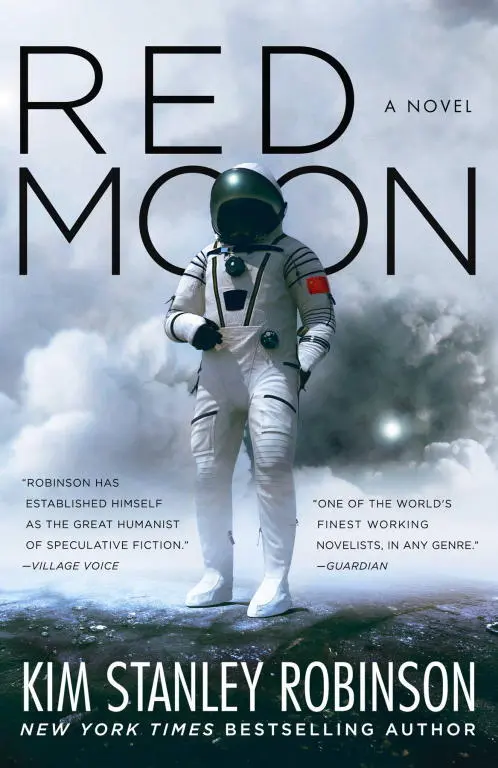
- Название:Red Moon
- Автор:
- Издательство:Orbit
- Жанр:
- Год:2018
- Город:New York
- ISBN:978-0-316-26237-8
- Рейтинг книги:3 / 5. Голосов: 1
-
Избранное:Добавить в избранное
- Отзывы:
-
Ваша оценка:
Red Moon: краткое содержание, описание и аннотация
Предлагаем к чтению аннотацию, описание, краткое содержание или предисловие (зависит от того, что написал сам автор книги «Red Moon»). Если вы не нашли необходимую информацию о книге — напишите в комментариях, мы постараемся отыскать её.
American Fred Fredericks is making his first trip, his purpose to install a communications system for China's Lunar Science Foundation. But hours after his arrival he witnesses a murder and is forced into hiding.
It is also the first visit for celebrity travel reporter Ta Shu. He has contacts and influence, but he too will find that the moon can be a perilous place for any traveler.
Finally, there is Chan Qi. She is the daughter of the Minister of Finance, and without doubt a person of interest to those in power. She is on the moon for reasons of her own, but when she attempts to return to China, in secret, the events that unfold will change everything - on the moon, and on Earth.
Red Moon is a magnificent novel of space exploration and political revolution from New York Times bestselling author Kim Stanley Robinson.
For more from Kim Stanley Robinson, check out:
New York 2140
2312
Aurora
Shaman
Red Moon — читать онлайн бесплатно полную книгу (весь текст) целиком
Ниже представлен текст книги, разбитый по страницам. Система сохранения места последней прочитанной страницы, позволяет с удобством читать онлайн бесплатно книгу «Red Moon», без необходимости каждый раз заново искать на чём Вы остановились. Поставьте закладку, и сможете в любой момент перейти на страницу, на которой закончили чтение.
Интервал:
Закладка:
When the sun came back they flew on to the north pole.
The north pole’s permanently sunlit area was slightly smaller than the corresponding district at the south pole, but its permanently shadowed craters held a bit more water than the south’s, so the two regions were about equivalent as suitable places to settle. The north pole was the United States’ home base on the moon, as it was for the Swiss, the European Union, Russia, South Africa, India, Iran, and Brazil. The Chinese staffed a consulate in the Brazilian station.
As their shuttle descended, Valerie looked out a window and saw the usual overlapping gray craters, with several rims marked by a number of low settlements. Her view from above, showing as it did such a mix of design styles, reminded her of an architectural charrette. The American base was the biggest, naturally, but it had not managed to claim the highest ground on the rim of Peary, occupied by the Brazilians six months before the Americans had arrived. The Brazilian base enjoyed ninety-seven percent constant sunlight, the Americans eighty-nine percent; the rest of the bases ranged between those two, with the Iranians, slightly farther south on the near side, at eighty-three percent.
As they descended, Valerie asked John Semple whom she should talk to in order to pursue her various inquiries.
He shrugged. “NSA has good intel on this place, and I like their analysts on station. I’ll introduce you to them. And to some other friends of mine, because this town is the place where you can get a sense of how life on the moon can change your priorities.”
“What do you mean?”
“Hopefully you’ll find out. There’s a couple internationals you need to meet.”
“Like who?”
“You’ll find out.”
“How?”
He smiled. He really was amused by her far too often. “It’s called intelligence for a reason.”
The social life between the north pole stations resembled the embassy circuit in Washington, DC. Every station hosted a mixer for the rest to attend. On the moon that wasn’t so simple on the logistical level, because although the stations clustered fairly close around the pole to catch as much sunlight as possible, one still had to get in spacesuit or rover and then walk or drive to the other bases, then get through locks or jetways and get out of spacesuits, always a hassle. To avoid spacesuits most people drove, even if it was only to go a hundred meters. And after all that they had to assemble in rooms not quite big enough to hold the entire polar population. In truth, compared to the Chinese complex sprawling around the south pole, Valerie found the whole scene pretty unimpressive.
John had suggested she attend the mixer at the Brazilian base, so she did. There all the tropical plants and colorful décor combined with the lunar gravity to create a little Carnaval thrill. The crush of people made everyone dance a little just to keep their balance. People collided, held each other upright, said hi to strangers who barged unintentionally into conversations, and in general acted like they were swimming around in chest-high water, slightly tipsy, drinks in hand.
At a certain point in the evening Valerie turned to the only woman near her and introduced herself. This woman turned out to be Russian, her English accented but articulate. Anna Kanina. Not Karenina. Very likely some kind of equivalent role to Valerie’s, but no way to be sure.
“Have you been here long?” Anna asked.
“Not long,” Valerie said. “And you?”
“Almost a year. I go home soon.”
“Are you looking forward to that?”
“No. I like it here.”
“What’s your job up here?”
“Spy.” Anna then laughed at Valerie’s expression. “Not really! I say that to see if you are spy. Which I see you are. Actually I do radio astronomy, over on the back side.”
“Is that a Russian observatory?”
“International. Mostly EU, in terms of who built it. But now it’s run by the IAU. You should come to visit.”
“Is it interesting?”
“No. But it’s always good to get to far side of moon, if you’re an astronomer anyway.”
Valerie thought it over. “Are there Chinese bases on the far side?”
“I don’t know. I’m neither sinologist nor selenologist.”
“Just an astronomer.”
“Right. If you want to learn more about selenology, the political kind, you should talk to Ginger Ellis, who runs the greenhouse in your building.”
“Really?”
“If she’ll talk, you will learn.”
So she really was a spy.
Women on the moon were a minority. Among the Americans they were said to constitute thirty-five percent of the population. On the moon, as elsewhere, that gender balance could feel somewhat like parity, and certainly normal for a situation like this one, with its strong element of construction and engineering. Using your hands to build things outdoors usually meant you were male. Make it an exotic outdoors and the percentage of women usually rose, true here as elsewhere. But it was still not fifty-fifty. That meant there was a certain solidarity among the women on hand, or so it seemed to Valerie. Everyone said hi and exchanged a little conversation in the course of doing business. People usually explained what they did on the moon, especially if they were meeting for the first time.
So now Valerie went looking for Ginger Ellis, and found her in the base’s greenhouse. This was again a big glass-walled round room with a 360-degree view, as tight-horizoned and monotonous as those one saw from the Chinese greenhouses at the south pole. Valerie introduced herself as a presidential assistant, and Ginger nodded and said she knew that.
“Do the plants grow taller here?” Valerie asked, looking around.
“Taller and spindlier. We put the least happy crops in a centrifuge, but mostly we harvest early, or just plant low plants. It’s not a good place for corn.”
“I can see how that would be.”
Now Ginger Ellis was staring at her. “And what is it that you can’t see?”
“I can’t see why people in the other stations think you’re the person who runs this one.”
Ginger laughed. “I grow their food.”
“But most of the food is shipped up, right? Even freshies?”
“My tomatoes rule,” Ginger said. “Anyone will tell you that. Heirlooms, never refrigerated. People beg me for them. I don’t even wash them.”
“Is that good?”
“Of course. Vine-ripe organics? What, aren’t you a foodie?”
“I am. But I do wash my veggies.”
“Don’t. Especially here. It’s already too sterile here, people get sick from being too clean.”
“So I should eat some dirt from time to time?”
“I do that, yes. Just a little, but sure.”
Valerie made a face. “Maybe in a pill.”
Ginger shook her head. “Just eat dirt.”
“Okay,” Valerie said. “Farm to fork, dirt included. But tell me what the hell is going on up here.”
Ginger stared at her, unfazed. “What? We’re here. We’re doing the moon.”
“But why?”
“Because it’s there. As they say.”
“Because the Chinese are there, you mean.”
“Well, sure. They’ve got the south pole, we’ve got the north pole.”
“Lots of countries have got the north pole.”
“Which means we have friends and they don’t.”
“Which means they don’t have to share.”
“Share what? There’s nothing to share.”
“I’ve heard that, but I was wondering if you thought it was true. Aren’t there things up here that are getting scarce on Earth? Like from those mines I saw on the way here?”
“No.” Ginger laughed. “The moon isn’t good for anything. Except as a launchpad. That’s what I think the Chinese are really focused on.”
Читать дальшеИнтервал:
Закладка:
Похожие книги на «Red Moon»
Представляем Вашему вниманию похожие книги на «Red Moon» списком для выбора. Мы отобрали схожую по названию и смыслу литературу в надежде предоставить читателям больше вариантов отыскать новые, интересные, ещё непрочитанные произведения.





![Ким Робинсон - Годы риса и соли [litres]](/books/394367/kim-robinson-gody-risa-i-soli-litres-thumb.webp)




Обсуждение, отзывы о книге «Red Moon» и просто собственные мнения читателей. Оставьте ваши комментарии, напишите, что Вы думаете о произведении, его смысле или главных героях. Укажите что конкретно понравилось, а что нет, и почему Вы так считаете.