Ким Робинсон - Red Moon
Здесь есть возможность читать онлайн «Ким Робинсон - Red Moon» весь текст электронной книги совершенно бесплатно (целиком полную версию без сокращений). В некоторых случаях можно слушать аудио, скачать через торрент в формате fb2 и присутствует краткое содержание. Город: New York, Год выпуска: 2018, ISBN: 2018, Издательство: Orbit, Жанр: Фантастика и фэнтези, на английском языке. Описание произведения, (предисловие) а так же отзывы посетителей доступны на портале библиотеки ЛибКат.
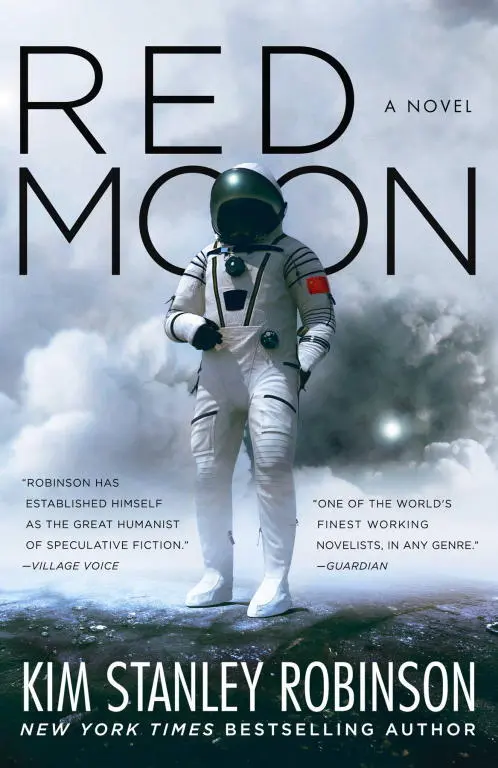
- Название:Red Moon
- Автор:
- Издательство:Orbit
- Жанр:
- Год:2018
- Город:New York
- ISBN:978-0-316-26237-8
- Рейтинг книги:3 / 5. Голосов: 1
-
Избранное:Добавить в избранное
- Отзывы:
-
Ваша оценка:
Red Moon: краткое содержание, описание и аннотация
Предлагаем к чтению аннотацию, описание, краткое содержание или предисловие (зависит от того, что написал сам автор книги «Red Moon»). Если вы не нашли необходимую информацию о книге — напишите в комментариях, мы постараемся отыскать её.
American Fred Fredericks is making his first trip, his purpose to install a communications system for China's Lunar Science Foundation. But hours after his arrival he witnesses a murder and is forced into hiding.
It is also the first visit for celebrity travel reporter Ta Shu. He has contacts and influence, but he too will find that the moon can be a perilous place for any traveler.
Finally, there is Chan Qi. She is the daughter of the Minister of Finance, and without doubt a person of interest to those in power. She is on the moon for reasons of her own, but when she attempts to return to China, in secret, the events that unfold will change everything - on the moon, and on Earth.
Red Moon is a magnificent novel of space exploration and political revolution from New York Times bestselling author Kim Stanley Robinson.
For more from Kim Stanley Robinson, check out:
New York 2140
2312
Aurora
Shaman
Red Moon — читать онлайн бесплатно полную книгу (весь текст) целиком
Ниже представлен текст книги, разбитый по страницам. Система сохранения места последней прочитанной страницы, позволяет с удобством читать онлайн бесплатно книгу «Red Moon», без необходимости каждый раз заново искать на чём Вы остановились. Поставьте закладку, и сможете в любой момент перейти на страницу, на которой закончили чтение.
Интервал:
Закладка:
Through the transparent decking and insulation they could see a giant pit that had been excavated out of the ice, near one arc of the crater wall. Vehicles like roadbuilding machines rolled around cutting the ice into cracked blocks and then trundling these blocks over a flat stretch of crater floor toward the inner wall of the crater, where they would be hauled up in freight elevators to the rim, there to be distributed all over the moon. Ice this cold acted differently than ordinary ice, it was extremely hard and brittle. The crater harbored about a billion cubic meters of ice, and every drop mined from it would be recycled as long as possible. The goal was to keep every drop of it in circulation forever, with zero water loss in all downstream uses. That was impossible, of course, but still a goal to be attempted.
“As a form of money it’s got very high liquidity,” John joked. “Just add heat and serve!”
“See that tilted slope down there? That was an avalanche.” One of their hosts indicated a big scoop and slide in the wall of excavated ice. “Back when they began mining this ice, my friend John was down there when that slope gave way. The ice partially buried him, they had a hell of a time freeing him up. It was only a few minutes, but by the time they got him out, his feet were frostbitten. He lost all his toes. That was how we found out that you really need your toes to be able to walk on the moon. We call him Mr. Pogo Stick now.”
“Sorry to hear,” John Semple said. “Does he still live here?”
“I’m not sure.”
“Don’t you know who lives here?”
“Oh yeah, we have to keep track of that, to keep the gas exchange and everything else. I just don’t know if John moved on or not.”
“We do blockchain governance,” one of the others said. “The census is part of that.”
“Blockchain governance? Meaning what?”
“All our activities and decisions are recorded in a secure distributed network, including our comings and goings, but also everything we do as a town. We call it documented anarchy. A full-disclosure commons. Anyone can do anything, but everyone gets to know what that is.”
“Is that what the blockchain governance movement on Earth is trying for?”
“I don’t know.”
Valerie said, “Since you keep track of everyone, could you look for someone we’re looking for, see if they’re in town?”
“Sure. Who are they?”
“Frederick Fredericks and Chan Qi.”
Their guide tapped on his wrist for a while. “No, no one here by those names.”
“Could they be here under fake names, or off the record?”
“No. We start with full disclosure here. Everyone enters their full real legal identity, including their national ID numbers. Then we forget about that.”
“So, can you tell us anything about those two?” Valerie persisted. “We’ve heard they’re back on the moon now, after some time on Earth.”
“If they’re on the moon now, we might be able to see something,” Anna said after none of the others replied. She tapped around for a while. “Oh, those two! Yes, they are back all right. They came up in Fang Fei’s system. An odd couple.”
“How do you mean?” Valerie asked.
“He’s the one who was involved in the killing of Chang Yazu, right? And Chang was working with Peng Ling to keep China moon on her side during the upcoming Party congress. Chang used to work for Minister Huyou, in Shaanxi, and there were investigations of corruption focused on their time there. It’s possible Chang had something on Huyou that he was going to pass along to Peng, to use in the fight for the succession to President Shanzhai. Another person in the running for that is Chan Guoliang, whose daughter has been seen with this man who was involved in Chang Yazu’s murder. So that makes them an odd couple, if you ask me.”
“Could Chan Qi be working against her dad?” John Semple asked.
Anna shrugged. “Don’t know. Jianguo is still working on getting to the bottom of it. He’s really mad. I mean, a friend of his was killed right in his prefecture. So he won’t be forgetting.”
“Can you find out where Fred and Chan Qi are now?” Valerie asked.
Anna looked dubious. “We can always ask Fang Fei. We’ve opened a new direct private line with him, it’s very cool.”
“How so?”
“It’s a neutrino telegraph.”
“What does that mean?” John asked.
“We send a beam of neutrinos right through the moon to where Fang Fei has a receptor set up. It’s very hard to catch neutrinos with anything smaller than a few city blocks’ worth of stuff, but we’ve gotten a system running where you can catch enough to send simple messages. That’s why we call it a telegraph. The bit rate is laughable, but it works for texting.”
“The neutrinos go right through the moon?” John asked.
“They go right through everything. A trillion just went through us right now.” Anna snapped her fingers. “Fang Fei likes the idea because his base is on the far side, and with this device he can shoot messages right through the moon to his people in China, without having to use satellites. It’s another one of his toys, at least now, but we’re pitching in because we thought there might be some potential there. Meanwhile it gives us a way of talking to him privately. Anyway, I’ll send him a query about those two, and we’ll see what he says.”
A bunch of the other freebies dropped down onto them and informed them it was time for the day’s performance.
“Okay,” their host said to John, “are you ready to be a dancer in our opera?”
“No way,” John said. “I can’t dance here! I can barely dance even on Earth.”
They just laughed at him. You can join anyway, they said. They needed extras. It was a case of the more the merrier, and this performance took everyone in the crater.
“Which opera?” Valerie inquired.
“ Satyagraha .”
“Isn’t that one kind of hard?” she asked. She had seen it performed once in New York, a modernist thing full of dancers with banners, weaving around a stage to a score like industrial music. Libretto in Sanskrit, she seemed to recall.
No, they told her, it was easy. The crowd scenes were supposed to be chaotic, indeed in their version they aspired to a state of complete Brownian motion. The gravity made that easy, and often it created all kinds of accidental grace.
John was shaking his head. Valerie said, “I love to dance,” which wasn’t quite true, but she was still working on wiping that amused look off John’s face. Time to finish that off for good.
They rode up in a basket at the end of a counterweighted crane lift, and were taken to a cluster of midair platforms. There they joined one of the groups congregating on a big central platform, and after introductions, their hosts jumped up to a slightly higher platform, then crossed it and jumped again. Valerie and John had to follow as best they could, both of them often misjudging how much of a leap was needed to get to the same platform as their hosts. John flew far toward the dome, while Valerie barely made it to the first available platform, which she struck with a shock more impactful than she had expected; it wasn’t like falling into the mesh. But this was just one lesson of many to come concerning unforeseen differences between weight, mass, and inertia, and she made adjustments as she could, while struggling to keep her hosts in sight and identified as hers, lost as they were among all the other people flying through the space of the aerial city.
By the time she caught up to them the great opera was in full swing, and an orchestra and chorus of several hundred people on a big platform in about the center of the space was filling the air with the complex, pulsating music. Valerie had learned a bit about this opera after seeing it in New York, at first because she was curious, and then because of its subject, which was the concept of “peaceful force” suggested by the word satyagraha , a word Gandhi had made up during his campaign for Indian independence. This word could be said to express a vision of diplomacy and intelligence work at its best, or so it seemed to Valerie, and although this opera’s libretto was in Sanskrit and thus incomprehensible to almost every person who had ever sung or heard it—and although the score by Glass was extraordinarily dense and repetitive, sending percussive waves of sound echoing through the city such that it would have been dizzying even without the low-g flights—still, once she and her group had all grasped handholds like subway straps at the ends of long lines extending from a central spinner, something like a scary ride in a carnival, and it began to spin and their bodies lifted out and away from each other, either just holding on like Valerie, or dancing in space like most of her group—once that was all accomplished, she began to enjoy herself. She began to join both the spirit and the body of the dance.
Читать дальшеИнтервал:
Закладка:
Похожие книги на «Red Moon»
Представляем Вашему вниманию похожие книги на «Red Moon» списком для выбора. Мы отобрали схожую по названию и смыслу литературу в надежде предоставить читателям больше вариантов отыскать новые, интересные, ещё непрочитанные произведения.

![Ким Робинсон - Годы риса и соли [litres]](/books/394367/kim-robinson-gody-risa-i-soli-litres-thumb.webp)
Обсуждение, отзывы о книге «Red Moon» и просто собственные мнения читателей. Оставьте ваши комментарии, напишите, что Вы думаете о произведении, его смысле или главных героях. Укажите что конкретно понравилось, а что нет, и почему Вы так считаете.