Ким Робинсон - Red Moon
Здесь есть возможность читать онлайн «Ким Робинсон - Red Moon» весь текст электронной книги совершенно бесплатно (целиком полную версию без сокращений). В некоторых случаях можно слушать аудио, скачать через торрент в формате fb2 и присутствует краткое содержание. Город: New York, Год выпуска: 2018, ISBN: 2018, Издательство: Orbit, Жанр: Фантастика и фэнтези, на английском языке. Описание произведения, (предисловие) а так же отзывы посетителей доступны на портале библиотеки ЛибКат.
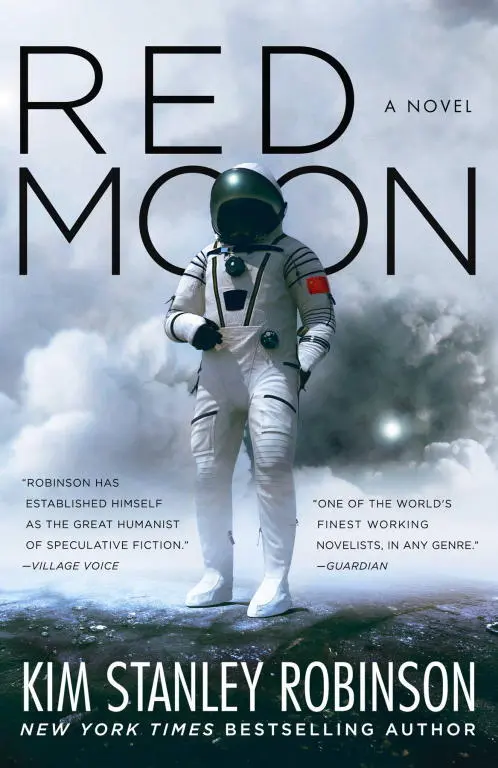
- Название:Red Moon
- Автор:
- Издательство:Orbit
- Жанр:
- Год:2018
- Город:New York
- ISBN:978-0-316-26237-8
- Рейтинг книги:3 / 5. Голосов: 1
-
Избранное:Добавить в избранное
- Отзывы:
-
Ваша оценка:
Red Moon: краткое содержание, описание и аннотация
Предлагаем к чтению аннотацию, описание, краткое содержание или предисловие (зависит от того, что написал сам автор книги «Red Moon»). Если вы не нашли необходимую информацию о книге — напишите в комментариях, мы постараемся отыскать её.
American Fred Fredericks is making his first trip, his purpose to install a communications system for China's Lunar Science Foundation. But hours after his arrival he witnesses a murder and is forced into hiding.
It is also the first visit for celebrity travel reporter Ta Shu. He has contacts and influence, but he too will find that the moon can be a perilous place for any traveler.
Finally, there is Chan Qi. She is the daughter of the Minister of Finance, and without doubt a person of interest to those in power. She is on the moon for reasons of her own, but when she attempts to return to China, in secret, the events that unfold will change everything - on the moon, and on Earth.
Red Moon is a magnificent novel of space exploration and political revolution from New York Times bestselling author Kim Stanley Robinson.
For more from Kim Stanley Robinson, check out:
New York 2140
2312
Aurora
Shaman
Red Moon — читать онлайн бесплатно полную книгу (весь текст) целиком
Ниже представлен текст книги, разбитый по страницам. Система сохранения места последней прочитанной страницы, позволяет с удобством читать онлайн бесплатно книгу «Red Moon», без необходимости каждый раз заново искать на чём Вы остановились. Поставьте закладку, и сможете в любой момент перейти на страницу, на которой закончили чтение.
Интервал:
Закладка:
Knowing the music helped a lot. When the battles of the middle act began, she kicked and flailed as rhythmically as she could, and when her entire group let go of their ropes all at once and were cast like dandelion seeds in all directions, never to meet again during the course of this opera at least, she was quick to follow, and with an almost gymnastic twist she let go, and found herself cast high over other spinning dancers. Apparently many people had let go of similar spinning mechanisms at around the same time, and the weave of flying dancers through the air was beautiful to see, although it also had to be said that if two dancers happened to be on a collision course, nothing they could do would keep them from running into each other. Or so it seemed, until Valerie saw she was headed right at a young woman dressed in scarlet, and the young woman saw her too; this allowed them to contort themselves as they flew by each other such that they just missed colliding, a nifty trick that caused them both to laugh and wave at each other as they diverged. Then the moon’s g exerted its pull, and Valerie curved down and down until she hit a bunch of netting and managed not to injure herself as she bounced to a halt. Another group of singers hanging there welcomed her and invited her by gesture to join them in their singing. This Valerie declined, at least at first; but then she recognized where the opera had gotten to, and could join in under her breath, making up the words as she went along. She knew the tune, such as it was, and at this point her group’s part was a staccato buh-buh-buh-buh buh-buh-buh-buh buh-buh-buh-buh buh-buh-buh-buh , repeated over and over and over, great fun to enunciate with the rest of them, and after a while she was actually shouting it as loud as she could shout.
Eventually they came to the last great aria, which was made of a repeated scale of rising notes—just the eight notes of a C major scale begun on E, repeated as if someone were just learning to play the piano. This turned out to make a beautiful song, one of the composer’s finest discoveries, nicely saved for the ending. The whole population of the city sang this together, and the dance troupes had come to stillness somehow, wherever they were, so that everyone now hung suspended somewhere in the air under the dome. Valerie found herself with people she had never seen, people of all kinds floating there. In the distance across the city the other participants were small in her sight, so that suddenly it looked to her like she had fallen into the Disneyland ride called It’s a Small World. That ride had bowled her over when she was five years old, and now her head was suddenly hearing its simple tune, It’s a world of laughter, a world of tears , et cetera, leading to It’s a small world after all! Which was quite a tune to impinge on the sublimity of the finale of Satyagraha , but her earworm weakness had already latched onto it, and all she could do was try to braid the two tunes together in her head, and in this particular moment it even seemed to kind of work, as a counterpoint or fugue or descant.
That odd little duet accompanied her all the rest of that day, which was taken up mostly by relocating John Semple. She couldn’t find him, she couldn’t find Anna, and she couldn’t find their hosts from the platform, and she didn’t know any of their names, and couldn’t immediately recall their faces. She had to brachiate her way back to where she thought their first meeting had taken place, dodging other swingers as she swung. Lots of flushed and happy faces flying around out there, and she was sure she probably looked like the rest.
Finally she ran into John, sitting on a platform drinking tea and talking with what she thought was a completely different set of people. He welcomed her back with a real smile, a smile of acceptance, and she sat and took a cup of tea, and listened to them tell stories about the place, and looked at all their faces, glowing like paper lanterns. All the while she was hearing in her head “it’s a world of laughter, a world of tears,” chiming across the rising scale that ended Satyagraha , and this stranded tune persisted in her head through the rest of their stay in the little flying crater, and all the way back to the north pole.
AI 8
lianxi
Contact
Little Eyeball said in her stiff version of the beautiful voice of Zhou Xuan, “Ready to transmit.”
The analyst sat by the Unicaster 3000 unit, hesitating over the keyboard. Time to send a hopeful greeting to the wayward princessling Chan Qi. He found he was nervous. Slowly he typed,
Hello, Chan Qi.
I’m a friend in China.
I work under the Great Firewall, in what some call the Invisible Wall. Colleagues of mine are surveilling you and others organizing the three withouts. I’m sure you know about some of this. I like your efforts, and would like to help you succeed in them.
He looked at the message for a while, then hit send. This kind of phone pair was quantum encrypted, but capable of exchanging only a relatively tiny thread, a string of binaries almost like Morse code, tapping on the ether itself.
He contemplated the device as he waited for a response. Possibly she would never write back, given that he had mentioned the Great Firewall. He had admitted to being someone in national security; why reply? But she had been traveling with the American who worked in quantum encryption, and the analyst had had this device sent to them hoping that the quantum expert would explain to her how the entanglement of the qubits inside the devices meant no one could overhear their conversation without them knowing of it.
Of course his phone could be in an office of the Ministry of State Security with a crowd of policemen reading its screen, but even if it were so, they would not be able to find her if she answered them. So he waited with some curiosity.
A reply appeared on his screen:
Why should you want to help me when you work on the Great Firewall?
He wrote back, I work under the Great Firewall. I helped design it, and I can use it to help people sometimes, if I want to.
Why do you want to help me?
I want to help the three withouts.
Why?
The Party exists to serve the people. As Mao said, “The people alone are the motive force in the making of world history.”
And yet you work in a security agency.
I feel it’s best if the people are secure. But then the question becomes, what creates the greatest security? For me, when the people are happy the country is safest. So I like your ideas.
How do you know what my ideas are?
You are often surveilled. I’ve heard recordings, I’ve read transcripts.
Did you work for Xi?
I did. He was a good leader, all things considered. I helped design his poverty eradication campaign, back in the twenties.
How could you do that from a security agency?
My work has always been in quantum computers and artificial intelligence. President Xi asked us to investigate how we could help eradicate poverty. That turned out to be hard, as early efforts often are. But there were some results that helped push poverty down.
And yet the problem still exists.
President Xi’s fourth term came to an end, and he could not extend to a fifth. Even the fourth term was hard. Progress was impeded by the struggle over who would come after him. After he was gone his influence waned and new policies were pursued. The leadership since his time has been weak. They are not interested in poverty eradication. They are only fighting among themselves now, thinking they could become the next Xi.
Читать дальшеИнтервал:
Закладка:
Похожие книги на «Red Moon»
Представляем Вашему вниманию похожие книги на «Red Moon» списком для выбора. Мы отобрали схожую по названию и смыслу литературу в надежде предоставить читателям больше вариантов отыскать новые, интересные, ещё непрочитанные произведения.


![Ким Робинсон - Годы риса и соли [litres]](/books/394367/kim-robinson-gody-risa-i-soli-litres-thumb.webp)


Обсуждение, отзывы о книге «Red Moon» и просто собственные мнения читателей. Оставьте ваши комментарии, напишите, что Вы думаете о произведении, его смысле или главных героях. Укажите что конкретно понравилось, а что нет, и почему Вы так считаете.