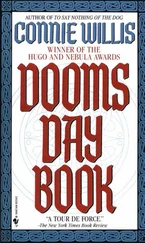
Connie Willis - Doomsday Book
Здесь есть возможность читать онлайн «Connie Willis - Doomsday Book» весь текст электронной книги совершенно бесплатно (целиком полную версию без сокращений). В некоторых случаях можно слушать аудио, скачать через торрент в формате fb2 и присутствует краткое содержание. Год выпуска: 1992, ISBN: 1992, Издательство: Bantam Books, Жанр: Фантастика и фэнтези, Социально-психологическая фантастика, на английском языке. Описание произведения, (предисловие) а так же отзывы посетителей доступны на портале библиотеки ЛибКат.
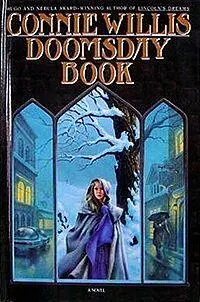
- Название:Doomsday Book
- Автор:
- Издательство:Bantam Books
- Жанр:
- Год:1992
- ISBN:ISBN 0-553-35167-2
- Рейтинг книги:3 / 5. Голосов: 1
-
Избранное:Добавить в избранное
- Отзывы:
-
Ваша оценка:
Doomsday Book: краткое содержание, описание и аннотация
Предлагаем к чтению аннотацию, описание, краткое содержание или предисловие (зависит от того, что написал сам автор книги «Doomsday Book»). Если вы не нашли необходимую информацию о книге — напишите в комментариях, мы постараемся отыскать её.
is an intelligent and satisfying blend of classic science fiction and historical reconstruction. Kivrin, a history student at Oxford in 2048, travels back in time to a 14th-century English village, despite a host of misgivings on the part of her unofficial tutor. When the technician responsible for the procedure falls prey to a 21st-century epidemic, he accidentally sends Kivrin back not to 1320 but to 1348 — right into the path of the Black Death. Unaware at first of the error, Kivrin becomes deeply involved in the life of the family that takes her in. But before long she learns the truth and comes face to face with the horrible, unending suffering of the plague that would wipe out half the population of Europe. Meanwhile, back in the future, modern science shows itself infinitely superior in its response to epidemics, but human nature evidences no similar evolution, and scapegoating is still alive and well in a campaign against "infected foreigners." This book finds villains and heroes in all ages, and love, too, which Kivrin hears in the revealing and quietly touching deathbed confession of a village priest. Won Nebula Award for Best Novel in 1992
Won Hugo Award for Best Novel in 1993
Doomsday Book — читать онлайн бесплатно полную книгу (весь текст) целиком
Ниже представлен текст книги, разбитый по страницам. Система сохранения места последней прочитанной страницы, позволяет с удобством читать онлайн бесплатно книгу «Doomsday Book», без необходимости каждый раз заново искать на чём Вы остановились. Поставьте закладку, и сможете в любой момент перейти на страницу, на которой закончили чтение.
Интервал:
Закладка:
"I'm sorry, I'm sorry," Kivrin said, trying to get her balance, trying to clutch at his hands. "I'm sorry."
His bloodshot eyes were wide open now, staring straight ahead. " Gloriam tuam ," he bellowed, in a strange high voice that was almost a scream.
"I'm sorry," Kivrin said. She grabbed at his wrist, and his other arm shot out, striking her full in the chest.
" Requiem aeternum dona eis ," he roared, rising up on his knees and then his feet to stand in the middle of the bed. " Et lux perpetua luceat eis ."
Kivrin realized suddenly that he was trying to sing the mass for the dead.
Father Roche clutched at his shift, and he lashed out, kicking himself free, and then went on kicking, spinning around as if he were dancing.
" Miserere nobis ."
He was too near the wall for them to reach him, hitting the timbers with his feet and flailing arms at every turn without even seeming to notice. "When he comes within reach, we must grab his ankles and knock him down," Kivrin said.
Father Roche nodded, out of breath. The others stood transfixed, not even trying to stop him, Imeyne still on her knees. Maisry pushed herself completely into the window, her hands over her ears and her eyes squeezed shut. Rosemund had retrieved the sopping rag and held it in her outstretched hand as if she thought Kivrin might try to lay it on his head again. Agnes was staring open-mouthed at the clerk's half-exposed body.
The clerk spun back toward them, his hands pawing at the ties on the front of his shift, trying to rip them free.
"Now," Kivrin said.
Father Roche and she reached for his ankles. The clerk went down on one knee, and then, flinging his arms out wide, burst free and launched himself off the high bed straight at Rosemund. She put her hands up, still holding the rag, and he hit her full in the chest.
" Miserere nobis ," he said, and they went down together.
"Grab his arms before he hurts her," Kivrin said, but the clerk had stopped flailing. He lay atop Rosemund, motionless, his mouth almost touching hers, his arms limply out at his sides.
Father Roche took hold of the clerk's unresisting arm and rolled him off Rosemund. He flopped onto his side, breathing shallowly but no longer panting.
"Is he dead?" Agnes asked, and as if her voice had released the rest of them from a spell, they all moved forward, Lady Imeyne struggling to her feet, gripping the bedpost.
"Blackie died," Agnes said, clutching at her mother's skirts.
"He is not dead," Imeyne said, kneeling beside him, "but the fever in his blood has gone to the brain. It is often thus."
It's never thus, Kivrin thought. This isn't a symptom of any disease I've ever heard of. What could it be? Spinal meningitis? Epilepsy?
She bent down next to Rosemund. The girl lay rigidly on the floor, her eyes squeezed shut, her hands clenched into whitening fists. "Did he hurt you?" Kivrin asked.
Rosemund opened her eyes. "He pushed me down," she said, her voice quavering a little.
"Can you stand?" Kivrin asked.
Rosemund nodded, and Eliwys stepped forward, Agnes still clinging to her skirt. They helped her to her feet.
"My foot hurts," she said, leaning on her mother, but in a minute she was able to stand on it. "He…of a sudden…"
Eliwys supported her to the end of the bed and sat her down on the carved chest. Agnes clambered up next to her. "The bishop's clerk jumped on top of you," she said.
The clerk murmured something, and Rosemund looked fearfully at him. "Will he rise up again?" she asked Eliwys.
"Nay," Eliwys said, but she helped Rosemund up and led her to the door. "Take your sister down to the fire and sit with her," she told Agnes.
Agnes took hold of Rosemund's arm and led her out. "When the clerk dies, we will bury him in the churchyard," Kivrin could hear her say going down the stairs. "Like Blackie."
The clerk looked already dead, his eyes half-open and unseeing. Father Roche knelt next to him and hoisted him easily over his shoulder, the clerk's head and arms hanging limply down, the way Kivrin had carried Agnes home from the midnight mass. Kivrin hastily pulled the coverlet off the featherbed, and Roche eased him down onto the bed.
"We must draw the fever from the brain," Lady Imeyne said, returning to her poultice. "It is the spices that have fevered his brain."
"No," Kivrin whispered, looking at the priest. He lay on his back with his arms out at his sides, the palms up. The thin shift was ripped halfway down the front and had fallen completely off his left shoulder so his outstretched arm was exposed. Under the arm was a red swelling. "No," she breathed.
The swelling was bright red and nearly as large as an egg. High fever, swollen tongue, intoxication of the nervous system, buboes under the arms and in the groin.
Kivrin took a step back from the bed. "It can't be," she said. "It's something else." It had to be something else. A boil. Or an ulcer of some kind. She reached forward to pull the sleeve away from it.
The clerk's hands twitched. Roche stretched to grasp his wrists, pushing them down into the featherbed. The swelling was hard to the touch, and around it the skin was a mottled purplish- black.
"It can't be," she said. "It's only 1320."
"This will draw the fever out," Imeyne said. She stood up stiffly, holding the poultice out in front of her. "Pull his shift away from his body that I may lay on the poultice." She started toward the bed.
"No!" Kivrin said. She put her hands up to stop her. "Stay away! You mustn't touch him!"
"You speak wildly," Imeyne said. She looked at Roche. "It is naught but a stomach fever."
"It isn't a fever!" Kivrin said. She turned to Roche. "Let go of his hands and get away from him. It isn't a fever. It's the plague."
All of them, Roche and Imeyne and Eliwys looked at her as stupidly as Maisry.
They don't even know what it is, she thought desperately, because it doesn't exist yet, there was no such thing as the Black Death yet. It didn't even begin in China until 1333. And it didn't reach England till 1348. "But it is," Kivrin said. "He's got all the symptoms. The bubo and the swollen tongue and the hemorrhaging under the skin."
"It is naught but a stomach fever," Imeyne said and pushed past Kivrin to the bed.
"No — " Kivrin said, but Imeyne had already stopped, the poultice poised above his naked chest.
"Lord have mercy on us," she said, and backed away, still holding the poultice.
"Is it the blue sickness?" Eliwys said frightenedly.
And suddenly Kivrin saw it all. They had not come here because of the trial, because Lord Guillaume was in trouble with the king. He had sent them here because the plague was in Bath.
"Our nurse died," Agnes had said. And Lady Imeyne's chaplain, Brother Hubard. "Rosemund said he died of the blue sickness," Agnes had told her. And Sir Bloet had said that the trial had been delayed because the judge was ill. That was why Eliwys hadn't wanted to send word to Courcy and why she had been so angry when Imeyne sent Gawyn to the bishop. Because the plague was in Bath. But it couldn't be. The Black Death hadn't reached Bath until the fall of 1348.
"What year is it?" Kivrin said.
The women looked at her dumbly, Imeyne still holding the forgotten poultice. Kivrin turned to Roche. "What is the year?"
"Are you ill, Lady Katherine?" he said anxiously, reaching for her wrists as if he was afraid she was going to have one of the clerk's seizures.
She jerked her hands away. "Tell me the year."
"It is the twenty-first year of Edward III's reign," Eliwys said.
Edward III, not the Second. In her panic she could not remember when he had reigned. "Tell me the year ," she said.
"Anno domine," the clerk said from the bed. He tried to lick his lips with his swollen tongue. "One thousand three hundred and forty-eight."
Читать дальшеИнтервал:
Закладка:
Похожие книги на «Doomsday Book»
Представляем Вашему вниманию похожие книги на «Doomsday Book» списком для выбора. Мы отобрали схожую по названию и смыслу литературу в надежде предоставить читателям больше вариантов отыскать новые, интересные, ещё непрочитанные произведения.



Обсуждение, отзывы о книге «Doomsday Book» и просто собственные мнения читателей. Оставьте ваши комментарии, напишите, что Вы думаете о произведении, его смысле или главных героях. Укажите что конкретно понравилось, а что нет, и почему Вы так считаете.