Connie Willis - Doomsday Book
Здесь есть возможность читать онлайн «Connie Willis - Doomsday Book» весь текст электронной книги совершенно бесплатно (целиком полную версию без сокращений). В некоторых случаях можно слушать аудио, скачать через торрент в формате fb2 и присутствует краткое содержание. Год выпуска: 1992, ISBN: 1992, Издательство: Bantam Books, Жанр: Фантастика и фэнтези, Социально-психологическая фантастика, на английском языке. Описание произведения, (предисловие) а так же отзывы посетителей доступны на портале библиотеки ЛибКат.
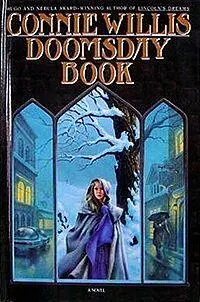
- Название:Doomsday Book
- Автор:
- Издательство:Bantam Books
- Жанр:
- Год:1992
- ISBN:ISBN 0-553-35167-2
- Рейтинг книги:3 / 5. Голосов: 1
-
Избранное:Добавить в избранное
- Отзывы:
-
Ваша оценка:
Doomsday Book: краткое содержание, описание и аннотация
Предлагаем к чтению аннотацию, описание, краткое содержание или предисловие (зависит от того, что написал сам автор книги «Doomsday Book»). Если вы не нашли необходимую информацию о книге — напишите в комментариях, мы постараемся отыскать её.
is an intelligent and satisfying blend of classic science fiction and historical reconstruction. Kivrin, a history student at Oxford in 2048, travels back in time to a 14th-century English village, despite a host of misgivings on the part of her unofficial tutor. When the technician responsible for the procedure falls prey to a 21st-century epidemic, he accidentally sends Kivrin back not to 1320 but to 1348 — right into the path of the Black Death. Unaware at first of the error, Kivrin becomes deeply involved in the life of the family that takes her in. But before long she learns the truth and comes face to face with the horrible, unending suffering of the plague that would wipe out half the population of Europe. Meanwhile, back in the future, modern science shows itself infinitely superior in its response to epidemics, but human nature evidences no similar evolution, and scapegoating is still alive and well in a campaign against "infected foreigners." This book finds villains and heroes in all ages, and love, too, which Kivrin hears in the revealing and quietly touching deathbed confession of a village priest. Won Nebula Award for Best Novel in 1992
Won Hugo Award for Best Novel in 1993
Doomsday Book — читать онлайн бесплатно полную книгу (весь текст) целиком
Ниже представлен текст книги, разбитый по страницам. Система сохранения места последней прочитанной страницы, позволяет с удобством читать онлайн бесплатно книгу «Doomsday Book», без необходимости каждый раз заново искать на чём Вы остановились. Поставьте закладку, и сможете в любой момент перейти на страницу, на которой закончили чтение.
Интервал:
Закладка:
She stood in by the gate till she got cold and then went back along the wall to the pigsty and into the courtyard. There was still no one in the courtyard, but Rosemund was in the anteroom, with her cloak on.
"Where have you been?" she said. "I've been looking everywhere for you. The clerk — "
Kivrin's heart jerked. "What is it? Is he leaving?" He'd woken from his hangover and was ready to leave. And Lady Imeyne had persuaded him to take her to Godstow.
"Nay," Rosemund said, going into the hall. It was empty. Eliwys and Imeyne must both be in the bower with him. She unfastened Sir Bloet's brooch and took her cloak off. "He is ailing. Father Roche sent me to find you." She started up the stairs.
"Ailing?" Kivrin said.
"Aye. Grandmother sent Maisry to the bower to take him somewhat to eat."
And to put him to work, Kivrin thought, following her up the steps. "And Maisry found him ill?"
"Aye. He has a fever."
He has a hangover, Kivrin thought, frowning. But Roche would surely recognize the effects of drink, even if Lady Imeyne couldn't, or wouldn't.
A terrible thought occurred to her. He's been sleeping in my bed, Kivrin thought, and he's caught my virus.
"What symptoms does he have?" she asked.
Rosemund opened the door.
There was scarcely room for them all in the little room. Father Roche was by the bed, and Eliwys stood a little behind him, her hand on Agnes's head. Maisry cowered by the window. Lady Imeyne knelt at the foot of the bed next to her medicine casket, busy with one of her foul-smelling poultices, and there was another smell in the room, sickish and so strong it overpowered the mustard and leek smell of the poultice.
They all, except Agnes, looked frightened. Agnes looked interested, the way she had with Blackie, and Kivrin thought, he's dead, he's caught what I had, and he's died. But that was ridiculous. She had been here since the middle of December. That would mean an incubation period of nearly two weeks, and no one else had caught it, not even Father Roche, or Eliwys, and they had been with her constantly while she was ill.
She looked at the clerk. He lay uncovered in the bed, wearing a shift and no breeches. The rest of his clothes were draped over the foot of the bed, his purple cloak dragging on the floor. His shift was yellow silk, and the ties had come unfastened so that it was open halfway down his chest, but she wasn't noticing either his hairless skin or the ermine bands on the sleeves of his shift. He was ill. I was never that ill, Kivrin thought, not even when I was dying.
She went up to the bed. Her foot hit a half-empty earthenware wine bottle and sent it rolling under the bed. The clerk flinched. Another bottle, with the seal still on it, stood at the head of the bed.
"He has eaten too much rich food," Lady Imeyne said, mashing something in her stone bowl, but it was clearly not food poisoning. Nor too much alcohol, in spite of the wine bottles. He's ill, Kivrin thought. Terribly ill.
He breathed rapidly in and out through his open mouth, panting like poor Blackie, his tongue sticking out. It was bright red and looked swollen. His face was an even darker red, and his expression was distorted, as if he were terrified.
She wondered if he might have been poisoned. The bishop's envoy had been so anxious to leave he had nearly run Agnes down, and he had told Eliwys not to disturb him. The church had done things like that in the thirteen hundreds, hadn't they? Mysterious deaths in the monastery and the cathedral. Convenient deaths.
But that made no sense. The bishop's envoy and the monk would not have hurried off and given orders not to disturb the victim when the whole point of poison was to make it look like botulism or peritonitis or the dozen other unaccountable things people died of in the Middle Ages. And why would the bishop's envoy poison one of his own underlings when he could demote him, the way Lady Imeyne wanted to demote Father Roche.
"Is it the cholera?" Lady Eliwys said.
No, Kivrin thought, trying to remember its symptoms. Acute diarrhea and vomiting with massive loss of body fluids. Pinched expression, dehydration, cyanosis, raging thirst.
"Are you thirsty?" she asked.
The clerk gave no sign that he had heard. His eyes were half-closed, and they looked swollen, too.
Kivrin laid her hand on his forehead. He flinched a little, his reddened eyes flickering open and then closed.
"He's burning with fever," Kivrin said, thinking, cholera doesn't produce this high a fever. "Fetch me a cloth dipped in water."
"Maisry!" Eliwys snapped, but Rosemund was already at her elbow with the same filthy rag they must have used on her.
At least it was cool. Kivrin folded it into a rectangle, watching the priest's face. He was still panting, and his face contorted when she laid the rag across his forehead, as if he was in pain. He clutched his hand to his belly. Appendicitis? Kivrin thought. No, that usually was accompanied by a low-grade fever. Typhoid fever could produce temps as high as forty degrees, though usually not at the onset. It produced enlargement of the spleen, as well, which frequently resulted in abdominal pain.
"Are you in pain?" she asked. "Where does it hurt?"
His eyes flickered half-open again, and his hands moved restlessly on the coverlet. That was a symptom of typhoid fever, that restless plucking, but only in the last stages, eight or nine days into the progress of the disease. She wondered if the priest had already been ill when he came.
He had stumbled getting off his horse when they arrived, and the monk had had to catch him. But he had eaten and drunk more than a little at the feast, and grabbed at Maisry. He couldn't have been very ill, and typhoid came on gradually, beginning with a headache and an only slightly elevated temperature. It didn't reach thirty-nine degrees until the third week.
Kivrin leaned closer, pulling his untied shift aside to look for typhoid's rose-colored rash. There wasn't any. The side of his neck seemed slightly swollen, but swollen lymph glands went with almost every infection. She pulled his sleeve up. There weren't any rose spots on his arm either, but his fingernails were a bluish-brown color, which meant not enough oxygen. And cyanosis was a symptom of cholera.
"Has he vomited or had loosening of his bowels?" she asked.
"Nay," Lady Imeyne said, smearing a greenish paste on a piece of stiff linen. "He has but eaten too much of sugars and spices, and it has fevered his blood."
It couldn't be cholera without vomiting, and at any rate the fever was too high. Perhaps it was her virus after all, but she hadn't felt any stomach pain, and her tongue hadn't swollen like that.
The clerk raised his hand and pushed the rag off his forehead and onto the pillow, and then let his arm fall back to his side. Kivrin picked the rag up. It was completely dry. And what besides a virus could cause that high a fever? She couldn't think of anything but typhoid.
"Has he bled from the nose?" she asked Roche.
"Nay," Rosemund said, stepping forward and taking the rag from Kivrin. "I have seen no sign of bleeding."
"Wet it with cold water but don't wring it out," Kivrin said. "Father Roche, help me to lift him."
Roche put his hands to the priest's shoulders and raised him up. There was no blood on the linen under his head.
Roche laid him gently back down. "Think you it is the typhoid fever?" he said, and there was something curious, almost hopeful in his tone.
"I know not," Kivrin said.
Rosemund handed Kivrin the rag. She had took Kivrin at her word. It was dripping with icy water.
Kivrin leaned forward and laid it across the clerk's forehead.
His arms came up suddenly, wildly, knocking the cloth backwards out of Kivrin's hand, and then he was sitting up, flailing at her with both his hands, kicking out with his feet. His fist caught her on the side of her leg, buckling her knees so that she almost toppled onto the bed.
Читать дальшеИнтервал:
Закладка:
Похожие книги на «Doomsday Book»
Представляем Вашему вниманию похожие книги на «Doomsday Book» списком для выбора. Мы отобрали схожую по названию и смыслу литературу в надежде предоставить читателям больше вариантов отыскать новые, интересные, ещё непрочитанные произведения.






Обсуждение, отзывы о книге «Doomsday Book» и просто собственные мнения читателей. Оставьте ваши комментарии, напишите, что Вы думаете о произведении, его смысле или главных героях. Укажите что конкретно понравилось, а что нет, и почему Вы так считаете.