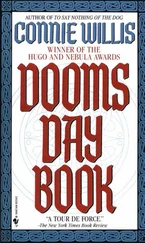
Connie Willis - Doomsday Book
Здесь есть возможность читать онлайн «Connie Willis - Doomsday Book» весь текст электронной книги совершенно бесплатно (целиком полную версию без сокращений). В некоторых случаях можно слушать аудио, скачать через торрент в формате fb2 и присутствует краткое содержание. Год выпуска: 1992, ISBN: 1992, Издательство: Bantam Books, Жанр: Фантастика и фэнтези, Социально-психологическая фантастика, на английском языке. Описание произведения, (предисловие) а так же отзывы посетителей доступны на портале библиотеки ЛибКат.

- Название:Doomsday Book
- Автор:
- Издательство:Bantam Books
- Жанр:
- Год:1992
- ISBN:ISBN 0-553-35167-2
- Рейтинг книги:3 / 5. Голосов: 1
-
Избранное:Добавить в избранное
- Отзывы:
-
Ваша оценка:
Doomsday Book: краткое содержание, описание и аннотация
Предлагаем к чтению аннотацию, описание, краткое содержание или предисловие (зависит от того, что написал сам автор книги «Doomsday Book»). Если вы не нашли необходимую информацию о книге — напишите в комментариях, мы постараемся отыскать её.
is an intelligent and satisfying blend of classic science fiction and historical reconstruction. Kivrin, a history student at Oxford in 2048, travels back in time to a 14th-century English village, despite a host of misgivings on the part of her unofficial tutor. When the technician responsible for the procedure falls prey to a 21st-century epidemic, he accidentally sends Kivrin back not to 1320 but to 1348 — right into the path of the Black Death. Unaware at first of the error, Kivrin becomes deeply involved in the life of the family that takes her in. But before long she learns the truth and comes face to face with the horrible, unending suffering of the plague that would wipe out half the population of Europe. Meanwhile, back in the future, modern science shows itself infinitely superior in its response to epidemics, but human nature evidences no similar evolution, and scapegoating is still alive and well in a campaign against "infected foreigners." This book finds villains and heroes in all ages, and love, too, which Kivrin hears in the revealing and quietly touching deathbed confession of a village priest. Won Nebula Award for Best Novel in 1992
Won Hugo Award for Best Novel in 1993
Doomsday Book — читать онлайн бесплатно полную книгу (весь текст) целиком
Ниже представлен текст книги, разбитый по страницам. Система сохранения места последней прочитанной страницы, позволяет с удобством читать онлайн бесплатно книгу «Doomsday Book», без необходимости каждый раз заново искать на чём Вы остановились. Поставьте закладку, и сможете в любой момент перейти на страницу, на которой закончили чтение.
Интервал:
Закладка:
"I read about this in meds," the boy said, "but I've never actually seen it. It's a common terminal symptom in respiratory cases." He went to the console, punched something up, and pointed at the top left screen. "I've written it all down."
He had, even the gibberish. He had written that phonetically, with ellipses to represent pauses, and (sic) after questionable words. "Rats," he had written, and "backer (sic)" and "Why doesn't he come?"
"This is mostly from yesterday," he said. He moved a cursor to the lower third of the screen. "He talked a big this morning. Now, of course, he doesn't say anything."
Dunworthy sat down beside Badri and took his hand. It was ice-cold even through the imperm glove. He glanced at the temp screen. Badri no longer had a fever or the dark flush that had gone with it. He seemed to have lost all color. His skin was the color of wet ashes.
"Badri," he said. "It's Mr. Dunworthy. I need to ask you some questions."
There was no response. His cold hand lay limply in Dunworthy's gloved one, and the other continued picking steadily, uselessly at the sheet.
"Dr. Ahrens thinks you might have caught your illness from an animal, a wild duck or a goose."
The nurse looked interestedly at Dunworthy and then back at Badri, as if he were hoping he would exhibit another yet- unobserved medical phenomenon.
"Badri, can you remember? Did you have any contact with ducks or geese the week before the drop?"
Badri's hand moved. Dunworthy frowned at it, wondering if he were trying to communicate, but when he loosened his grip a little, the thin, thin fingers were only trying to pluck at his palm, at his fingers, at his wrist.
He was suddenly ashamed that he was sitting here torturing Badri with questions, though he was past hearing, past even knowing Dunworthy was here, or caring.
He laid Badri's hand back on the sheet. "Rest," he said, patting it gently, "Try to rest."
"I doubt if he can hear you," the nurse said. "When they're this far gone they're not really conscious."
"No. I know," Dunworthy said, but he went on sitting there.
The nurse adjusted a drip, peered nervously at it and adjusted it again. He looked anxiously at Badri, adjusted the drip a third time and finally went out. Dunworthy sat on, watching Badri's fingers plucking blindly at the sheet, trying to grasp it but unable to. Trying to hold on. Now and then he murmured something, too soft to hear. Dunworthy rubbed his arm gently, up and down. After awhile, the plucking grew slower, though Dunworthy didn't know if that was a good sign or not.
"Graveyard," Badri said.
"No," Dunworthy said. "No."
He sat on a bit longer, rubbing Badri's arm, but after a little it seemed to make his agitation worse. He stood up. "Try to rest," he said and went out.
The nurse was sitting at the desk, reading a copy of Patient Care .
"Please notify me when…" Dunworthy said, and realized he would not be able to finish the sentence. "Please notify me."
"Yes, sir," the boy said. "Where are you?"
He fumbled in his pocket for a scrap of paper to write on and came up with the list of supplies. He had nearly forgotten it. "I'm at Balliol," he said, "send a messenger," and went back down to Supplies.
"You haven't filled this out properly," the crone said starchily when Dunworthy gave her the form.
"I've had it signed," he said, handing her his list. "You fill it out."
She looked disapprovingly at the list. "We haven't any masks or temps." She reached down a small bottle of aspirin. "We're out of synthamycin and AZL."
The bottle of aspirin contained perhaps twenty tablets. He put them in his pocket and walked down to the High to the chemist's. A small crowd of protesters stood outside in the rain, holding pickets that said, "UNFAIR!" and "Price gouging!" He went inside. They were out of masks, and the temps and the aspirin were outrageously priced. He bought all they had.
He spent the night dispensing them and studying Badri's chart, looking for some clue to the virus's source. Badri had run an on-site for Nineteenth Century in Hungary on the tenth of December, but the chart did not say where in Hungary , and William, who was flirting with the detainees who were still on their feet, didn't know, and the phones were still out.
They were still out in the morning when Dunworthy tried to phone to check on Badri's condition. He could not even raise a dialing tone, but as soon as he put down the receiver, the telephone rang.
It was Andrews. Dunworthy could scarcely hear his voice through the static. "Sorry this took so long," he said, and then something that was lost entirely.
"I can't hear you," Dunworthy said.
"I said, I've had difficulty getting through. The phones…" More static. "I did the parameter checks. I used three different L-and-L's and triangulated the…" The rest was lost.
"What was the maximal slippage?" he shouted into the phone.
The line went momentarily clear. "Six days."
"Six days?" Dunworthy shouted. "Are you certain?"
"That was with an L-and-L of…" More static. "I ran probabilities, and the possible maximal for any L-and-L's within a circumference of fifty kilometers was still five years." The static roared in again, and the line went dead.
Dunworthy put the receiver down. He should have felt reassured, but he could not seem to summon any feeling. Gilchrist had no intention of opening the net on the sixth, whether Kivrin was there or not. he reached for the phone to phone the Scottish Tourism Bureau, and as he did, it rang again.
"Dunworthy here," he said, squinting at the screen, but the visuals were still nothing but snow.
"Who?" a woman's voice that sounded hoarse or groggy said. "Sorry," it murmured, "I meant to ring — " and something else too blurred to make out, and the visual went blank.
He waited to see if it would ring again, and then went back across to Salvin. Magdalen's bell was chiming the hour. It sounded like a funeral bell in the unceasing rain. Ms. Piantini had apparently heard the bell, too. She was standing in the quad in her nightgown, solemnly raising her arms in an unheard rhythm. "Middle, wrong, and into the hunt," she said when Dunworthy tried to take her back inside.
Finch appeared, looking distraught. "It's the bells, sir," he said, taking hold of her other arm. "They upset her. I don't think they should ring them under the circumstances."
Ms. Piantini wrenched free of Dunworthy's restraining hand. "Every man must stick to his bell without interruption," she said furiously.
"I quite agree," Finch said, clutching her arm as firmly as if it were a bell rope, and led her back to her cot.
Colin came skidding in, drenched as usual and nearly blue With cold. His jacket was open, and Mary's gray muffler dangled uselessly about his neck. He handed Dunworthy a message. "It's from Badri's nurse," he said, opening a packet of soap tablets and popping a light blue one into his mouth.
The note was drenched, too. It read, "Badri asking for you," though the word 'Badri' was so blurred he couldn't make out more than the B.
"Did the nurse say whether Badri was worse?"
"No, just to give you the message. And Aunt Mary says when you come, you're to get your enhancement. She said she doesn't know when the analogue will get here."
Dunworthy helped Finch wrestle Ms. Piantini into bed and hurried to Infirmary and up to isolation. There was another new nurse, this one a middle-aged woman with swollen feet. She was sitting with them propped up on the screens, watching a pocket vidder, but she stood up immediately when he came in.
"Are you Mr. Dunworthy?" she asked, blocking his way. "Dr. Ahrens said you're to meet her downstairs immediately."
She said it quietly, even kindly, and he thought, she's trying to spare me. She doesn't want me to see what's in there. She wants Mary to tell me first.
Читать дальшеИнтервал:
Закладка:
Похожие книги на «Doomsday Book»
Представляем Вашему вниманию похожие книги на «Doomsday Book» списком для выбора. Мы отобрали схожую по названию и смыслу литературу в надежде предоставить читателям больше вариантов отыскать новые, интересные, ещё непрочитанные произведения.










Обсуждение, отзывы о книге «Doomsday Book» и просто собственные мнения читателей. Оставьте ваши комментарии, напишите, что Вы думаете о произведении, его смысле или главных героях. Укажите что конкретно понравилось, а что нет, и почему Вы так считаете.