Robert Sawyer - Frameshift
Здесь есть возможность читать онлайн «Robert Sawyer - Frameshift» весь текст электронной книги совершенно бесплатно (целиком полную версию без сокращений). В некоторых случаях можно слушать аудио, скачать через торрент в формате fb2 и присутствует краткое содержание. Год выпуска: 1998, ISBN: 1998, Издательство: Tor Science Fiction, Жанр: Фантастика и фэнтези, на английском языке. Описание произведения, (предисловие) а так же отзывы посетителей доступны на портале библиотеки ЛибКат.
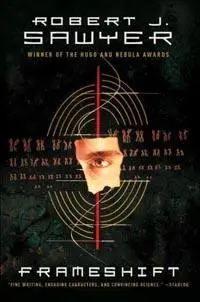
- Название:Frameshift
- Автор:
- Издательство:Tor Science Fiction
- Жанр:
- Год:1998
- ISBN:0-812-57108-8
- Рейтинг книги:4 / 5. Голосов: 1
-
Избранное:Добавить в избранное
- Отзывы:
-
Ваша оценка:
Frameshift: краткое содержание, описание и аннотация
Предлагаем к чтению аннотацию, описание, краткое содержание или предисловие (зависит от того, что написал сам автор книги «Frameshift»). Если вы не нашли необходимую информацию о книге — напишите в комментариях, мы постараемся отыскать её.
Frameshift — читать онлайн бесплатно полную книгу (весь текст) целиком
Ниже представлен текст книги, разбитый по страницам. Система сохранения места последней прочитанной страницы, позволяет с удобством читать онлайн бесплатно книгу «Frameshift», без необходимости каждый раз заново искать на чём Вы остановились. Поставьте закладку, и сможете в любой момент перейти на страницу, на которой закончили чтение.
Интервал:
Закладка:
“And?”
“And think about our work on codon synonyms.” He waved vaguely at the wall chart labeled “The Genetic Code.”
“Yes?”
“That’s one possible additional level of coding hidden in DNA, if the choice of which synonym used is significant. Now we’ve got a second possible type of additional coding in DNA: the code made by whether cytosine is methylated or not. I’m willing to bet that one or both of those additional codes is the key to what the so-called junk DNA is really for.”
“So what do we do now?” asked Shari.
“Well, as Einstein is supposed to have said, ‘God is subtle, but malicious he is not.’” He smiled at Shari. “No matter how complex the codes are, we should be able to crack them.”
Pierre went home. His apartment seemed vast. He sat on the living-room couch, pulling idly at an orange thread coming unraveled from one of the cushions.
They were making progress, he and Shari. They were getting close to a breakthrough. Of that he felt sure.
But he wasn’t elated. He wasn’t excited.
God, what an idiot I am.
He watched Letterman, watched Conan O’Brien.
He didn’t laugh.
He started getting ready for bed, dumping his socks and underwear on the living-room floor — there wasn’t any reason not to anymore.
He’d been reading Camus again. His fat copy of the Collected Works was facedown on one of the couch’s orange-and-green cushions. Camus, who had taken the literature Nobel in ‘57; Camus, who commented on the absurdity of the human condition. “I don’t want to be a genius,” he had said. “I have enough problems just trying to be a man.”
Pierre sat down on the couch and exhaled into the darkness. The absurdity of the human condition. The absurdity of it all. The absurdity of being a man.
Bertrand Russell ran through his mind, too — a Nobel laureate in 1950.
“To fear love,” he’d said, “is to fear life — and those who fear life are already three parts dead.”
Three parts dead — just about right for a Huntington’s sufferer at thirty-two.
Pierre crawled into bed, lying in a fetal position.
He slept hardly at all — but when he did, he dreamt not of Stockholm, but of Molly.
Chapter 15
“I can’t let you redo the exam,” said Molly to the male student sitting opposite her, “but if you undertake another research project, I can give you up to ten marks in extra credit for that. If you get eight or above, you’ll pass — just barely. It’s your choice.”
The student was looking at his hands, which were resting in his lap. “I’ll do the project. Thank you, Professor Bond.”
“That’s all right, Alex. Everyone deserves a second chance.”
The student got to his feet and left the cramped office. Pierre, who had been standing just outside the door waiting for Molly to be alone, stepped into the doorway, holding a dozen red roses in front of him.
“I’m so sorry,” he said.
Molly looked up, eyes wide.
“I feel like a complete heel.” He actually said “eel,” but Molly assumed he meant the former, although she thought the latter was just as applicable. Still, she said nothing.
“May I come in?” he said.
She nodded, but did not speak.
Pierre stepped inside and closed the door behind him. “You are the very best thing that ever happened to me,” he said, “and I am an idiot.”
There was silence for a time. “Nice flowers,” said Molly at last.
Pierre looked at her, as if trying to read her thoughts in her eyes. “If you will still have me as your husband, I would be honored.”
Molly was quiet for a time. “I want to have a child.”
Pierre had given this much thought. “I understand that. If you wanted to adopt a child, I’d be glad to help raise it for as long as I’m able.”
“Adopt? I — no, I want to have a child of my own. I want to undergo in vitro fertilization.”
“Oh,” said Pierre.
“Don’t worry about passing on bad genes,” said Molly. “I was reading an article about this in Cosmo . They could culture the embryos outside my body, then test them for whether they’d inherited Huntington’s. Then they could implant only healthy ones.”
Pierre was a lapsed Catholic; the whole idea of such a procedure still left him uncomfortable — tossing out viable embryos because they didn’t pass genetic muster. But that wasn’t his main objection. “I was serious about what I said before. I think a child should have both a mother and a father — and I probably won’t live long enough to see a child grow up.” He paused. “I can’t in good conscience begin a new life that I know I’m not going to be around to see through its childhood,” he said. “Adoption is a special case — we’d still be improving the child’s life, even if it wouldn’t always have a father.”
“I’m going to do it anyway,” said Molly firmly. “I’m going to have a baby. I’m going to have in vitro fertilization.”
Pierre felt it all slipping away. “I can’t be the sperm donor. I — I’m sorry.
I just can’t.”
Molly sat without saying anything. Pierre felt angry with himself. This was supposed to be a reunion, dammit. How did it get so off track?
Finally, Molly spoke. “Could you come to love a child that wasn’t biologically yours?”
Pierre had already considered this when contemplating adoption. “ Oui .”
“I was going to have a child without a husband anyway,” said Molly.
“Millions of children have grown up without fathers; for most of my childhood, I didn’t have one myself.”
Pierre nodded. “I know.”
Molly frowned. “And you still want to marry me, even if I go ahead and have a child using donated sperm?”
Pierre nodded again, not trusting his voice just then.
“And you could come to love such a child?”
He’d been all prepared to love an adopted child. Why did this seem so different? And yet — and yet—
“Yes,” said Pierre at last. “After all, the child would still be partly you.”
He locked onto her blue eyes. “And I love you completely.” He waited while his heart beat a few more times. “So,” he said, at last, “will you consent to be Mrs. Tardivel?”
She looked at her lap and shook her head. “No, I can’t do that.” But when she lifted her face, she was smiling. “But I do want to be Ms. Bond, who happens to be married to Mr. Tardivel.”
“Then you will marry me?”
Molly got up and walked toward him. She put her arms around his neck. “ Oui ,”she said.
They kissed for several seconds, but when they pulled apart, Pierre said, “There is one condition. At any time — any time — if you feel my disease is too much for you, or you see an opportunity for happiness that will last the rest of your life, rather than the rest of mine, then I want you to leave me.”
Molly was silent, her mouth hanging slightly open.
“Promise,” said Pierre.
“I promise,” she said at last.
That night, Pierre and Molly did what they had often done before they’d broken up: they went for a long walk. They’d stopped at a cafe on Telegraph Avenue for a light snack, and now were just ambling along, occasionally looking in shop windows. Like many young couples, they were still trying to get to know every facet of each other’s personalities and pasts. On one long walk, they had talked about earlier sexual experiences; on another, relations with their parents; on others still, debates about gun control and environmental issues. Nights of probing, of stimulating conversations, of each refining his or her mental image of the other.
And tonight, the biggest question of all came up as they strolled, enjoying the early evening warmth. “Do you believe in God?” asked Molly.
Читать дальшеИнтервал:
Закладка:
Похожие книги на «Frameshift»
Представляем Вашему вниманию похожие книги на «Frameshift» списком для выбора. Мы отобрали схожую по названию и смыслу литературу в надежде предоставить читателям больше вариантов отыскать новые, интересные, ещё непрочитанные произведения.

Обсуждение, отзывы о книге «Frameshift» и просто собственные мнения читателей. Оставьте ваши комментарии, напишите, что Вы думаете о произведении, его смысле или главных героях. Укажите что конкретно понравилось, а что нет, и почему Вы так считаете.