Robert Sawyer - Frameshift
Здесь есть возможность читать онлайн «Robert Sawyer - Frameshift» весь текст электронной книги совершенно бесплатно (целиком полную версию без сокращений). В некоторых случаях можно слушать аудио, скачать через торрент в формате fb2 и присутствует краткое содержание. Год выпуска: 1998, ISBN: 1998, Издательство: Tor Science Fiction, Жанр: Фантастика и фэнтези, на английском языке. Описание произведения, (предисловие) а так же отзывы посетителей доступны на портале библиотеки ЛибКат.
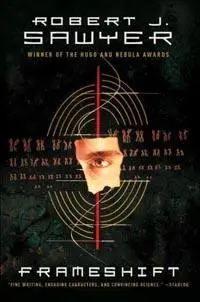
- Название:Frameshift
- Автор:
- Издательство:Tor Science Fiction
- Жанр:
- Год:1998
- ISBN:0-812-57108-8
- Рейтинг книги:4 / 5. Голосов: 1
-
Избранное:Добавить в избранное
- Отзывы:
-
Ваша оценка:
Frameshift: краткое содержание, описание и аннотация
Предлагаем к чтению аннотацию, описание, краткое содержание или предисловие (зависит от того, что написал сам автор книги «Frameshift»). Если вы не нашли необходимую информацию о книге — напишите в комментариях, мы постараемся отыскать её.
Frameshift — читать онлайн бесплатно полную книгу (весь текст) целиком
Ниже представлен текст книги, разбитый по страницам. Система сохранения места последней прочитанной страницы, позволяет с удобством читать онлайн бесплатно книгу «Frameshift», без необходимости каждый раз заново искать на чём Вы остановились. Поставьте закладку, и сможете в любой момент перейти на страницу, на которой закончили чтение.
Интервал:
Закладка:
“Pierre—”
“It’s over. I’ve wasted too much time on this already .”
He could see that the words had cut her. She headed for the laboratory door, but looked back at him once more. He didn’t meet her eyes.
She left the room. Pierre sat down on a lab stool, his hands still shaking.
Chapter 14
Pierre called Tiffany Feng and told her to go ahead and put in his health-insurance application at the first of the year. Condor might have disputed the informal testing if the result had been negative, but there was no conceivable advantage to lying about having Huntington’s. Tiffany said Pierre’s statement on Human Genome Center letterhead, notarized by the campus archivist, would be acceptable proof that the test had indeed been conducted.
Pierre went back to spending his evenings in Doe Library. Periodically he’d look up, look around, look for a familiar face.
She never appeared.
He spent each evening reading, searching the literature for information on junk DNA — now, more than ever, he knew he was in a race against time. He was already seven years older than James D. Watson had been when he’d made his great breakthrough — and only two years younger than Watson had been when he’d accepted his Nobel Prize.
A wall clock above Pierre’s chair was ticking audibly. He got up and moved to another table.
He’d started with current material and was working his way backward.
A reference in a magazine index caught his eye. “A Different Kind of Inheritance.”
Different kind of inheritance…
Could it be?
He asked Pablo to dig up the June 1989 Scientific American .
There it was — exactly what he’d been looking for. A whole different level of information potentially coded into DNA, and a plausible scheme for the reliable inheritance of that information from generation to generation.
The genetic code consisted of four letters: A, C, G, and T. The C stood for cytosine, and cytosine’s chemical formula was C H,N O — four carbons, 4 3 five hydrogens, three nitrogens, and an oxygen.
But not all cytosine was the same. It had long been known that sometimes one of those five hydrogens could be replaced by a methyl group, CH, — a carbon atom attached to three hydrogens. The process was called, logically enough, cytosine methylation.
So when one wrote out a genetic formula — say, the CAG that repeated on and on in Pierre’s own diseased genes — the C might be either regular cytosine or the methylated form, called 5-methylcytosine. Geneticists paid no attention to which one it was; both forms resulted in exactly the same proteins being synthesized.
But this article in Scientific American , by Robin Holliday, described an intriguing finding: almost always when cytosine undergoes methylation, the base next to the cytosine on the DNA strand is guanine: a CG doublet.
But C and G side by side on one side of a DNA strand meant that G and C would be found on the opposite side. After all, cytosine always bonds with guanine, and guanine with cytosine.
In the article, Holliday proposed a hypothetical enzyme he dubbed “maintenance methylase.” It would bind a methyl group to a cytosine that was adjacent to a guanine if and only if the corresponding doublet on the other side was already methylated.
It was all hypothetical. Maintenance methylase might not exist.
But if it did—
Pierre looked at his watch; it was almost closing time. He photocopied the article, returned the magazine to Pablo, and went home.
That night he dreamed of Stockholm.
“Good morning, Shari,” said Pierre, coming into the lab.
Shari was dressed in a beige blouse under a wine-colored two-piece suit. She’d cut her long, dark hair recently and was now wearing it fashionably short, parted on the left, and curving in toward her neck at the bottom. Like Pierre, Shari was burying herself in her work, trying to get over the loss of Howard.
“What’s this?” she said, holding up an autorad she’d found while tidying up. The lab would have been a pigsty if it weren’t for Shari’s periodic attempts to restore order.
Pierre glanced at the piece of X-ray film. He tried to sound nonchalant.
“Nothing. Just garbage.”
“Whoever this DNA belongs to has Huntington’s disease,” said Shari matter-of-factly.
“It’s just an old sheet.”
“It’s yours, isn’t it?” asked Shari.
Pierre thought about continuing to lie, but then shrugged. “I thought I’d thrown it out.”
“I’m sorry, Pierre. I’m so sorry.”
“Don’t tell anyone.”
“No, of course not. How long have you known?”
“Few weeks.”
“How is Molly taking it?”
“We — we’ve broken up.”
Shari put the film in a Rubbermaid garbage pail. “Oh.”
Pierre shrugged a little.
They looked at each other for a moment. Pierre’s mind did what he supposed every male’s did in moments like these. He thought for an instant about him and Shari, about the possibilities there. Both of them carried diseased genes. He was thirty-two and she was twenty-six — not an outrageous difference. But — but there were other gulfs between them. And he saw on her face no indication, no suggestion, no inkling. The thought had not occurred to her.
Some gulfs are not easily crossed.
“Let’s not talk about it,” said Pierre. “I — I’ve got some research I want to share with you. Something I found in the library last night.”
Shari looked as though she wanted to pursue the subject of Pierre’s Huntington’s further, but then she nodded and took a seat on a lab stool.
Pierre told her about the article in Scientific American; about the two forms of cytosine, the regular one and the 5-methylcytosine variant; and about the hypothetical enzyme that could turn the former into the latter but would do so only if the cytosine in the CG doublet on the opposite side of the strand was already methylated.
“Hypothetically,” said Shari, stressing the word. “If this enzyme exists.”
“Right, right,” said Pierre. “But suppose it does. What happens when DNA reproduces? Well, of course, the ladder unzips down the middle, forming two strands. One strand contains all the left-hand components of the base pairs, maybe something like this…” He wrote on the blackboard that covered most of one wall:
Left side: T-C-A-C-G-T
“See that CG doublet? Okay, let’s say its cytosine is methylated.” He went over the pair again with his chalk, making it heavier:
Left side: T-C-A-C-G-T
“Now, in DNA reproduction, free-floating nucleotides are plugged into the appropriate spots on each strand, meaning the right-hand side of this one will end up looking like this…”
His chalk flew across the blackboard, writing in the complementary sequence:
Left side: T-C-A-C-G-T
Right side: A-G-T-G-C-A
“See? Directly opposite the left-hand CG pair is the right-hand GC pair.” He paused, waiting for Shari to nod acknowledgment of this. “Now the maintenance methylase comes along and sees that there isn’t parity between the two sides of the strand, so it adds a methyl group to the right-hand side.” He went over the GC pair, making it darker, too:
Left side: T-C-A-C-G-T
Right side: A-G-T-G-C-A
“At the same time, the other half of the original strand is being filled in with free-floating nucleotides. But maintenance methylase would do exactly the same thing to it, duplicating cytosine methylation on both sides, if originally present on one side.”
Pierre clapped his hands together to shake off chalk dust. “ Voila! By postulating that one enzyme, you end up with a mechanism for preserving cytosine-methylation state from cell generation to cell generation.”
Читать дальшеИнтервал:
Закладка:
Похожие книги на «Frameshift»
Представляем Вашему вниманию похожие книги на «Frameshift» списком для выбора. Мы отобрали схожую по названию и смыслу литературу в надежде предоставить читателям больше вариантов отыскать новые, интересные, ещё непрочитанные произведения.




Обсуждение, отзывы о книге «Frameshift» и просто собственные мнения читателей. Оставьте ваши комментарии, напишите, что Вы думаете о произведении, его смысле или главных героях. Укажите что конкретно понравилось, а что нет, и почему Вы так считаете.