Robert Sawyer - Frameshift
Здесь есть возможность читать онлайн «Robert Sawyer - Frameshift» весь текст электронной книги совершенно бесплатно (целиком полную версию без сокращений). В некоторых случаях можно слушать аудио, скачать через торрент в формате fb2 и присутствует краткое содержание. Год выпуска: 1998, ISBN: 1998, Издательство: Tor Science Fiction, Жанр: Фантастика и фэнтези, на английском языке. Описание произведения, (предисловие) а так же отзывы посетителей доступны на портале библиотеки ЛибКат.
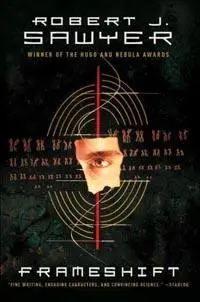
- Название:Frameshift
- Автор:
- Издательство:Tor Science Fiction
- Жанр:
- Год:1998
- ISBN:0-812-57108-8
- Рейтинг книги:4 / 5. Голосов: 1
-
Избранное:Добавить в избранное
- Отзывы:
-
Ваша оценка:
Frameshift: краткое содержание, описание и аннотация
Предлагаем к чтению аннотацию, описание, краткое содержание или предисловие (зависит от того, что написал сам автор книги «Frameshift»). Если вы не нашли необходимую информацию о книге — напишите в комментариях, мы постараемся отыскать её.
Frameshift — читать онлайн бесплатно полную книгу (весь текст) целиком
Ниже представлен текст книги, разбитый по страницам. Система сохранения места последней прочитанной страницы, позволяет с удобством читать онлайн бесплатно книгу «Frameshift», без необходимости каждый раз заново искать на чём Вы остановились. Поставьте закладку, и сможете в любой момент перейти на страницу, на которой закончили чтение.
Интервал:
Закладка:
“What? Molly, we’ve only known each other a few months.”
“I know that. But I love you, and you love me. And we may not have a lot of time to waste.”
“I can’t marry you,” said Pierre.
“Why not? Is it because I’m not Catholic?”
Pierre laughed out loud. “No, sweetheart, no.” He hugged her again.
“God, I do love you. But I can’t ask you to get into a relationship with me.”
“You’re not asking me. I’m asking you.”
“But—”
“But nothing. I’m going into this with my eyes wide open.”
“But surely—”
“That argument won’t work.”
“What about—”
“I don’t care about that, either.”
“Still, I’d—”
“Oh, come on! You don’t believe that yourself.”
Pierre laughed. “Are all our arguments going to be like this?”
“Of course. We don’t have time to waste on fighting.”
He was silent for several moments, chewing on his lower lip. “There is a test,” he said at last.
“Whatever it is, I’ll try,” said Molly.
Pierre laughed. “No, no, no. I mean, there’s a test for Huntington’s disease. There’s been one for a while now; they discovered the Huntington’s gene in March 1993.”
“And you haven’t taken the test?”
“No… I— no.”
“Why not?” Her tone was one of curiosity, not confrontation.
Pierre exhaled and looked at the ceiling. “There’s no cure for Huntington’s. It’s not like anything could be done to help me if I knew. And— and—” He sighed. “I don’t know how to explain this. My assistant Shari said something to me today — she said, ‘You’re not Jewish,’ meaning there were parts of her that I could never understand because I hadn’t walked in her shoes. Most people at risk for Huntington’s haven’t had the test.”
“Why? Is it painful?”
“No. All that’s needed is a drop of blood.”
“Is it expensive?”
“No. Hell, I could do it myself, using the equipment in my lab.”
“Then why?”
“Do you know who Arlo Guthrie is?”
“Sure.”
Pierre lifted his eyebrows; he’d expected her ignorance to be the same as his had been all those years ago. “Well,” he went on, “his father Woody died of Huntington’s, but Arlo still hasn’t had the test.” A pause. “Do you know who Nancy Wexler is?”
“No.”
“Everyone with Huntington’s knows her name. She’s the president of the Hereditary Disease Foundation, which spearheaded the search for the Huntington’s gene. Like Arlo, she’s got a fifty-fifty chance of having Huntington’s — her mother died of the disease — and she’s never taken the test, either.”
“I don’t understand why people don’t take it. I’d want to know.”
Pierre sighed, thinking again of what Shari had said to him. “That’s what everyone who isn’t at risk says. But it’s not that simple. If you find out you’ve got the disease, you lose all hope. It’s inescapable. At least now, I have some hope…”
Molly nodded slightly.
“And — and, well, I sometimes have trouble getting through the night, Molly. I’ve… contemplated suicide. Lots of Huntington’s at-risks have. I’ve… come close a couple of times. What’s kept me from doing it is the chance that maybe I don’t have the disease.” He sighed, trying to decide what to say next. “One study showed that twenty-five percent of those who do take the test and are found to have the defective gene actually attempt suicide — and one in four of those succeeds. I’m… I’m not sure I could make it through all the dark nights if I knew for sure I had it.”
“But the flip side is that if you found you didn’t have it, you could relax.”
“Flip side is almost exactly right. It is a flip of the coin; the chances are exactly fifty-fifty. But I’m afraid you’re wrong when you say I could relax.
Fully ten percent of those who take the test and find they don’t have the disease still end up with severe emotional problems.”
“Why on earth would that be true?”
Pierre looked away. “Those of us who are at risk for Huntington’s live our lives based on the presumption that they might be cut short. We often give up things because of that. I — before you, I hadn’t been involved with a woman for nine years, and, to be honest, I didn’t think I ever would be again.”
Molly nodded, as if a mystery had finally been explained. “This is why you’re so driven,” she said, her blue eyes wide. “Why you work so hard.”
Pierre returned the nod. “But when you’ve made sacrifices and then discover they were unnecessary, the regret can be too much to bear. That’s why even some of those who discover they don’t have the disease end up killing themselves.” He was quiet for a long time. “But now — now, it isn’t just me. I guess I should have the test.”
Molly reached out and stroked his cheek. “No,” she said. “No. Don’t do it for me. If you ever want to take it, do it for yourself. I was serious: I want to marry you and, if you do turn out to have the disease, we’ll deal with that at the time. My proposal wasn’t contingent on your taking the test.”
Pierre blinked. He was close to tears. “I’m so lucky to have found you.”
She smiled. “I feel the same way about you.”
They held each other tightly. When their embrace ended, Pierre said, “But I don’t know — maybe I should take the test anyway. I did do what you asked, you know: I met with someone from Condor Health a couple of weeks ago. But I couldn’t get a policy.”
“You still don’t have health insurance?”
Pierre shook his head. “See, right now, they’d reject me based on my family history. But in two months, on New Year’s Day, a new California law comes into effect. It doesn’t bar the use by insurance companies of family-history information, but it does bar the use of genetic info, and the latter takes precedence over the former. If I take the test for Huntington’s, regardless of the results, then they have to insure me; they can’t even charge me a higher premium, so long as I have no symptoms.”
Molly was quiet for a moment, digesting this. “I meant what I said: I don’t want you to take the test for me, and, well — if you can’t get insurance down here, we could move to Canada, no?”
“I — I suppose. But I don’t want to leave LBL; being here is the opportunity of a lifetime.”
“Well, there are thirty million Americans without health insurance. But they mostly manage—”
“No. No, it’s one thing to let you risk being married to someone who might become very sick; it’s quite another to ask you to additionally risk financial ruin. I should have the test.”
“If you think it’s best,” said Molly. “But I’ll marry you either way.”
“Don’t say that now. Wait till we have the test results.”
“How long will that take?”
“Well, normally a lab requires you to go through months of counseling before they’ll administer the test, to make sure you really want to take it and are going to be able to deal with the results. But…”
“Yes?”
Pierre shrugged. “It’s not a hard test — no harder than any other genetic test. As I said, I could do it myself in my lab at LBL”
“I don’t want you to feel pressured into doing this.”
Pierre shrugged. “It’s not you doing the pressuring; it’s the insurance company.” He was quiet for a while. “It’s all right,” he said finally. “It’s time I found out.”
Chapter 13
“Explain what’s going on to me,” said Molly, sitting on a stool in Pierre’s lab. It was ten o’clock on a Saturday morning. “I want to understand exactly what’s happening.”
Читать дальшеИнтервал:
Закладка:
Похожие книги на «Frameshift»
Представляем Вашему вниманию похожие книги на «Frameshift» списком для выбора. Мы отобрали схожую по названию и смыслу литературу в надежде предоставить читателям больше вариантов отыскать новые, интересные, ещё непрочитанные произведения.


Обсуждение, отзывы о книге «Frameshift» и просто собственные мнения читателей. Оставьте ваши комментарии, напишите, что Вы думаете о произведении, его смысле или главных героях. Укажите что конкретно понравилось, а что нет, и почему Вы так считаете.