Robert Sawyer - Frameshift
Здесь есть возможность читать онлайн «Robert Sawyer - Frameshift» весь текст электронной книги совершенно бесплатно (целиком полную версию без сокращений). В некоторых случаях можно слушать аудио, скачать через торрент в формате fb2 и присутствует краткое содержание. Год выпуска: 1998, ISBN: 1998, Издательство: Tor Science Fiction, Жанр: Фантастика и фэнтези, на английском языке. Описание произведения, (предисловие) а так же отзывы посетителей доступны на портале библиотеки ЛибКат.
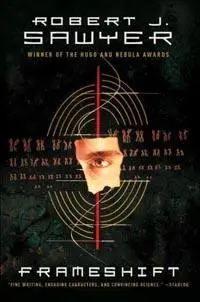
- Название:Frameshift
- Автор:
- Издательство:Tor Science Fiction
- Жанр:
- Год:1998
- ISBN:0-812-57108-8
- Рейтинг книги:4 / 5. Голосов: 1
-
Избранное:Добавить в избранное
- Отзывы:
-
Ваша оценка:
Frameshift: краткое содержание, описание и аннотация
Предлагаем к чтению аннотацию, описание, краткое содержание или предисловие (зависит от того, что написал сам автор книги «Frameshift»). Если вы не нашли необходимую информацию о книге — напишите в комментариях, мы постараемся отыскать её.
Frameshift — читать онлайн бесплатно полную книгу (весь текст) целиком
Ниже представлен текст книги, разбитый по страницам. Система сохранения места последней прочитанной страницы, позволяет с удобством читать онлайн бесплатно книгу «Frameshift», без необходимости каждый раз заново искать на чём Вы остановились. Поставьте закладку, и сможете в любой момент перейти на страницу, на которой закончили чтение.
Интервал:
Закладка:
Pierre nodded. “Okay,” he said. “On Thursday, I extracted samples of my DNA from a drop of my own blood. I separated out my two copies of chromosome four, snipped off particular segments using special enzymes, and set about making radioactive images of those segments. It takes a while to develop those images, but they should be ready now, so we can actually check what my genetic code says in the specific gene associated with Huntington’s disease. That gene contains an area called IT15 — ‘interesting transcript number fifteen,’ a name given to it back when people didn’t know what it was for.”
“And if you’ve got IT15, you’ve got Huntington’s?”
“It’s not as simple as that. Everybody has IT15. Like all genes, IT15’s job is to code for the synthesis of a protein molecule. The protein IT15 makes has recently been dubbed ‘huntingtin.’ ”
“So if everyone has IT15,” said Molly, “and everybody’s body produces huntingtin, then what determines whether you have Huntington’s disease?”
“People with Huntington’s have a mutant form of IT15, which causes them to produce too much huntingtin. Huntingtin is crucial to organizing the nervous system in the first few weeks of an embryo’s development. It should cease to be produced at a certain point, but in those with Huntington’s disease it isn’t, and that causes damage to the developing brain. In both the normal and mutant versions of IT15, there’s a run of repeating nucleo-tide triplets: cytosine-adenine-guanine, or CAG, over and over again. Well, in the genetic code, each nucleotide triplet specifies the production of one specific amino acid, and amino acids are the building blocks of proteins. CAG happens to be one of the codes for making an amino acid called glutamine. In healthy individuals, IT15 contains between eleven repeats and thirty-eight repeats of this CAG triplet. But those who have Huntington’s disease have between forty-two and a hundred or so CAG repeats.”
“Okay,” said Molly, “so we look at each of your chromosome fours, find the beginning of the run of CAG triplets, then simply count the number of repeats of that triplet. Right?”
“Right.”
“You’re sure you want to go through with this?”
Pierre nodded. “I’m sure.”
“Then let’s do it.”
And they did. It was painstaking work, carefully examining the autoradiograph film. Faint lines represented each nucleotide. Pierre used a felt-tipped marker to write in the letters beneath each triplet: CAG, CAG. Molly, meanwhile, tallied the number of repeats on a sheet of paper.
Without blood samples from Elisabeth Tardivel and Henry Spade, there was no easy way to tell which of his chromosome fours had come from his father, so he had to check them both. On the first one, the string of CAG triplets ended after seventeen repeats.
Pierre breathed a sigh of relief. “One down, one to go,” he said.
He began checking the sequence on the second chromosome. No reaction when they reached the tally of eleven; that was the normal minimum. When they got to twenty-five, though, Pierre found his hand shaking.
Molly touched his arm. “Don’t worry,” she said. “You said you could have as many as thirty-eight and still be normal.”
Pierre nodded. “But what I didn’t say was that seventy percent of all normal people have twenty-four or fewer repeats.”
Molly bit her lower lip.
Pierre continued sequencing. Twenty-six, twenty-seven, twenty-eight.
His eyes were blurring.
Thirty-five. Thirty-six. Thirty-seven. Thirty-eight.
Damn. Goddamn.
Thirty-nine.
God fucking damn it.
“Still,” said Molly, trying to sound brave, “thirty-eight may be the normal limit, but you have to have at least forty-two…”
Forty.
Forty-one.
Forty-two.
“I’m sorry, honey,” said Molly. “I’m so sorry.”
Pierre put down his marker. His whole body was shaking.
“God, I am so sorry,” said Molly.
A fifty-fifty shot.
A flip of a coin.
Heads or tails.
Call it!
Pierre said nothing. His heart was pounding.
“Let’s go home,” said Molly, stroking the back of his hand.
“No,” said Pierre. “Not yet.”
“There’s nothing more to be done here.”
“Yes, there is. I want to finish the sequencing. I want to know how many repeats I have.”
“What difference does that make?”
“ It makes all the difference,” said Pierre, his voice shaking. “It makes all the difference in the world.”
Molly looked perplexed.
“I didn’t tell you everything. Merde. Merde. Merde . I didn’t tell you everything.”
“What?”
“There’s an inverse correlation between the number of repeats and the age of onset of the disease.”
Molly didn’t seem to understand, or didn’t want to. “What?” she said again.
“The more repeats, the sooner symptoms are likely to appear. Some patients get Huntington’s as children; others don’t get it until their eighties. I — I have to finish the sequencing; I have to know how many repeats I’ve got.”
Molly looked at him. There was nothing to say.
Pierre rubbed his eyes, blew his nose, and bent back to the autorad film.
The tally kept growing. Forty-five.
Fifty.
Fifty-five.
Sixty.
Time continued to pass. Pierre felt faint, but he pressed on, marking letters over and over again on the film: CAG, CAG, CAG…
Molly got up and walked across the room. She found a box of Kimwipes — expensive, lab-quality tissues. She used them to dry her eyes.
She tried to hide from Pierre the fact that she was crying.
Finally, Pierre hit a codon that wasn’t CAG. The total count: seventy-nine repeats.
There was silence between them for a time. Somewhere in the distance, a fire-truck siren was wailing.
“How long?” asked Molly at last.
“Seventy-nine is a very high number,” said Pierre softly. “Very high.” He sucked in air, thinking. “I’m thirty-two now. The correlation is inexact. I can’t be sure. But… I don’t know, I guess I’d expect to see symptoms very soon. Certainly by the time I’m thirty-five or thirty-six.”
“Well, then, you—”
“At the outside.” He raised a hand. “The disease can take years or decades to run its course. First symptoms might just be a reduction in coordination, or facial tics. It might be years before things got serious.
Or…”
“Or?”
Pierre shrugged. “Well,” he said, his voice full of sadness, “I guess that’s it.”
Molly reached for his hand, but Pierre pulled it away. “Please,” he said.
“It’s over.”
“What’s over?” said Molly.
“Please. Let’s not make this difficult.”
“I love you,” said Molly softly.
“Please don’t…”
“And I know you love me.”
“Molly, I’m dying.”
Molly moved over to him, draped her arms around his neck, and rested her head against his chest. His thoughts were all in French.
“I still want to marry you,” Molly said.
“Molly, I only want what’s best for you. I don’t want to be a burden on you.”
Molly held him tighter. “I want to marry you, and I want to have a child.”
“No,” said Pierre. “No, I can’t become a father. The number of CAG repeats tends to increase from generation to generation — it’s a phenomenon called ‘anticipation.’ I have seventy-nine; any child of mine who got the gene from me might very likely have even more — meaning he or she might come down with the disease as a teenager, or even earlier.”
“But—”
“No buts. I’m sorry; this was crazy. It can never work.” He saw her face, saw the hurt, felt his own heart breaking. “Please, don’t make it harder for both of us. Just go home, would you? It’s over.”
Читать дальшеИнтервал:
Закладка:
Похожие книги на «Frameshift»
Представляем Вашему вниманию похожие книги на «Frameshift» списком для выбора. Мы отобрали схожую по названию и смыслу литературу в надежде предоставить читателям больше вариантов отыскать новые, интересные, ещё непрочитанные произведения.



Обсуждение, отзывы о книге «Frameshift» и просто собственные мнения читателей. Оставьте ваши комментарии, напишите, что Вы думаете о произведении, его смысле или главных героях. Укажите что конкретно понравилось, а что нет, и почему Вы так считаете.