Robert Sawyer - Frameshift
Здесь есть возможность читать онлайн «Robert Sawyer - Frameshift» весь текст электронной книги совершенно бесплатно (целиком полную версию без сокращений). В некоторых случаях можно слушать аудио, скачать через торрент в формате fb2 и присутствует краткое содержание. Год выпуска: 1998, ISBN: 1998, Издательство: Tor Science Fiction, Жанр: Фантастика и фэнтези, на английском языке. Описание произведения, (предисловие) а так же отзывы посетителей доступны на портале библиотеки ЛибКат.
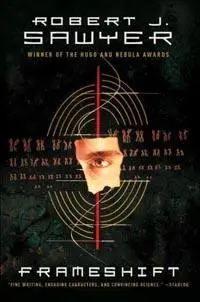
- Название:Frameshift
- Автор:
- Издательство:Tor Science Fiction
- Жанр:
- Год:1998
- ISBN:0-812-57108-8
- Рейтинг книги:4 / 5. Голосов: 1
-
Избранное:Добавить в избранное
- Отзывы:
-
Ваша оценка:
Frameshift: краткое содержание, описание и аннотация
Предлагаем к чтению аннотацию, описание, краткое содержание или предисловие (зависит от того, что написал сам автор книги «Frameshift»). Если вы не нашли необходимую информацию о книге — напишите в комментариях, мы постараемся отыскать её.
Frameshift — читать онлайн бесплатно полную книгу (весь текст) целиком
Ниже представлен текст книги, разбитый по страницам. Система сохранения места последней прочитанной страницы, позволяет с удобством читать онлайн бесплатно книгу «Frameshift», без необходимости каждый раз заново искать на чём Вы остановились. Поставьте закладку, и сможете в любой момент перейти на страницу, на которой закончили чтение.
Интервал:
Закладка:
“I suppose,” said Molly slowly. She had gotten up and was now standing in the entrance to the dining room, leaning against the wall. “Still, didn’t I read about a case of the exact opposite? A couple, both of whom were genetically deaf, chose to abort their child because prenatal testing showed that it was not going to be deaf, and so they felt they wouldn’t be able to relate to it. This sort of thing goes both ways.”
“That case was different,” said Pierre. “I’m not sure I agree with the morality of it — aborting a normal child simply because he was normal — but at least it was the parents making the choice on their own, not being coerced by an outside agency. But this—” He shook his head.
“Decisions that should be private, family affairs — whether it’s to continue a pregnancy, or, as in my case, whether it’s to take a genetic test as an adult — are essentially being made for you by insurance companies. You have to terminate the pregnancy, or lose insurance; you have to take the test, or lose insurance.” He shook his head. “It stinks.”
He picked up the chop suey container, looked inside, but put it back down without taking any more. His appetite was gone.
Chapter 17
It was Molly’s turn to make dinner. Pierre used to try to help her, but had soon learned it was actually easier for her if he just stayed out of the way. She was making spaghetti tonight — about ten minutes’ work when Pierre did it, since he relied on Ragu for the sauce and a Kraft shaker for the cheese. But for Molly it was a big production, making the sauce from scratch and grating up fresh Parmesan. Pierre sat in the living room, channel surfing. When Molly called out that dinner was ready, he headed into the dining nook. They had a butcher-block style table with green wicker chairs. Pierre pulled out his chair without looking and tried to sit down, but almost immediately he hopped back onto his feet.
There was a plush toy bee sitting on his chair, with giant Mickey Mouse eyes and a fuzzy yellow-and-black coat. Pierre picked it up. “What’s this?” he said.
Molly entered from the kitchen, bearing two plates of steaming spaghetti. She set them down before she spoke. “Well,” she said, nodding at the bee, “I think it’s time we had my flowers fertilized.”
Pierre raised his eyebrows. “You want to go ahead with the IVF?”
Molly nodded. “If it’s still okay with you.” She held up a hand. “I know it’s a lot of money, but, well — frankly, I’m scared by what happened to Ingrid.” Molly’s friend Ingrid Lagerkvist had given birth to a boy with Down’s syndrome; the odds of having a Down’s child go up with age.
“We’ll find the money,” said Pierre. “Don’t worry.” His face broke into a broad grin. “We’re going to have a baby!” He sprinkled cheese on his spaghetti, then did something Molly always found amusing: he cut his spaghetti into little bits. “A baby!” he said again.
Molly laughed. “ Oui, monsieur .”
Pierre’s boss, Dr. Burian Klimus, looked up and nodded curtly at each of them in turn. “Tardivel. Molly.”
“Thank you for agreeing to see us, sir,” said Pierre, sitting down on the far side of the broad desk. “I know how busy you are.” Klimus was not one to waste energy acknowledging the obvious. He sat silently behind his cluttered desk, a slightly irritated expression on his broad, ancient face, waiting for Pierre to get to the point. “We need your advice. Molly and I, we’d like to have a child.”
“Flowers and a Chianti are an excellent starting point,” said Klimus in his dry voice, brown eyes unblinking.
Pierre laughed, more out of nervousness than because of the joke. He looked around the office. There was a second door, leading to some other room. Behind Klimus’s desk was a credenza with two globes on it. One was a globe of the Earth, with no political boundaries marked; the other was — Pierre guessed, based on its reddish color — a globe of Mars. There were framed astronomical photos on the walls. Pierre returned his gaze to Klimus. “We’ve decided we want to undergo in vitro fertilization, and, well, you wrote that big article about new reproductive technologies for
Science with Professor Sousa, so…”
“Why IVF?” asked Klimus.
“I have blocked fallopian tubes,” said Molly.
Klimus nodded. “I see.” He leaned back in his chair, which creaked as he did so, and interlaced his fingers behind his bald head. “Surely you understand the rudiments of the procedure: eggs would be removed from Molly and mixed with Pierre’s sperm in a petri dish. Once embryos are created, they’re implanted, and you hope for the best.”
“Actually,” said Pierre, “we weren’t planning to use my sperm.” He shifted slightly in his seat. “I, ah, I’m not in a position to be the biological father.”
“Are you impotent?”
Pierre was surprised by the question. “No.”
“Do you have a low sperm count? There are procedures—”
“I have no idea what my sperm count is. I assume it’s normal.”
“Then why? You have an adequate mind. Why not father a child?”
Pierre swallowed. “I, ah, carry some bad genes.”
Klimus nodded. “Voluntary eugenics. I approve.” He paused. “But, you know, once the embryo is eight cells in size, we can usually remove a single cell for PCR and then genetic testing, so—”
Pierre saw no reason to debate it with the old man. “We’re going to use donated sperm,” he said firmly.
Klimus shrugged. “It’s up to you.”
“But we’re looking for recommendations for a clinic. You visited a number of them while doing that article. Is there one you’d suggest?”
“There are several good ones here in the Bay Area,” said Klimus.
“Which would be the cheapest?” said Pierre. Klimus looked at him blankly. “We, ah, understand the procedure costs around ten thousand dollars.”
“ Per attempt,” said Klimus. “And IVF has only a twenty percent success rate. The average cost of actually getting a baby through this method is forty thousand dollars.”
Pierre’s jaw dropped. Forty thousand? It was a huge amount of money, and their mortgage was a killer. He doubted they could manage that much.
But Molly pressed on. “Do the clinics choose the sperm donors?”
“Occasionally,” said Klimus. “More often, the woman chooses from a catalog listing the potential fathers’ physical, mental, and ethnic characteristics. And—” He stopped in mid-sentence, completely dead, as though his mind were a million miles away.
Pierre finally leaned a bit closer. “Yes?” he said.
“What about me?” asked Klimus.
“I beg your pardon?” said Pierre.
“Me. As donor.”
Molly’s jaw dropped a little. Klimus saw that and held up a hand, palm out. “We could do it here at LBL. I can do the fertilization work, and Gwendolyn Bacon — an IVF practitioner who owes me a favor — I’m sure I could get her to do the egg extraction and embryo implantation.”
“I don’t know,” said Pierre.
Klimus looked at him. “I propose a deal: use me as the donor, and I’ll pay the costs for the procedure, no matter how many attempts it takes.
I’ve invested my Nobel money well, and have some lucrative consulting contracts.”
“But…” began Molly. She trailed off, not knowing what to say. She wished there wasn’t the wide desk between them so she could read his mind, but all she could detect was a barrage of French from Pierre.
“I am old, I know,” said Klimus, without humor. “But that makes little difference to my sperm. I’m fully capable of serving as the biological father — and I’ll provide full documentation to show myself free of HIV.”
Читать дальшеИнтервал:
Закладка:
Похожие книги на «Frameshift»
Представляем Вашему вниманию похожие книги на «Frameshift» списком для выбора. Мы отобрали схожую по названию и смыслу литературу в надежде предоставить читателям больше вариантов отыскать новые, интересные, ещё непрочитанные произведения.

Обсуждение, отзывы о книге «Frameshift» и просто собственные мнения читателей. Оставьте ваши комментарии, напишите, что Вы думаете о произведении, его смысле или главных героях. Укажите что конкретно понравилось, а что нет, и почему Вы так считаете.